

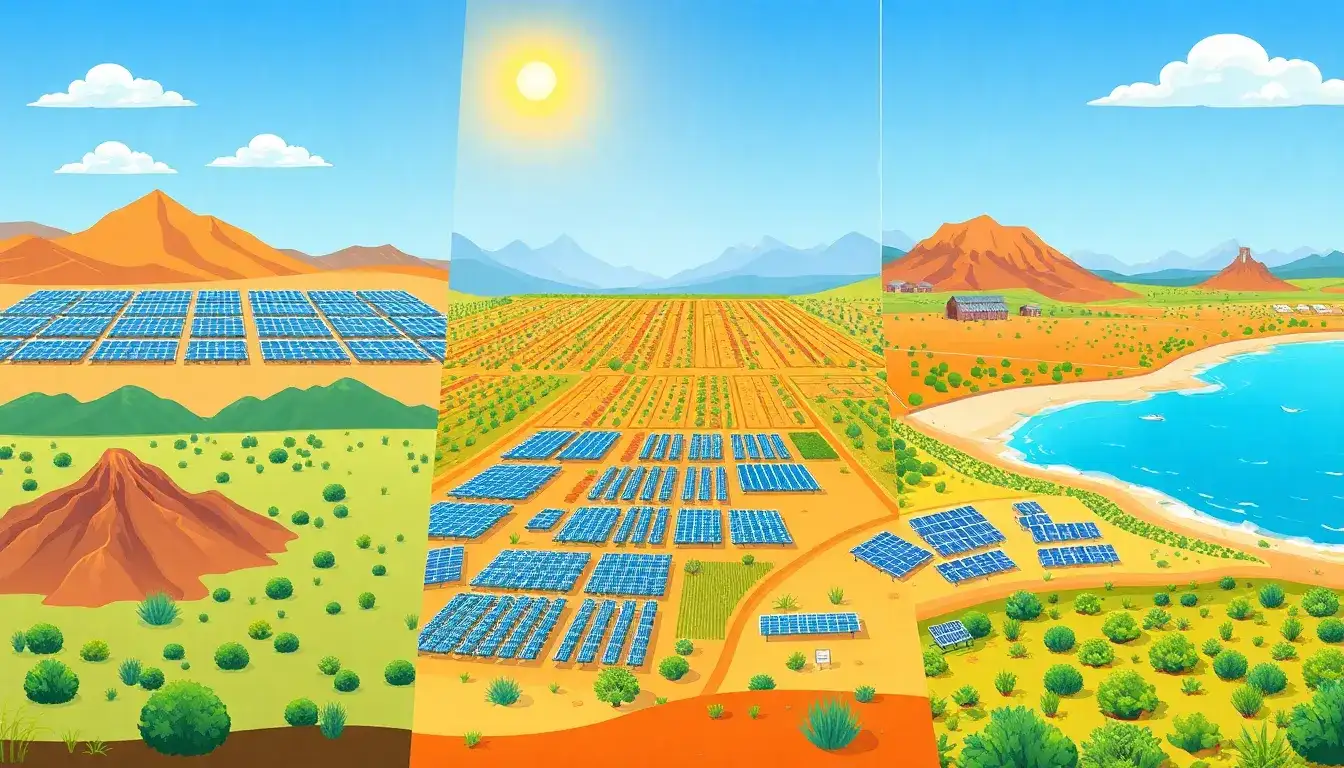
Regional Variations in Solar Farm Land Use
Midwest
- Cropland Dominance: In the Midwest, a significant portion (about 70%) of solar farms are located on cropland, reflecting the region’s agricultural focus.
West
- Pasture-Rangeland: In contrast, the West hosts most of its solar farms (around 60%) on pasture-rangeland, which is more typical of the region’s landscape.
East Coast and Other Regions
- Agricultural Land and Forests: On the East Coast, solar installations are often sited on agricultural land. For instance, in New York, about 44% of distributed solar energy projects were on agricultural land by 2018. In Virginia, solar facilities primarily impact forestland, cropland, and pastureland, although individual facilities are more likely to be on cropland.
Overall, solar development occupies a relatively small proportion of land use in most counties across the U.S., with local conditions and land availability influencing project locations.
General Trends
- Agricultural Land Retention: Studies show that agricultural land near solar and wind projects generally remains in agriculture after development. For solar farms, around 15% of sites shifted out of agriculture, but this change was less frequent for wind turbines.
- Private Land Use: Many utility-scale solar projects are located on privately held land, which varies in terms of topography and existing land use.
These regional differences highlight the adaptability and context-dependent nature of solar farm land use in the U.S.
Original article by NenPower, If reposted, please credit the source: https://nenpower.com/blog/how-does-the-land-use-for-solar-farms-vary-by-region/

