

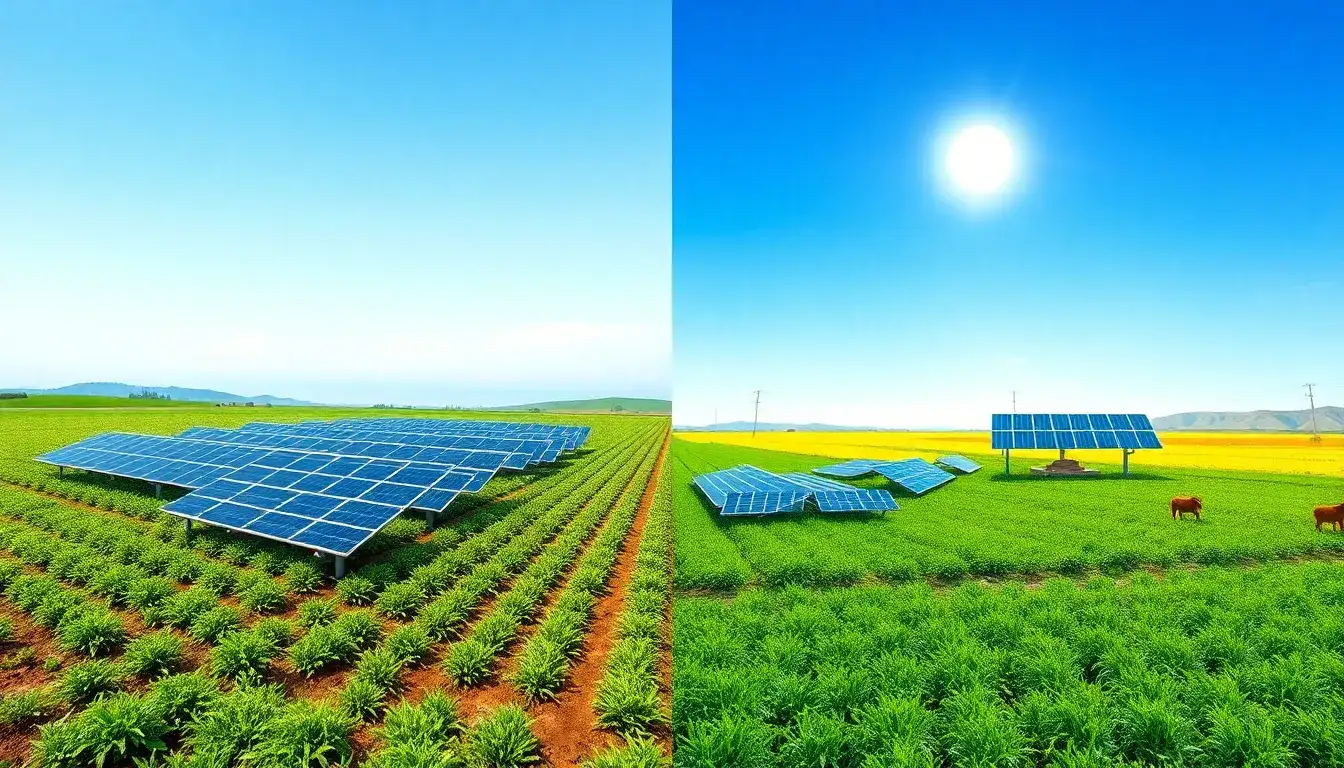
The land use for different types of solar farms, such as fixed-tilt versus tracking systems, varies primarily based on how the panels are arranged and spaced to optimize energy production.
General Land Use for Solar Farms:
- Ground-mounted solar farms typically occupy between 4 to 8 acres per megawatt (MW) of capacity.
- The total land footprint of solar farms in the U.S. was relatively small — around 336,090 acres in 2020, which constitutes less than 0.04% of the country’s farmland.
Fixed-Tilt vs. Tracking Solar Farms:
- Fixed-Tilt Solar Farms:
- Panels are mounted at a fixed angle, usually optimized for the location’s latitude, and remain stationary.
- Because panels do not move to track the sun, fixed-tilt arrays require relatively less spacing between rows.
- This layout tends to have a denser panel packing, leading to somewhat lower land use per MW compared to tracking systems.
- Tracking Solar Farms:
- These systems use single-axis or dual-axis trackers to follow the sun across the sky.
- Tracking increases the energy yield per panel but requires more spacing between rows to avoid shading from tilted panels.
- This results in a larger land area requirement per MW of installed capacity compared to fixed-tilt systems.
Land Use Efficiency Comparison:
| Solar Farm Type | Land Use (acres per MW) | Key Characteristics |
|---|---|---|
| Fixed-Tilt | ~4-6 acres per MW | Denser panel spacing, lower land footprint |
| Single-Axis Trackers | ~6-8 acres per MW | More spacing required, higher yield |
| Dual-Axis Trackers | More than single-axis | Even more spacing, highest energy yield but biggest land footprint |
Additional Context:
- The variation in land use depends also on other factors such as topography, shading, panel technology, and local land constraints.
- Land used for solar development is often previously cleared farmland, and solar farms usually affect a minor portion of agricultural land overall.
- The densest fixed-tilt systems minimize land impact but at a cost of somewhat lower energy yield compared to tracking systems that maximize output but demand more land.
In summary, fixed-tilt solar farms use land more efficiently by requiring less spacing between panels, resulting in lower acres per MW. Tracking systems require more land per MW due to spacing needs to prevent shading during panel movement but deliver higher electricity output per installed capacity. The choice between them involves a trade-off between land use and energy yield.
Original article by NenPower, If reposted, please credit the source: https://nenpower.com/blog/how-does-the-land-use-for-different-types-of-solar-farms-e-g-fixed-tilt-vs-tracking-compare/

