

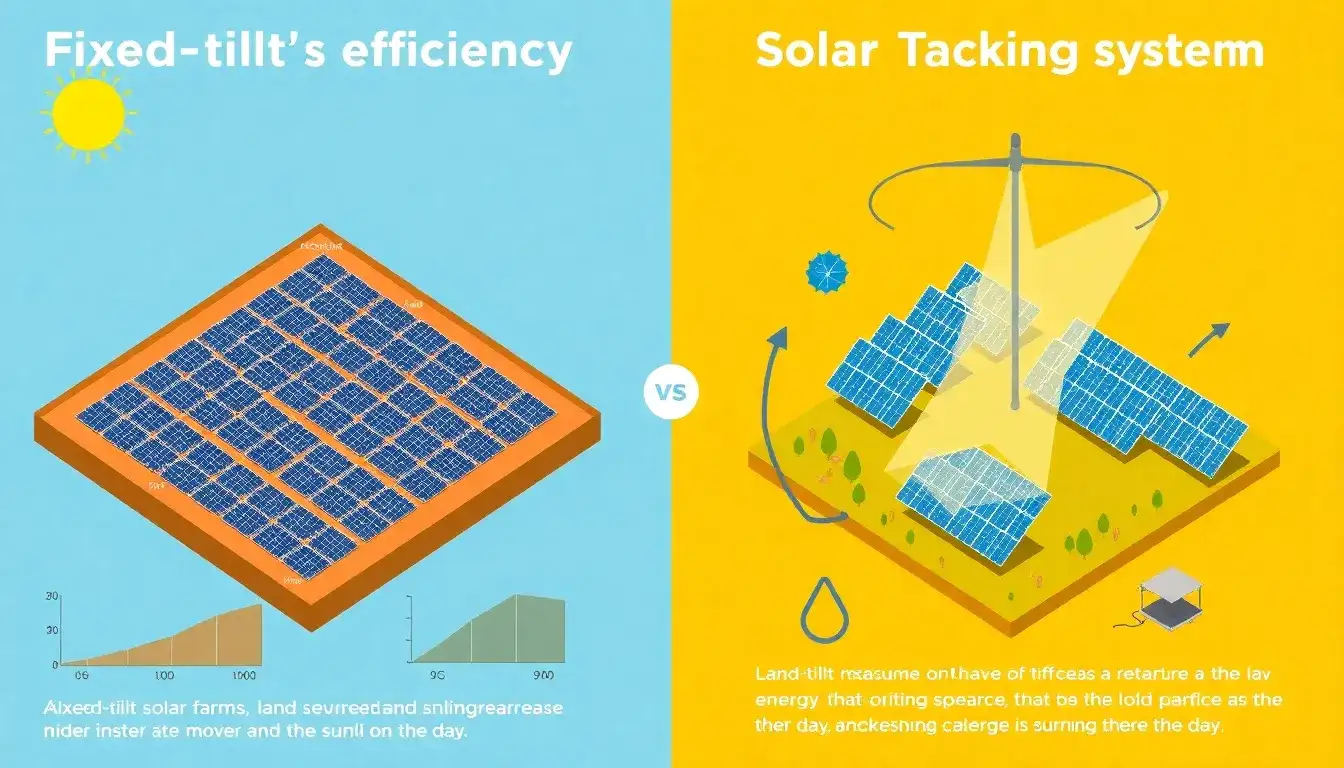
The land use efficiency of fixed-tilt solar farms compared to tracking systems involves a trade-off between land area occupied and energy generation per unit area.
Land Use on a Capacity Basis
- Fixed-tilt systems generally use about 13% less land area per installed capacity (megawatt) than one-axis tracking systems. This means fixed-tilt farms can have a more compact layout in terms of physical footprint per MW installed.
- Fixed-tilt solar arrays typically have higher ground coverage ratios (0.40 to 0.50), indicating modules are packed more tightly on the land compared to tracking systems, which have lower ratios (0.25 to 0.40) due to the need for spacing to avoid shading as panels move.
Land Use on an Energy Generation Basis
- Despite their smaller capacity footprint, fixed-tilt systems tend to use about 15% more land per unit of energy generated annually compared to one-axis trackers because trackers produce 12% to 25% more electricity by following the sun. Two-axis trackers can increase generation by 30% to 45%, although they may require even more land and their efficiency in land use is less conclusively determined due to limited data.
- Trackers need more row spacing to accommodate the east-west (and north-south for dual-axis) movement of panels, which increases the total land footprint but this is offset by higher energy yields per installed capacity.
Additional Considerations
- Fixed-tilt systems are more flexible regarding terrain and can be installed on uneven land, which can reduce land preparation costs and enable use of less ideal sites.
- Tracker systems require flatter, more open land to operate effectively and have higher “land dependency,” meaning they need more contiguous, level space for optimal performance.
- In urban or land-constrained settings, fixed-tilt may be preferred despite lower energy yield per area due to simpler installation and lower land requirements.
Summary Table
| Aspect | Fixed-Tilt Systems | Tracking Systems |
|---|---|---|
| Land use per MW installed | About 13% less than one-axis trackers | Higher due to increased spacing for movement |
| Energy output increase | Baseline | +12-25% (1-axis), +30-45% (2-axis) |
| Land use per MWh generated | About 15% more than one-axis trackers | Lower due to higher generation |
| Ground coverage ratio | 0.40 to 0.50 | 0.25 to 0.40 |
| Terrain requirements | Can use uneven terrain | Requires flatter, more level land |
| Suitability | More flexible for variable land | Requires more contiguous space |
In conclusion, fixed-tilt solar farms are more land-efficient per unit of installed capacity but less land-efficient per unit of energy generated compared to tracking systems. Trackers require more land area due to spacing needs for panel movement but compensate with higher energy production, improving land use efficiency on a generation basis.
Original article by NenPower, If reposted, please credit the source: https://nenpower.com/blog/how-does-the-land-use-efficiency-of-fixed-tilt-solar-farms-compare-to-tracking-systems/

