

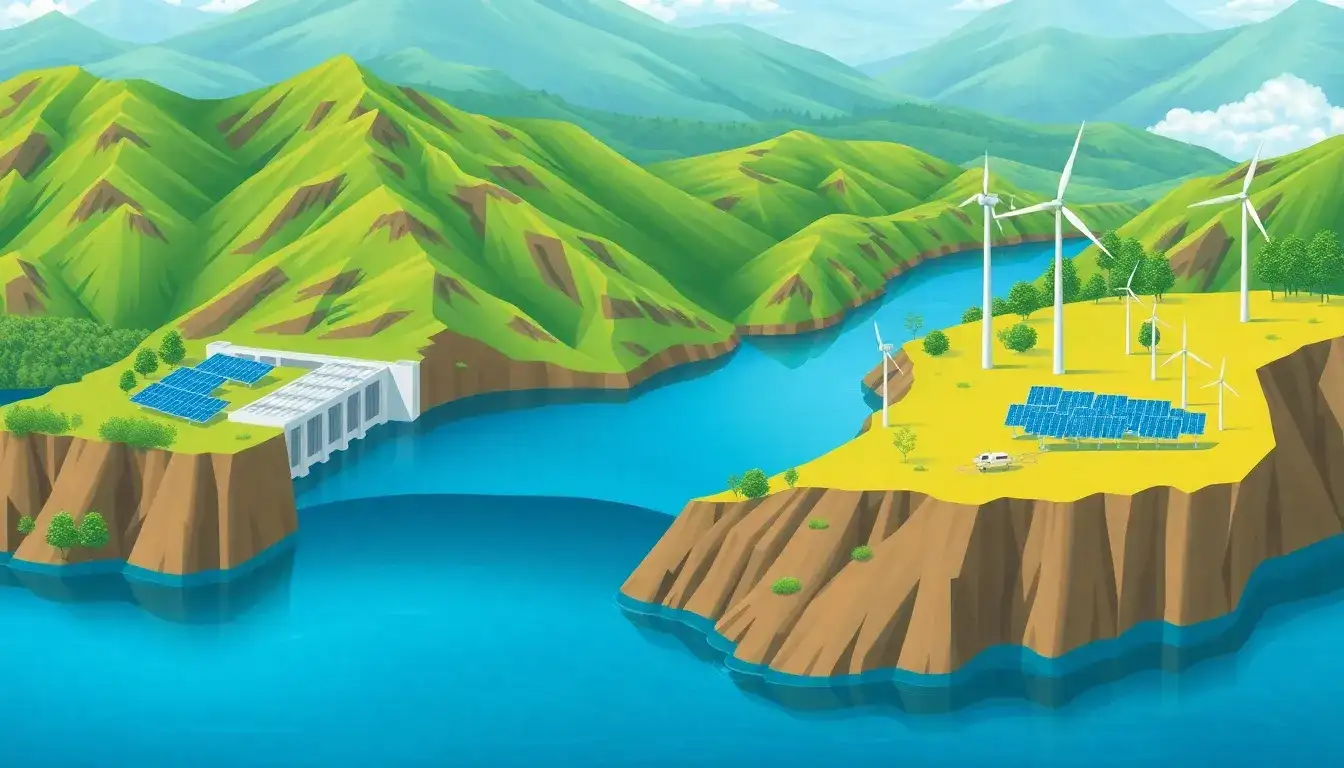
Pumped hydroelectric energy storage (PHES) has a relatively small land usage compared to other energy storage technologies and renewable energy sources. Here’s how it compares to some other technologies:
Comparison of Land Usage
- Pumped Hydroelectric Storage (PHES):
- PHES requires about 10 hectares per gigawatt-hour of storage.
- It is highly efficient in terms of land usage, especially when considering closed-loop systems away from rivers, which minimize environmental impact.
- Solar Farms:
- Solar farms typically require more land than PHES for the same capacity. For example, a solar farm generating about 1 GWh per year might require around 10 to 20 hectares depending on efficiency and location.
- This results in a much larger footprint compared to PHES when scaled up.
- Wind Farms:
- While wind turbines themselves occupy a small footprint, the overall land use for wind farms can be significant due to the spacing needed between turbines to optimize efficiency.
- On average, a wind farm might require 50 to 100 hectares per megawatt of capacity, though this can vary widely.
- Other Energy Storage Technologies:
- Battery Storage: The land requirement for battery storage is generally even smaller than PHES, as batteries can be housed in compact facilities. However, they currently do not match the scale of PHES.
- Compressed Air Energy Storage (CAES): This technology requires large underground caverns but can be efficient in terms of surface land use, though its construction is limited by geological constraints.
Environmental and Practical Considerations
- PHES offers advantages in terms of long-term energy storage capability, scalability, and grid stability, making it an essential component of renewable energy systems.
- However, PHES requires specific geological conditions (hilly terrain) and involves potential environmental impacts related to reservoir creation and water management.
- The ongoing water needs are minimal, and the water does not significantly interact with natural soil or the water table due to reservoir lining.
Original article by NenPower, If reposted, please credit the source: https://nenpower.com/blog/how-does-the-land-usage-of-pumped-hydroelectric-energy-storage-compare-to-other-energy-storage-technologies/

