

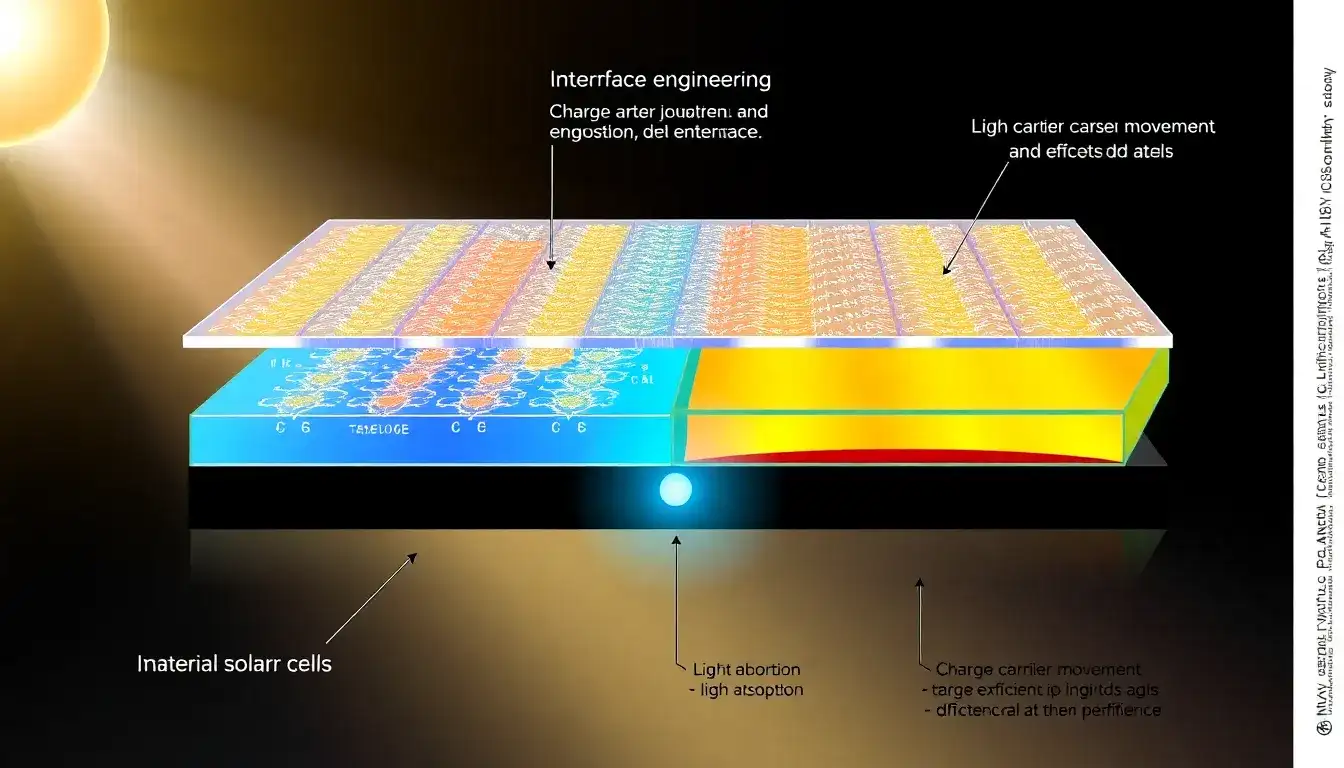
The interface engineering between perovskite and silicon layers is crucial for maximizing the overall efficiency of tandem solar cells by improving band alignment, reducing recombination losses, enhancing charge extraction, and optimizing light management at their junctions.
Key Impacts of Interface Engineering in Perovskite/Silicon Tandem Solar Cells
- Improved Band Alignment and Charge Extraction:
Using ionic liquids such as piperazinium iodide at the interface creates a positive dipole that optimizes band alignment between the perovskite and electron-transporting layers (e.g., C60). This modification reduces nonradiative recombination and enables more efficient charge extraction, leading to enhanced open-circuit voltages reaching up to 2.0 V in tandem cells. - Minimization of Recombination Losses:
Tailoring the interface with molecules like phosphonic acids improves the crystallization of the perovskite layer on textured silicon surfaces, which not only enhances layer uniformity but also reduces carrier recombination at the interface. This directly contributes to higher photocurrents and improved power conversion efficiencies exceeding 31% for large-area tandem solar cells. - Light Management Optimization:
Introducing thin interfacial layers such as hydrogenated nanocrystalline silicon oxide ((n)nc-SiOx:H) and hydrogenated nanocrystalline silicon ((n)nc-Si:H) effectively reduces reflection losses at the perovskite-silicon interface, allowing more light to reach the silicon bottom cell. This enhances the photocurrent generated by the silicon sub-cell, thus boosting the overall tandem efficiency. Additionally, anti-reflective coatings (e.g., MgF2) and optimized thicknesses of transport layers (C60, SnOx) further minimize optical losses. - Electrical Junction Quality and Stability:
Use of nickel oxide (NiOx) as a recombination layer reduces electrical shunts and improves interfacial passivation, leading to higher fill factors and improved device stability.
Summary Table of Interface Engineering Benefits
| Interface Engineering Strategy | Impact on Tandem Solar Cell Performance |
|---|---|
| Piperazinium iodide ionic liquid | Enhanced band alignment, increased open-circuit voltage (up to 2.0 V), reduced recombination losses |
| Phosphonic acid molecules | Improved perovskite crystallization, minimized carrier recombination, higher photocurrent and efficiency (>31%) |
| (n)nc-SiOx:H and (n)nc-Si:H interfacial layers | Reduce reflection losses, improve light coupling into silicon subcell, increase photocurrent |
| NiOx recombination layer | Reduced electrical shunting, improved fill factor, enhanced stability |
| Anti-reflective coatings (MgF2) | Minimized optical losses, better light management |
In conclusion, precise engineering of the interface between perovskite and silicon layers is fundamental to achieve high-performance tandem solar cells. It enables superior electronic coupling and optical transmission between the two sub-cells, thereby significantly boosting power conversion efficiencies, with records surpassing 31% and open-circuit voltages around 2 volts. These advances highlight that interface modifications are a key lever for pushing the performance limits of perovskite/silicon tandem photovoltaics.
Original article by NenPower, If reposted, please credit the source: https://nenpower.com/blog/how-does-the-interface-engineering-between-perovskite-and-silicon-layers-impact-the-overall-efficiency-of-tandem-solar-cells/

