

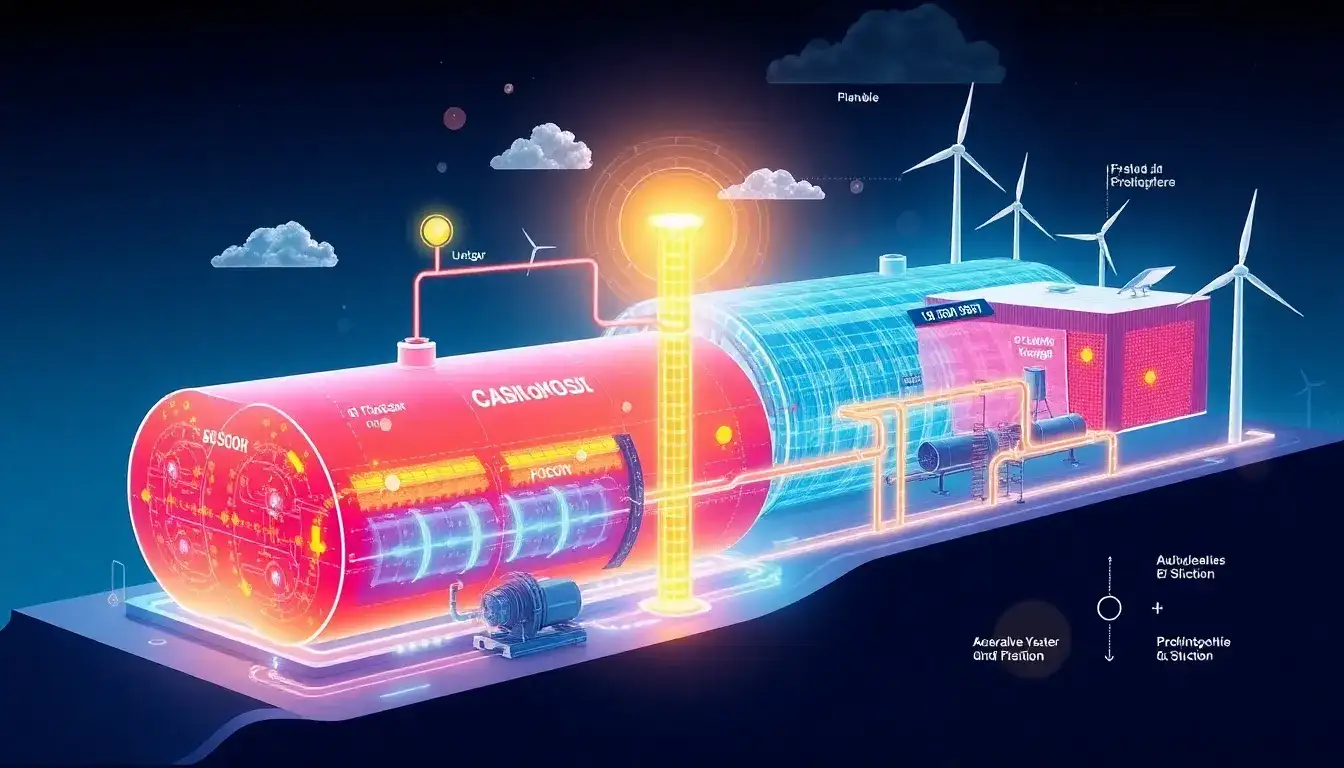
Thermal Integration Principles
LAES operates by liquefying air (which requires extremely low temperatures), storing it, and then regasifying it to generate power. Its performance is highly dependent on managing thermal energy flows, especially the heat exchanged during liquefaction and expansion phases.
Use of External Cold Sources
- LAES systems can integrate with external cold sources, such as Liquefied Natural Gas (LNG) regasification processes. LNG regasification releases cold energy at temperatures as low as -162°C, which can be used in LAES to boost the efficiency of air liquefaction, since the LAES lowest operating temperature is between roughly -170°C and -190°C. This integration allows better utilization of the cold exergy from LNG, improving overall system efficiency that would otherwise be wasted.
Use of External Heat Sources
- External waste heat, for example at around 300°C, can be used to preheat air before it enters the expanders during the discharge phase of LAES. This increase in inlet air temperature leads to higher power generation during expansion without negatively impacting the charging/liquefaction phase. Consequently, the round-trip efficiency (RTE) of the LAES system improves significantly, reaching values around 83.1% or higher depending on integration specifics.
Integration Outcomes
- Combining both external cold (like LNG cold energy) and external waste heat sources has shown to dramatically improve LAES round-trip efficiency, sometimes up to nearly 189% relative improvement in specific studies.
- Integrating LAES with adjacent thermal power plants or industrial facilities provides ready access to thermal streams, which helps overcome challenges related to thermal integration and reduces reliance on external fuels, helping lower associated CO2 emissions.
- Integration with related thermal energy storage technologies such as pumped thermal energy storage (PTES) creates a hybrid PT-LAES system. In this configuration, PTES supplies the cold source needed for air liquefaction, enabling complete air liquefaction, reducing or eliminating the need for bulky cold stores, boosting energy density, and allowing the system to operate independently of external thermal resources.
Summary
| Integration Method | Thermal Resource Utilized | Benefits |
|---|---|---|
| LNG regasification integration | Ultra-low temperature cold energy | Improved liquefaction efficiency, better cold energy recovery |
| External waste heat integration | High-temperature waste heat (~300°C) | Increased power output during discharge, improved round-trip efficiency |
| Integration with thermal plants/facilities | Adjacent heat/cold streams | Overcomes thermal integration challenges, reduces CO2 emissions |
| Hybrid PT-LAES integration | Internal PTES cold source | Higher energy density, full liquefaction, standalone operation |
This integration strategy enables LAES to achieve much higher efficiency and energy density, making it a promising technology for sustainable, carbon-neutral energy storage solutions.
Original article by NenPower, If reposted, please credit the source: https://nenpower.com/blog/how-does-the-integration-of-laes-with-external-thermal-systems-work/

