

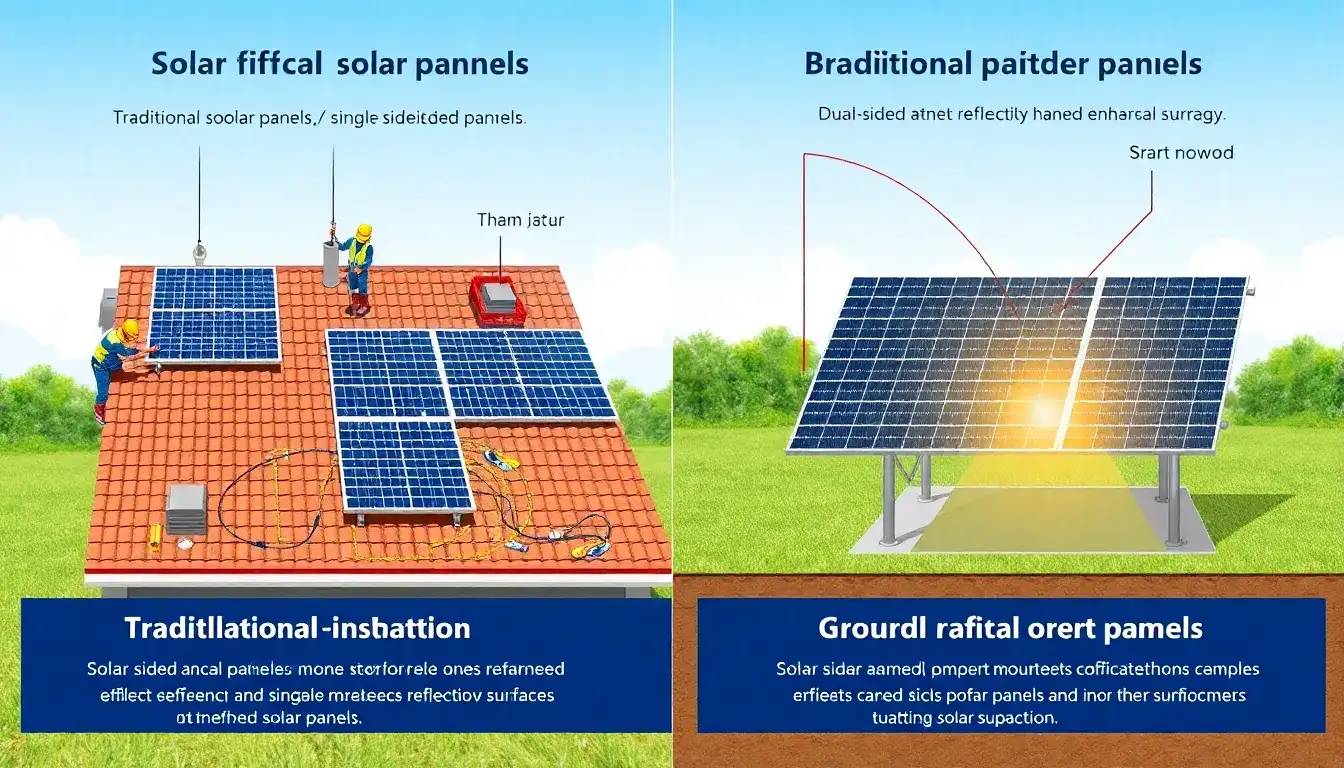
The installation process of bifacial solar panels differs from traditional (monofacial) solar panels mainly due to their unique design that captures sunlight from both the front and the rear sides, which requires specific considerations to maximize energy generation:
Key Differences in Installation Process
1. Site Assessment and Location Considerations
- Bifacial panels need a site with high ground reflectivity (albedo) because reflected sunlight from the ground or nearby surfaces significantly contributes to their output. Ideal surfaces include white roofs, gravel, sand, snow-covered areas, or specially treated reflective surfaces.
- Traditional panels do not rely on reflected light, so albedo has minimal impact on their performance.
2. Mounting System and Panel Elevation
- Bifacial panels are usually mounted higher off the ground or roof than traditional panels to allow maximum light reflection to the rear surface. Recommended clearance is typically at least 1 meter (3.3 feet) for ground mounts and 10-15 cm above roofs for airflow and reflectivity.
- Traditional panels are often mounted closer to the surface and do not require extra space underneath for reflected light.
3. Panel Orientation and Tilt
- The tilt angle and orientation for bifacial panels are carefully optimized not only to capture direct sunlight but also to maximize reflected light on the back side, typically between 20 to 30 degrees but can vary based on location.
- Traditional panels focus primarily on maximizing direct sunlight, so tilt is optimized mainly for sun angle.
4. Row Spacing
- Bifacial solar installations require wider row spacing to prevent shading of reflected light on the rear side. Row spacings around 2.5 meters or more are common, designed depending on solar angles and ground coverage ratio to maximize rear illumination.
- Traditional installations can have tighter row spacing since rear side illumination is irrelevant.
5. Mounting Hardware and Methods
- Specialized mounting systems are used for bifacial panels to ensure stability while maintaining elevation and optimal positioning for light capture. Mounting hardware must allow secure fastening, often at four points, and accommodate the double-glass or dual-active surfaces.
- Traditional panels use standard mounting hardware without the need for clearance or reflectivity considerations.
6. Electrical Connections and Components
- Wiring for bifacial panels may involve power optimizers or MPPT (Maximum Power Point Tracking) inverters to handle varied illumination on the front and rear surfaces, ensuring maximum efficiency.
- Traditional panels generally use standard string inverters without special optimization for dual-side illumination.
7. Maintenance and Cleaning
- Bifacial panels require cleaning on both sides to maintain optimal performance, as dirt or debris on either side reduces energy capture.
- Traditional panels require cleaning only on the front surface facing the sun.
Summary Table
| Installation Aspect | Bifacial Solar Panels | Traditional Solar Panels |
|---|---|---|
| Site Assessment | Evaluate ground reflectivity (albedo) | Focus on shading, orientation |
| Mounting Height | Elevated (~1m above ground, 10-15 cm on roofs) | Closer mounting, minimal clearance |
| Panel Tilt Angle | Optimized for front + rear light capture | Optimized for sun angle only |
| Row Spacing | Wider spacing to avoid shading rear light | Tighter spacing possible |
| Mounting Hardware | Specialized mounts allowing clearance and stability | Standard mounts with close mounting |
| Electrical Configuration | Power optimizers/MPPT to maximize dual-side output | Standard wiring and inverters |
| Cleaning & Maintenance | Both sides require regular cleaning | Only front side cleaning needed |
In summary, bifacial solar panel installation involves additional steps to optimize for dual-sided energy capture, including higher mounting, reflective ground surfaces, wider spacing, and special electrical considerations, whereas traditional solar panel installation focuses mainly on optimizing direct front-side sunlight exposure.
Original article by NenPower, If reposted, please credit the source: https://nenpower.com/blog/how-does-the-installation-process-of-bifacial-solar-panels-differ-from-that-of-traditional-solar-panels/

