

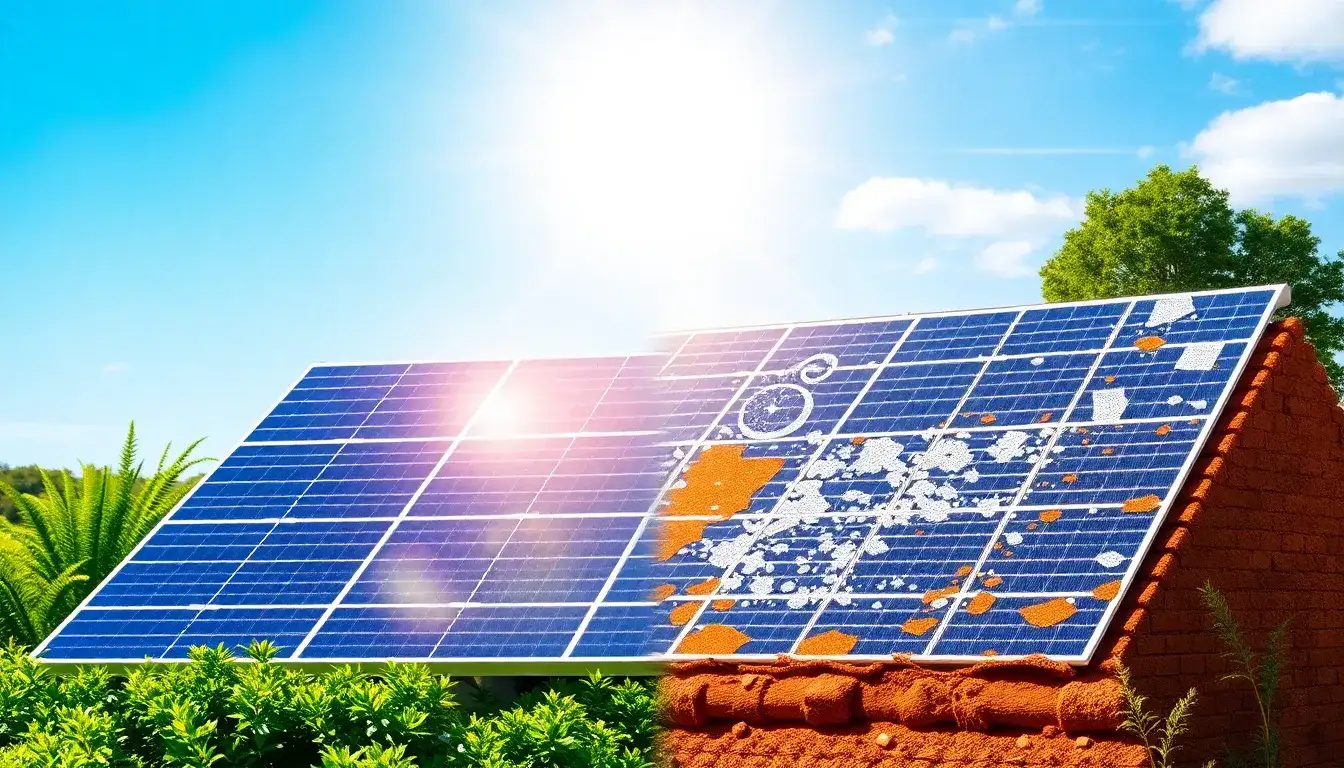
The initial quality of solar panels significantly impacts their long-term degradation rate, influencing both the initial power loss and the subsequent steady decline in energy output over the panels’ lifespan.
Initial Degradation and Quality Impact
- Initial degradation typically occurs within the first few months after installation and tends to be relatively high, ranging from about 1% to 3%. This early loss is largely due to unstable manufacturing factors and the initial operating phase, such as light-induced degradation (LID) caused by exposure to sunlight and UV radiation.
- High-quality panels generally exhibit lower initial degradation rates. While typical warranties indicate 2-3% power loss in the first year, some premium panels can have as low as 0.25% initial degradation.
Long-Term Degradation and Quality
- After the initial phase, degradation slows to a steady, lower rate typically between 0.5% and 0.8% annually for crystalline silicon panels. Research has shown that monocrystalline panels manufactured after 2000 may degrade at even lower rates of around 0.4% per year, reflecting advances in manufacturing and material quality.
- Higher-quality panels have more durable materials and better manufacturing processes, which reduce microcracks, corrosion, and electrical failures that contribute to degradation.
- Conversely, lower-quality panels tend to degrade faster over time due to weaker materials and less robust construction, resulting in more rapid performance loss.
Factors Influencing Degradation Related to Quality
- Quality affects resistance to environmental stresses such as thermal cycling, humidity, UV exposure, and mechanical strain. Poor-quality panels may suffer from more severe microcracking, encapsulant aging, and corrosion, accelerating degradation.
- The choice of encapsulant materials and soldering quality also impacts degradation rates. For example, silicone encapsulants and glass-glass modules tend to degrade less than EVA encapsulants and glass-polymer modules, which are usually tied to panel quality levels.
Summary of Quality Impact on Degradation Rate
| Aspect | Effect of Better Initial Quality | Effect of Lower Initial Quality |
|---|---|---|
| Initial degradation rate | Lower (closer to 0.25%-1%) | Higher (1%-3% or more) |
| Long-term annual degradation | Lower (around 0.4%-0.7%) | Higher (0.8% or more) |
| Resistance to environment | Greater resistance to thermal cycling, humidity, UV | More susceptible to microcracks, corrosion, and discoloration |
| Overall lifespan | Longer effective power output life (beyond 25 years) | Shorter effective lifespan due to faster power loss |
Conclusion
The initial quality of solar panels directly influences their degradation behavior. Higher-quality panels experience lower initial power loss and slower long-term degradation, ensuring higher energy yields and longer effective lifespans. This makes the selection of high-quality panels and professional installation crucial for maximizing the return on investment and reliability of solar power systems.
Regular maintenance and appropriate system design can further mitigate environmental impacts, but the foundational factor remains the intrinsic quality of the panels used.
Original article by NenPower, If reposted, please credit the source: https://nenpower.com/blog/how-does-the-initial-quality-of-solar-panels-impact-their-long-term-degradation-rate/

