

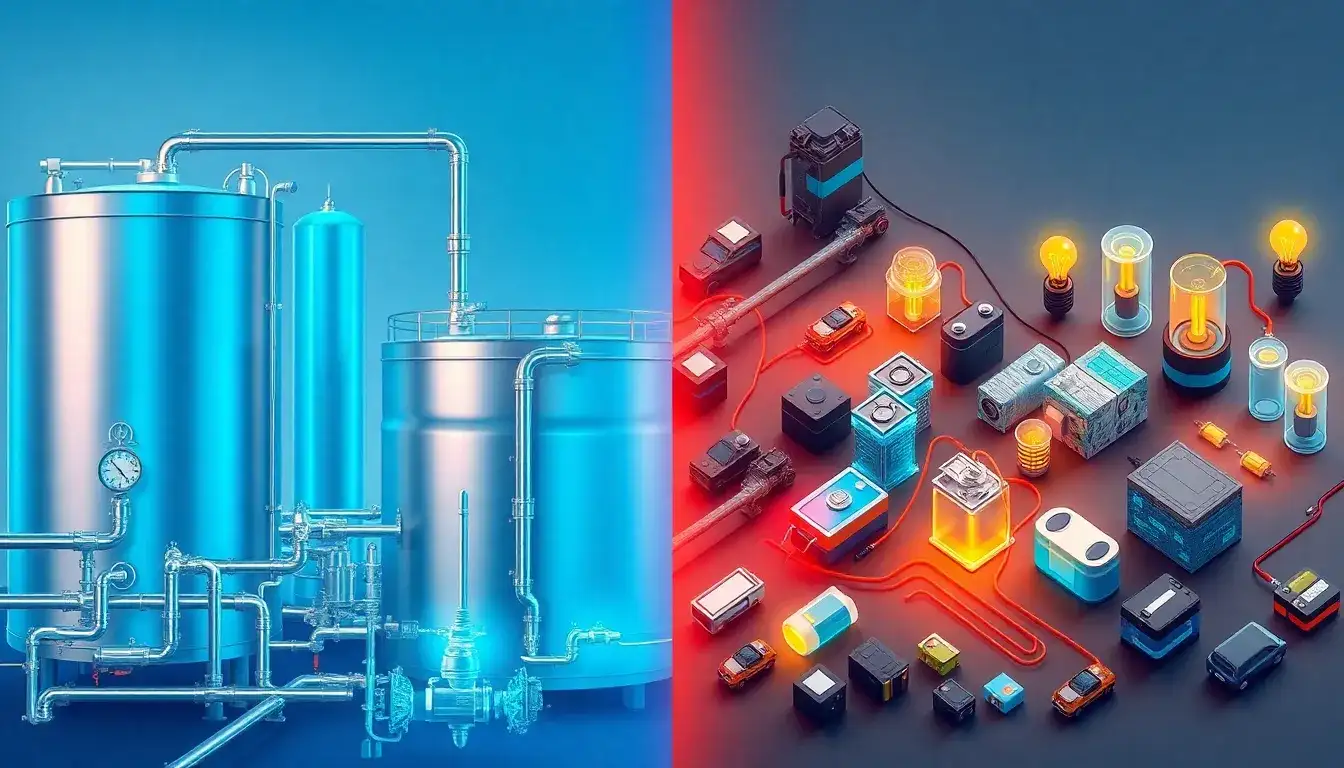
Hydrogen Storage Infrastructure
- Specialized Equipment: Hydrogen requires specialized high-pressure tanks or cryogenic systems for gas and liquid storage, respectively. These systems are necessary due to hydrogen's low volumetric energy density and high flammability.
- Storage Methods: Hydrogen can be stored physically as compressed gas, liquid hydrogen, or chemically within materials like metal hydrides or liquid organic hydrogen carriers (LOHCs).
- Transportation: Hydrogen is often transported via high-pressure tanks or pipelines. Pipelines are more cost-effective for long-distance transport, but they may require modifications to handle hydrogen, which can cause embrittlement in metals.
- Safety Concerns: The flammability of hydrogen necessitates enhanced safety measures, including strict handling procedures and robust safety systems at storage and refueling facilities.
- Energy Conversion: Hydrogen is converted back into electricity using fuel cells, allowing it to act as a flexible energy storage medium for renewable energy systems.
Battery Storage Infrastructure
- Standardized Systems: Battery storage, particularly lithium-ion batteries, uses well-established standardized systems with a wide range of scalable designs from small portable units to large grid-scale installations.
- Chemical Composition: Batteries store energy chemically within cells, which can be easily configured in modular systems to meet varying capacity needs.
- Transportation: Batteries are typically more straightforward to transport due to their relatively safe chemical composition compared to hydrogen. They are commonly transported as finished products or components.
- Safety Concerns: While batteries have safety concerns, such as overheating or fire risks, they do not require the same level of high-pressure containment as hydrogen.
- Energy Conversion: Batteries directly store electrical energy and can discharge it without the need for fuel cells.
Comparison Summary
- Specialization: Hydrogen storage requires highly specialized equipment for handling its unique properties, whereas batteries use more conventional systems.
- Safety and Handling: Hydrogen presents significant safety challenges due to its flammability, necessitating more stringent safety protocols.
- Energy Density and Volume: Hydrogen is energy-dense by mass but low in volumetric density, requiring large storage volumes compared to batteries.
- Transportation Infrastructure: Hydrogen often relies on pipelines or high-pressure tanks, while batteries are transported as finished or component goods without similar infrastructure needs.
Overall, the infrastructure for hydrogen and batteries reflects their fundamentally different storage and energy conversion mechanisms.
Original article by NenPower, If reposted, please credit the source: https://nenpower.com/blog/how-does-the-infrastructure-for-hydrogen-storage-differ-from-that-for-batteries/

