

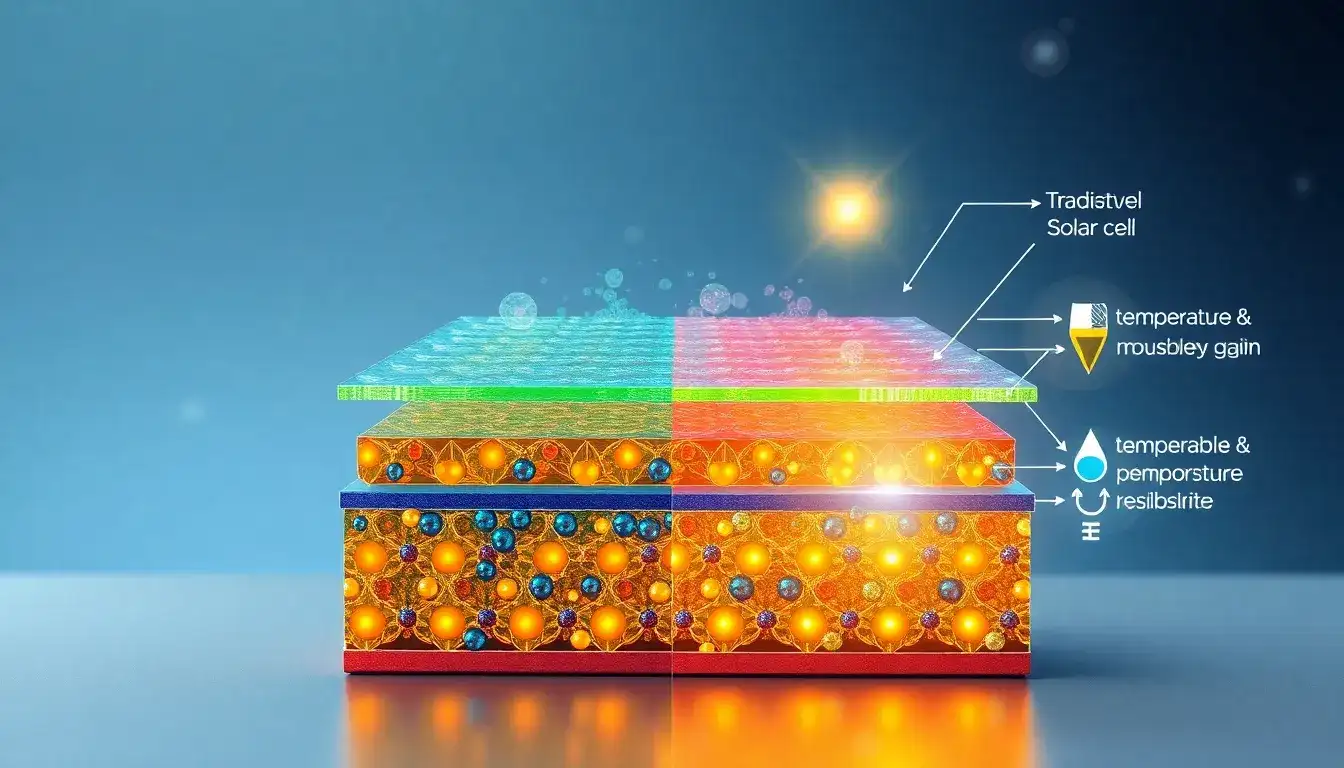
Hybrid organic-inorganic perovskite materials enhance solar cell stability through several key mechanisms related to their structure and interface engineering:
Structural Stability Improvements
- The hybrid perovskites generally have the formula ABX3, where the “A” site is an organic cation (e.g., methylammonium, formamidinium) and the “B” site is an inorganic metal cation (commonly lead or tin), while “X” is a halide anion. Stability can be improved by partially replacing the organic A-cation with a mixture of A-cations such as formamidinium and cesium instead of methylammonium alone. This mixed cation approach strengthens the crystal lattice and reduces structural degradation caused by environmental stressors like moisture and heat.
- Incorporating additives and introducing halide mixing (such as adding bromine to iodine) also help to create more robust crystal lattices, which resist decomposition pathways better than pure compositions.
Interface Passivation and Protective Coatings
- Stability is further enhanced by passivating the perovskite surface and interfaces. Treatments with organic molecules, such as ammonium salts (e.g., 2-thiopheneethylammonium chloride), can form a thin 2D perovskite layer at crucial interfaces between the perovskite and charge transport layers. This passivation reduces defects and traps that otherwise accelerate degradation, enhancing both efficiency and durability.
- Protective coatings developed through chemical modifications—such as amidination where the ammonium group is replaced with a more stable amidinium group—have been shown to significantly improve thermal and photo stability. This innovation has led to perovskite solar cells retaining 90% of their initial efficiency after 1100 hours under harsh conditions, essentially tripling device lifetime compared to uncoated cells.
Replacement and Optimization of Transport Layers
- Enhancements also come from replacing less stable transport layers or modifying them to reduce UV-induced photocatalytic degradation. For example, replacing TiO2 with more UV-stable materials (like alumina) or doping TiO2 reduces UV-related damage that can destabilize the perovskite layer.
In summary, hybrid organic-inorganic perovskite materials enhance solar cell stability by:
- Using mixed organic-inorganic cations and halides to strengthen the crystal framework.
- Applying interface passivation with ammonium salt treatments to reduce defects.
- Employing protective coatings (amidinium-based) to improve resistance to heat and light.
- Optimizing transport layers to minimize UV damage.
These approaches synergistically create more durable perovskite solar cells capable of maintaining high efficiency over prolonged periods under real-world environmental stresses.
Original article by NenPower, If reposted, please credit the source: https://nenpower.com/blog/how-does-the-hybrid-organic-inorganic-perovskite-material-enhance-solar-cell-stability/

