

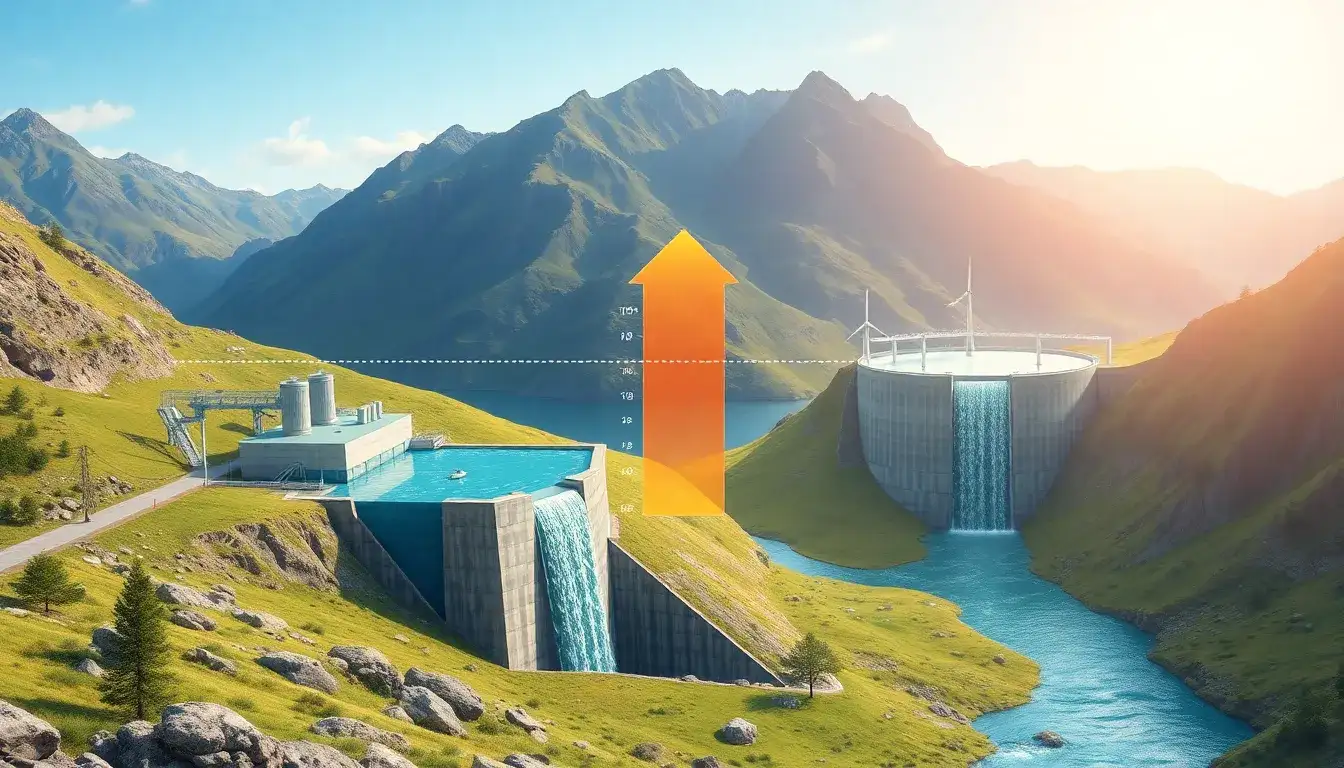
Pumped hydroelectric energy storage (PHES) efficiency is directly influenced by the height difference between reservoirs. Here’s how:
1. Energy Capacity:
The gravitational potential energy stored is calculated as:
E = m • g • h
where h (height difference) is a critical variable. Larger elevation differences increase stored energy per unit of water.
2. Round-Trip Efficiency:
PHES systems achieve 70–80% efficiency, with higher elevation systems often nearing the upper end of this range. While exact height-specific efficiency data isn’t explicitly detailed in available sources, the relationship is implied through physics principles:
- Higher head reduces friction losses in penstocks (due to shorter pipe lengths or steeper gradients for equivalent power output)
- Enables use of higher-pressure turbines optimized for efficiency.
3. Cost vs. Performance:
Projects with larger height differences often have lower water volume requirements for equivalent energy storage, reducing reservoir size and associated costs. However, extreme elevations may introduce engineering challenges offsetting these gains.
While not explicitly stated in sources, these factors are derived from fundamental hydroelectric engineering principles.
Practical Outcomes:
- 10+ hour storage capacities (common in high-head systems) optimize grid stability for renewable integration.
- 80%+ efficiency in modern systems typically assumes well-designed elevation differentials.
Thus, while height difference directly scales energy storage capacity, its efficiency impact manifests through secondary engineering optimizations rather than a direct linear relationship.
Original article by NenPower, If reposted, please credit the source: https://nenpower.com/blog/how-does-the-height-difference-between-reservoirs-impact-the-efficiency-of-pumped-hydroelectric-energy-storage/

