

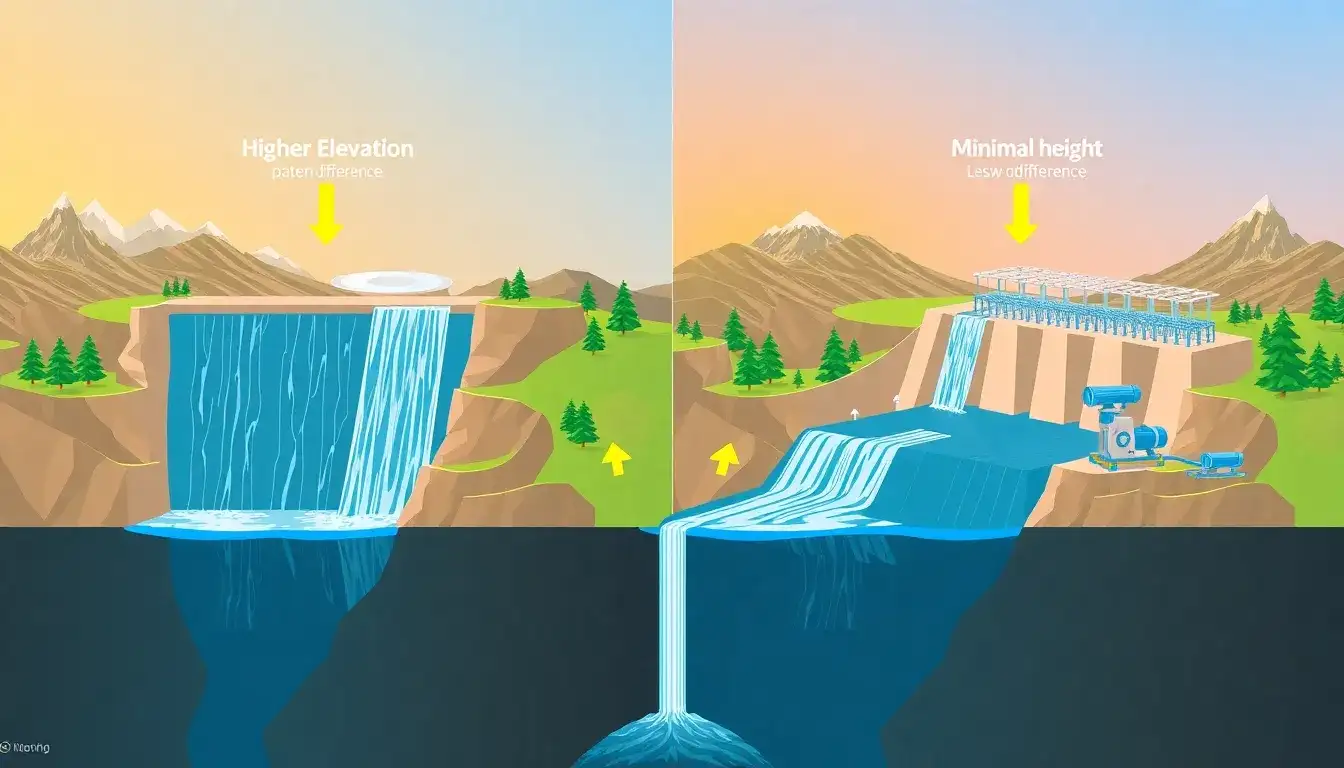
Energy Generation Potential
- Gravitational Potential Energy: The core principle of PHES is based on gravitational potential energy, which is calculated using the formula E = mgh, where E is energy, m is the mass of water, g is gravitational acceleration, and h is the height difference between the reservoirs. A greater height difference results in more potential energy available for conversion into kinetic energy when water flows back to the lower reservoir.
- Increased Output: As the height difference increases, so does the amount of electricity that can be generated during discharge. Systems with larger vertical drops can generate more power with the same volume of water compared to systems with lower elevation differences. This directly correlates with enhanced efficiency and capacity of the pumped storage operation.
Round-Trip Efficiency
- Efficiency Ranges: The round-trip efficiency of pumped storage systems typically ranges from 70% to 80%. This efficiency can be influenced by the height difference, where larger disparities may help optimize the use of turbines and pumps, thus improving overall efficiency.
- Loss Mitigation: While energy losses occur during the conversion processes (both pumping water to the upper reservoir and generating electricity when releasing it), higher elevation differences can help in overcoming some inefficiencies. For instance, systems can be designed to leverage variable speed operation which optimizes the energy recovery at different operational levels.
Design and Operational Considerations
- Site Selection: The geographic terrain plays a crucial role in the feasibility of pumped hydro projects. Sites with significant elevation differences naturally lend themselves to more efficient systems, reducing the need for extensive engineering solutions to create the required height.
- Volume Requirements: The storage requirements also scale with height. Higher reservoirs need to store a larger volume of water to achieve the same energy capacity as a lower reservoir system. This means that not only the height but also the total volume of water must be considered when assessing the efficiency and capability of a pumped storage facility.
Economic Implications
- Cost-Effectiveness: Although the initial capital costs of building pumped storage facilities can be high, including for site development and construction, the long-term operational efficiencies gained from greater height differences can result in improved economic viability. The benefits from peak shaving and load leveling using more efficient systems can lead to considerable cost savings in energy markets.
In summary, increasing the height difference between reservoirs in pumped hydro storage systems enhances energy generation potential, improves round-trip efficiency, and influences economic aspects of operation. This makes height a critical factor in the design and implementation of effective pumped hydro energy storage solutions.
Original article by NenPower, If reposted, please credit the source: https://nenpower.com/blog/how-does-the-height-difference-between-reservoirs-impact-the-efficiency-of-pumped-hydro-storage/

