

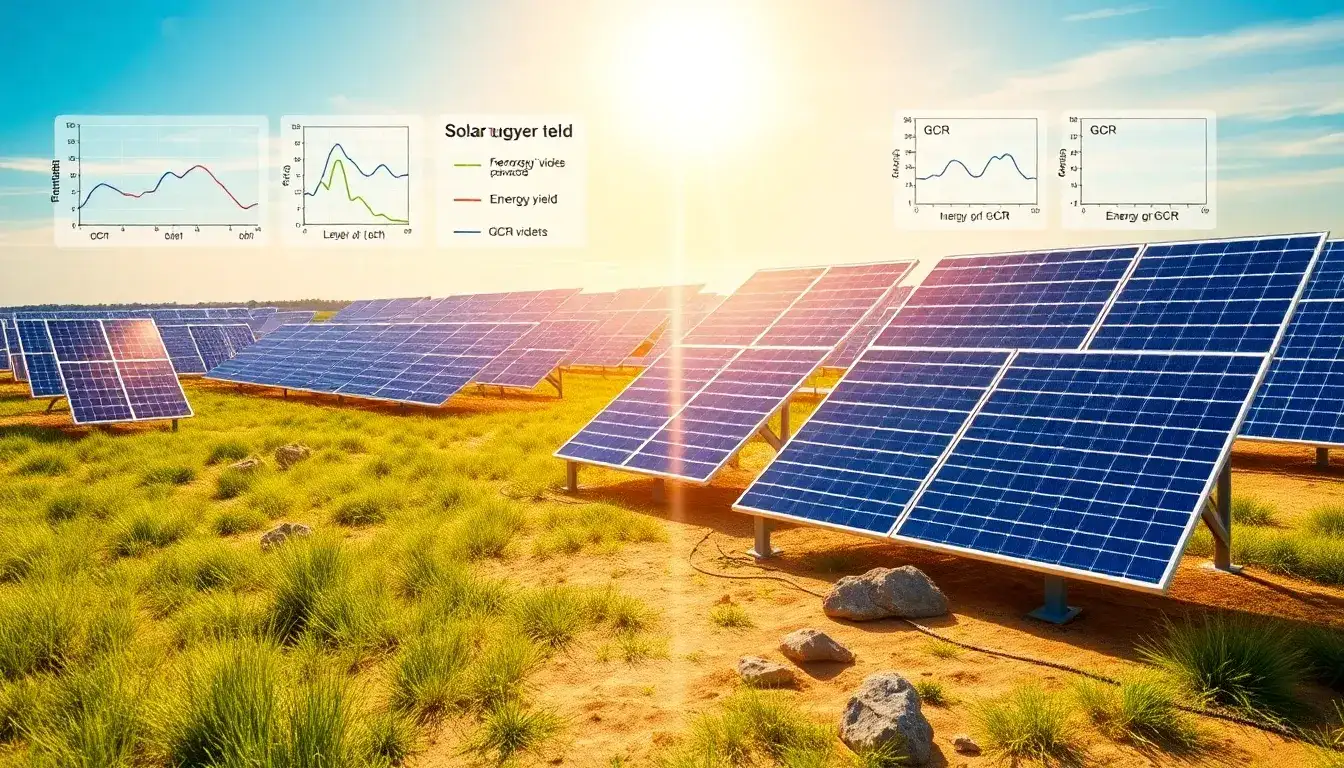
The ground coverage ratio (GCR) significantly influences the energy yield of bifacial photovoltaic (PV) systems by affecting the spacing between module rows and thus the amount of irradiance received on both the front and rear sides of the modules.
Definition and General Effect of GCR
- GCR is defined as the ratio of the area occupied by PV modules to the total available ground area, which is directly related to the pitch or the inter-row spacing between module arrays. A GCR of 1 means full ground coverage with no spacing, while a lower GCR indicates more space between rows.
- Decreasing GCR means increasing the pitch (larger spacing), which reduces shading between rows and allows more sunlight and reflected light to reach the rear side of bifacial modules. This typically increases energy production due to higher bifacial gain.
Specific Impact on Bifacial Systems
- Bifacial modules capture light from the ground reflected to their rear side. A lower GCR (more spacing) improves rear side irradiance by reducing shading and increasing ground-reflected light exposure, thus enhancing bifacial gain and total energy yield.
- However, too low a GCR means fewer modules per unit area, which may not be optimal economically or spatially. Studies and simulations suggest an optimal GCR range of around 0.3 to 0.5 (or 30% to 50% ground coverage) for bifacial PV systems to balance energy yield and land usage.
- For example, an assessment in Ghana found that the best bifacial system performance was achieved with a GCR of about 0.3 along with optimized albedo and tilt angle conditions.
Trade-Offs and Design Considerations
- While lower GCR increases energy yield by mitigating shading and enhancing bifacial gain, it increases land use and cost. Conversely, a higher GCR increases module density but heightens shading losses, especially in fixed-tilt systems.
- Unlike monofacial modules, bifacial modules are less sensitive to shading losses because the rear side can still collect diffuse and reflected light, allowing somewhat higher GCR values without as much penalty.
- System design must consider GCR alongside other parameters like module tilt, height above ground, ground albedo, and local solar geometry to maximize bifacial energy yield.
- Industry studies (e.g., by Waaree and RatedPower) recommend GCR in the range 40-50% for optimized bifacial fixed-tilt arrays. NREL modeling for utility-scale bifacial PV often assumes GCR around 0.35 to 0.4 for balance of performance and cost.
Summary Table of GCR Effects on Bifacial Systems
| GCR Range | Effect on Energy Yield | Notes |
|---|---|---|
| Low GCR (<0.3) | High energy yield due to low shading, high bifacial gain | Requires more land area, may reduce power density |
| Moderate GCR (0.3-0.5) | Balanced energy yield and land utilization | Generally recommended for bifacial systems |
| High GCR (>0.5) | Reduced energy yield due to shading losses | Higher power density but lower bifacial gain |
In conclusion, the ground coverage ratio influences bifacial system energy yield primarily by controlling row-to-row shading and the availability of ground-reflected irradiance to the module rear side. Optimizing GCR around 30-50% achieves a balance between maximizing bifacial gain and practical land use, thereby improving overall energy production of bifacial PV installations.
Original article by NenPower, If reposted, please credit the source: https://nenpower.com/blog/how-does-the-ground-coverage-ratio-gcr-influence-the-energy-yield-of-bifacial-systems/

