

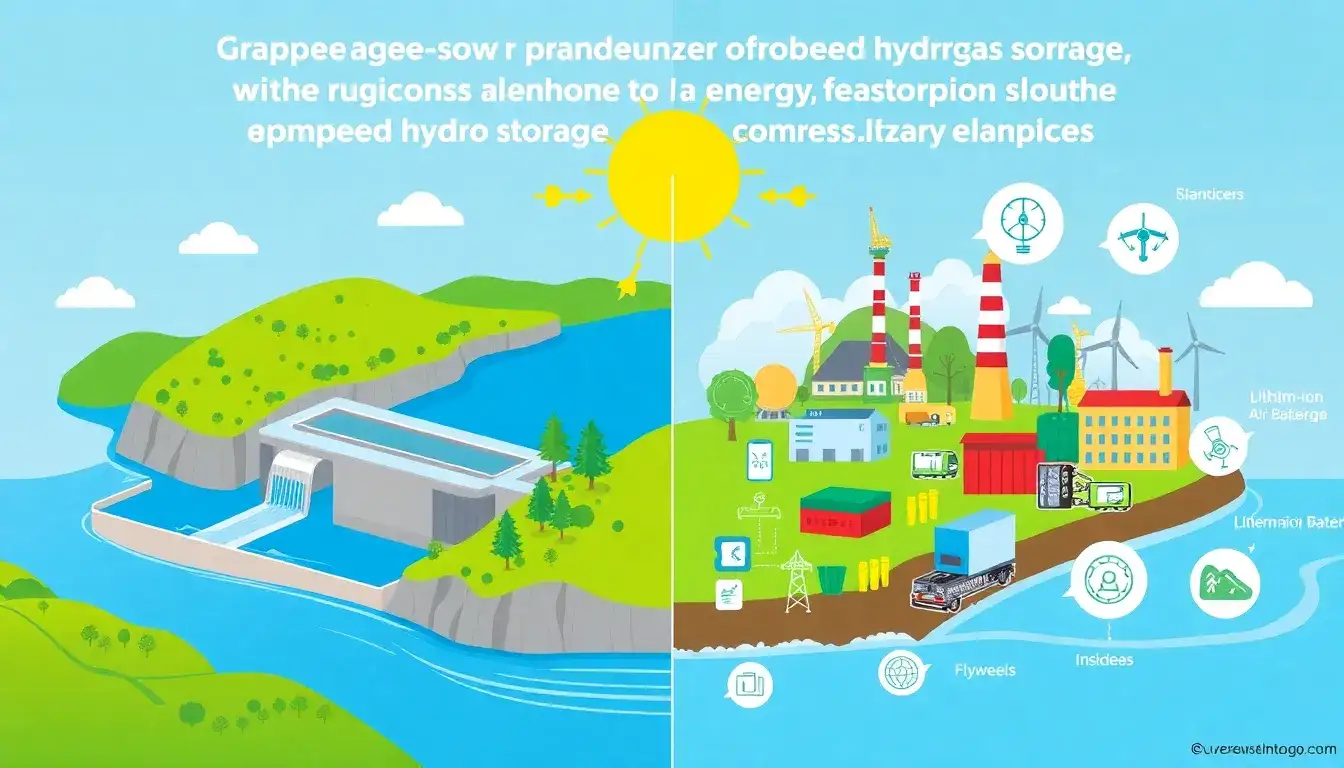
Pumped Hydro Storage
- Greenhouse Gas Emissions: The global warming potential (GWP) of pumped hydro storage ranges from about 58 to 530 grams of CO₂-eq per kWh.
- Factors Influencing Emissions: The largest impact comes from the grid mix used for the initial pumping of water, followed by construction materials like concrete. Building on brownfield sites can reduce emissions by 20% compared to greenfield sites.
Other Energy Storage Technologies
- Compressed-Air Energy Storage (CAES): This technology has higher GWP compared to PHS, typically being about four times or more that of PHS.
- Utility-Scale Lithium-Ion Batteries (LIBs): LIBs have a higher carbon footprint than PHS. They are used for shorter durations and require significant material inputs with associated emissions.
- Vanadium Redox Flow Batteries (VRFBs): Similar to LIBs, VRFBs have higher emissions than PHS but are designed for long-duration storage and offer different advantages.
- Lead-Acid Batteries: These have the highest emissions among the comparison group, largely due to the materials used.
Summary
Pumped hydro storage is the greenest option among major energy storage technologies, providing significant climate benefits by minimizing life cycle greenhouse gas emissions. Its ability to support the integration of renewable energy sources makes it crucial for transitioning to a low-carbon energy system.
Original article by NenPower, If reposted, please credit the source: https://nenpower.com/blog/how-does-the-greenhouse-gas-footprint-of-pumped-hydro-storage-compare-to-other-energy-storage-technologies/

