

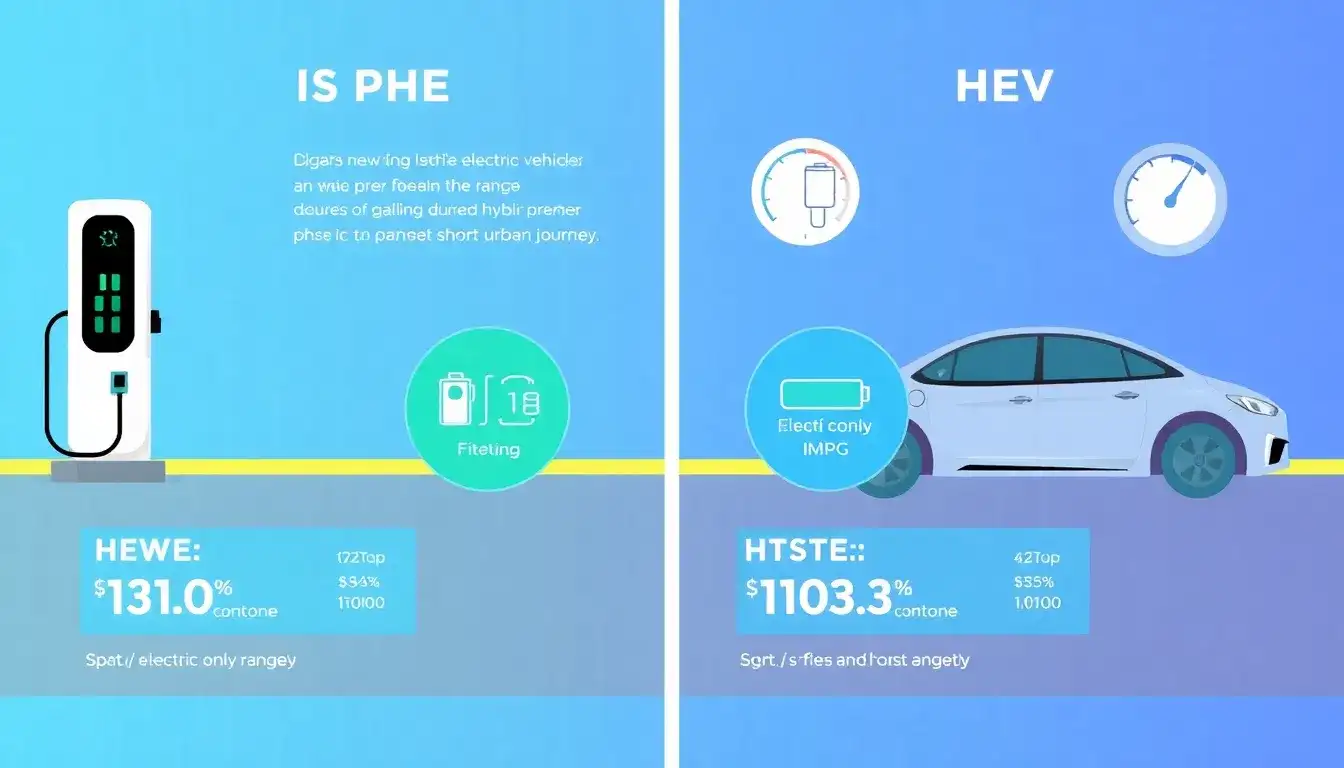
On short trips, plug-in hybrid electric vehicles (PHEVs) generally demonstrate superior fuel efficiency compared to traditional hybrid electric vehicles (HEVs), mainly because PHEVs can operate purely on electric power for a certain distance before the gasoline engine engages. Here’s a detailed comparison:
Fuel Efficiency of PHEVs vs HEVs on Short Trips
PHEVs:
- PHEVs have much larger battery packs—about 10 to 20 times the capacity of a typical HEV battery—allowing for an electric-only driving range of approximately 20 to 50 miles depending on the model. This means that for short trips within this electric range, a PHEV can operate entirely on electricity without using gasoline at all, resulting in very low or near-zero fuel consumption during such trips.
- Because PHEVs can be plugged in and recharged externally, they start short trips with a full battery, maximizing the chances of electric-only operation and thus excellent fuel efficiency in these scenarios.
- Real-world testing shows PHEVs can achieve significantly lower fuel usage than HEVs, with PHEVs consuming as low as 1.3 to 3.1 L/100 km, compared to HEVs which typically consume between 4.0 and 6.6 L/100 km. However, PHEVs tend to exceed their claimed fuel economy figures on longer or more demanding trips, as factors such as highway speeds and steep hills rapidly drain their batteries, causing more frequent gasoline engine use.
HEVs:
- HEVs rely on a small battery (about 1 kWh) that is continually charged through regenerative braking and the gasoline engine itself. They cannot be plugged in to start with a full charge. The electric motor assists the engine mainly during acceleration and low speeds but does not provide a significant all-electric range.
- On short trips, HEVs benefit from regenerative braking and electric assist but still use gasoline more consistently than PHEVs, resulting in moderate fuel efficiency. Their fuel economy is generally better than conventional gasoline vehicles but inferior to PHEVs when the latter can run in electric-only mode.
- HEVs tend to have more consistent fuel consumption figures closer to their official ratings and do not rely on driver plugging in for best performance.
Summary
| Feature | PHEVs | HEVs |
|---|---|---|
| Battery size | Large (10-20x HEV battery) | Small (~1 kWh) |
| Electric-only range | 20-50 miles | Negligible |
| Ability to plug in | Yes | No |
| Fuel efficiency on short trips | Very high if electric range covers trip (near zero gasoline use) | Moderate; better than conventional cars but inferior to PHEVs |
| Real-world fuel use | 1.3 – 3.1 L/100 km (effective electric-only use) | 4.0 – 6.6 L/100 km |
| Consistency vs claims | Fuel economy claims often exceeded due to battery depletion on longer trips | Closer to claims |
In brief, on short trips where a PHEV can operate solely on its electric battery, it is more fuel-efficient than a HEV because it can avoid using gasoline entirely. HEVs provide improved fuel economy over standard gasoline vehicles but cannot match the near-zero fuel consumption potential of PHEVs on short trips that fit within the electric range.
Original article by NenPower, If reposted, please credit the source: https://nenpower.com/blog/how-does-the-fuel-efficiency-of-phevs-compare-to-hevs-on-short-trips/

