

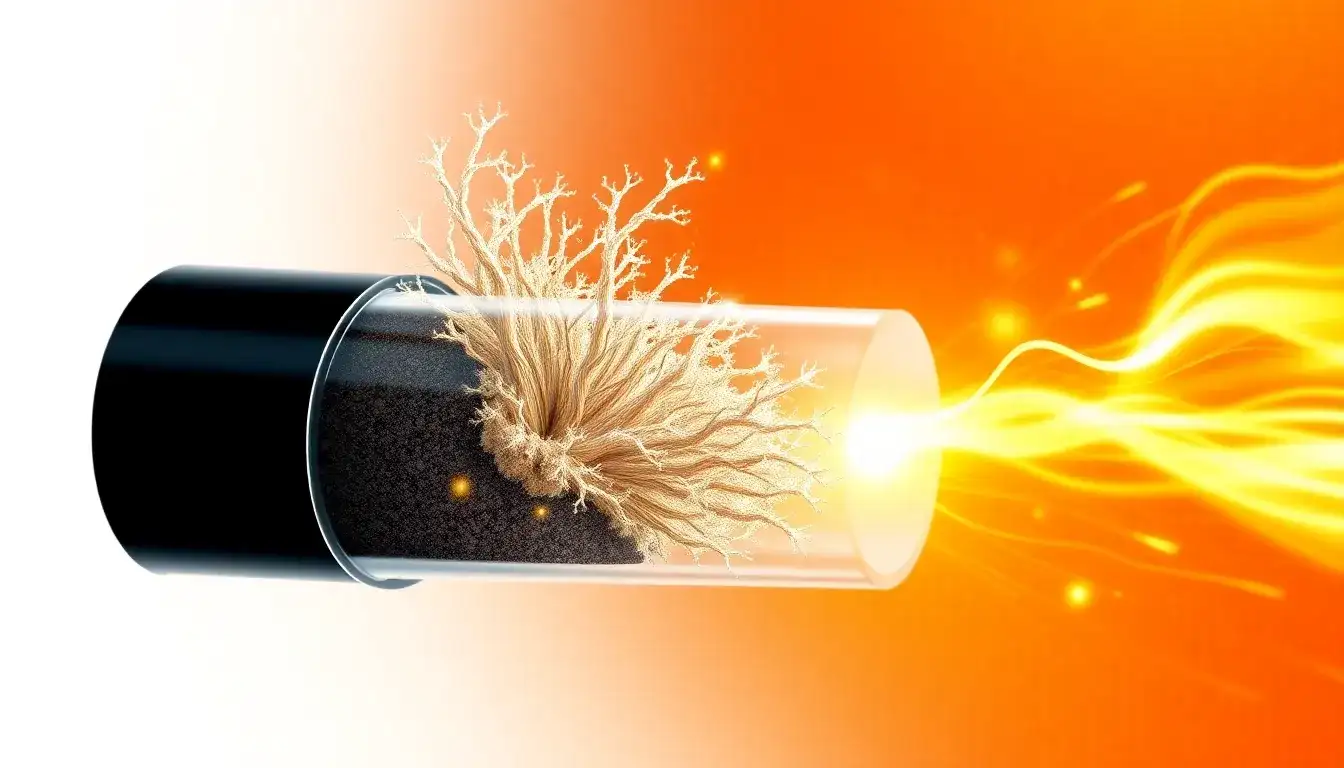
The formation of lithium dendrites in lithium-sulfur (Li-S) batteries significantly impacts their safety primarily due to the risk of internal short circuits. Lithium dendrites are tiny, needle-like structures that form when lithium ions deposit unevenly on the anode surface during battery charging. This inhomogeneous lithium plating leads to dendrite growth that can penetrate the electrolyte and reach the cathode, causing a short circuit and potentially leading to catastrophic battery failure such as fire or explosion.
Key aspects of how lithium dendrites affect Li-S battery safety include:
- Internal Short Circuits: As dendrites grow, they can pierce through the separator or solid-state electrolyte, creating a direct electrical pathway between the anode and cathode. This short circuit results in sudden voltage drops and may cause thermal runaway, a major safety hazard in batteries.
- Mechanical and Structural Instabilities: The growth mechanism of lithium dendrites is influenced by mechanical stresses, crystalline defects, and electrolyte properties. These factors combined cause local instabilities at the lithium/electrolyte interface, promoting dendrite formation and propagation. Even high mechanical strength electrolytes can be penetrated by dendrites along grain boundaries, undermining their protective role and posing safety risks.
- Impact on Battery Lifecycle and Performance: Beyond immediate safety concerns, dendrite growth compromises the solid electrolyte interphase (SEI) and overall battery integrity, leading to capacity loss, shorter cycle life, and eventual battery failure.
In Li-S batteries specifically, the use of solid electrolytes can help inhibit dendrite growth due to their mechanical strength and ability to suppress the polysulfide shuttle effect, but this is not a complete solution. Dendrites can still form within the bulk solid electrolyte and cause internal shorts, meaning safety challenges remain significant.
In summary, lithium dendrite formation threatens the safety of lithium-sulfur batteries by causing internal short circuits and mechanical damage that can lead to thermal runaway and battery failure. Advanced electrolyte materials and battery design strategies focus on preventing dendrite growth to enhance the safety and reliability of Li-S batteries.
Original article by NenPower, If reposted, please credit the source: https://nenpower.com/blog/how-does-the-formation-of-lithium-dendrites-impact-the-safety-of-lithium-sulfur-batteries/

