

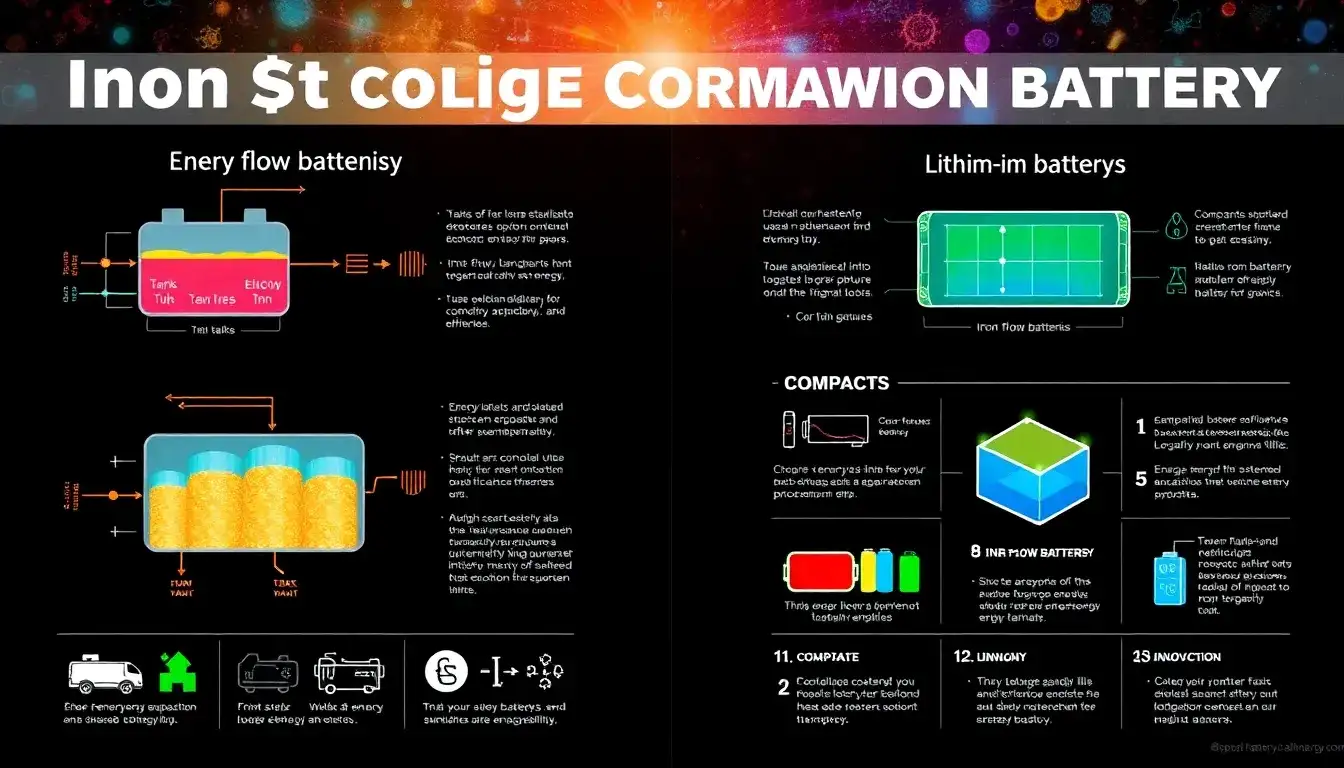
Energy Storage Capacity Comparison: Iron Flow Batteries vs. Lithium-Ion Batteries
Overview
Iron flow batteries and lithium-ion batteries are two distinct energy storage technologies, each with unique characteristics and applications. Here’s a comparison of their energy storage capacities:
Energy Density
- Lithium-Ion Batteries: These batteries have higher energy density compared to iron flow batteries. Typical lithium-ion batteries can store around 150-270 Wh/kg. This makes them suitable for portable electronics and electric vehicles where high energy density is crucial.
- Iron Flow Batteries: Iron flow batteries have lower energy density, typically around 9 Wh/L, as reported in some recent developments. However, they offer scalability and longer operational lifetimes, which can be advantageous in large-scale energy storage applications.
Scalability
- Lithium-Ion Batteries: As lithium-ion batteries increase in size, they become more expensive due to the need for more cathode material, which is costly. This limits their cost-effectiveness in large-scale applications.
- Iron Flow Batteries: These batteries are highly scalable. By simply increasing the size of the electrolyte tanks, their energy storage capacity can be significantly expanded without proportionally increasing the cost. This makes them suitable for large-scale energy storage, such as grid stabilization and renewable energy integration.
Duration of Storage
- Lithium-Ion Batteries: Suitable for short to medium duration energy storage, with typical applications in consumer electronics and electric vehicles.
- Iron Flow Batteries: Designed for long-duration energy storage, typically between 6 to 12 hours, which is ideal for integrating intermittent renewable energy sources into the grid.
Longevity
- Lithium-Ion Batteries: Generally have a lifecycle of about 10 years with around 10,000 charge/discharge cycles in stationary applications.
- Iron Flow Batteries: Offer a significantly longer design life of more than 25 years with unlimited cycling capability, minimizing capacity fade and operational maintenance costs.
In summary, while lithium-ion batteries have higher energy density and are suitable for portable applications, iron flow batteries excel in large-scale, long-duration energy storage due to their scalability and longevity. Iron flow batteries are particularly advantageous for grid-scale energy storage, where the ability to store energy over extended periods without significant degradation is crucial.
Original article by NenPower, If reposted, please credit the source: https://nenpower.com/blog/how-does-the-energy-storage-capacity-of-iron-flow-batteries-compare-to-lithium-ion-batteries/

