

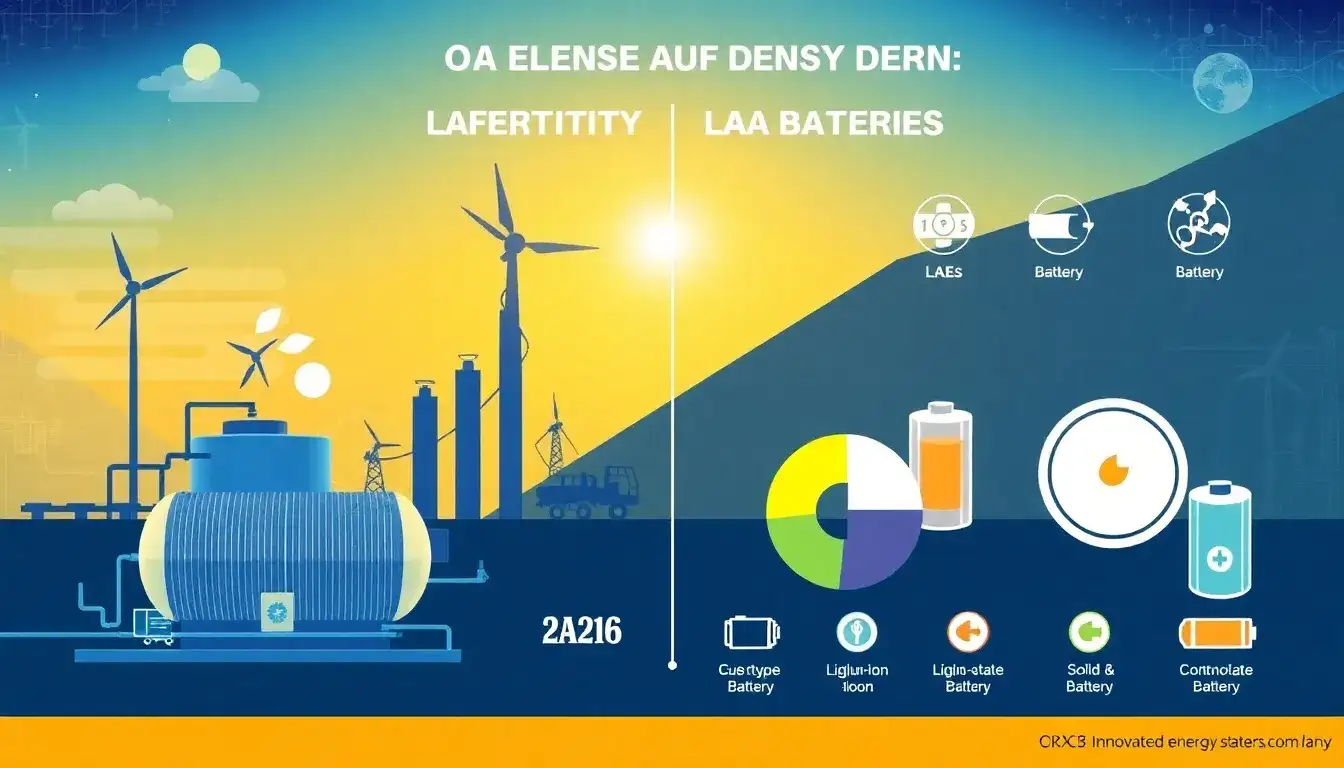
The energy density of Liquid Air Energy Storage (LAES) is comparable to that of batteries, particularly lithium-ion batteries, but there are important nuances:
- LAES energy density typically ranges around 107 kWh/m³ when heat recovery is incorporated, which is significantly higher than other mechanical storage methods like pumped hydro (0.28 kWh/m³) or compressed air storage (2–6 kWh/m³). This makes LAES a high energy density mechanical storage option.
- Lithium-ion batteries have an energy density of about 300 kWh/m³, roughly three times that of LAES with heat recovery, making batteries much more energy-dense on a volumetric basis.
- Despite lithium-ion batteries’ higher volumetric energy density and round-trip efficiencies above 90%, LAES offers other advantages such as the use of mature, low-cost, and long-lasting components that do not depend on scarce or toxic materials, and it is not geographically constrained like pumped hydro.
- LAES’s energy density is still considered high compared to many other grid-scale storage technologies and is sufficient to enable storage without requiring very large land areas.
In summary, while lithium-ion batteries have a higher energy density (~300 kWh/m³) compared to LAES (~107 kWh/m³ with heat recovery), LAES offers a competitive energy density relative to other mechanical storage methods and benefits from lower material constraints and geographic flexibility. This makes LAES a promising complementary technology for grid-scale energy storage despite its somewhat lower energy density and efficiency.
Original article by NenPower, If reposted, please credit the source: https://nenpower.com/blog/how-does-the-energy-density-of-laes-compare-to-that-of-batteries/

