

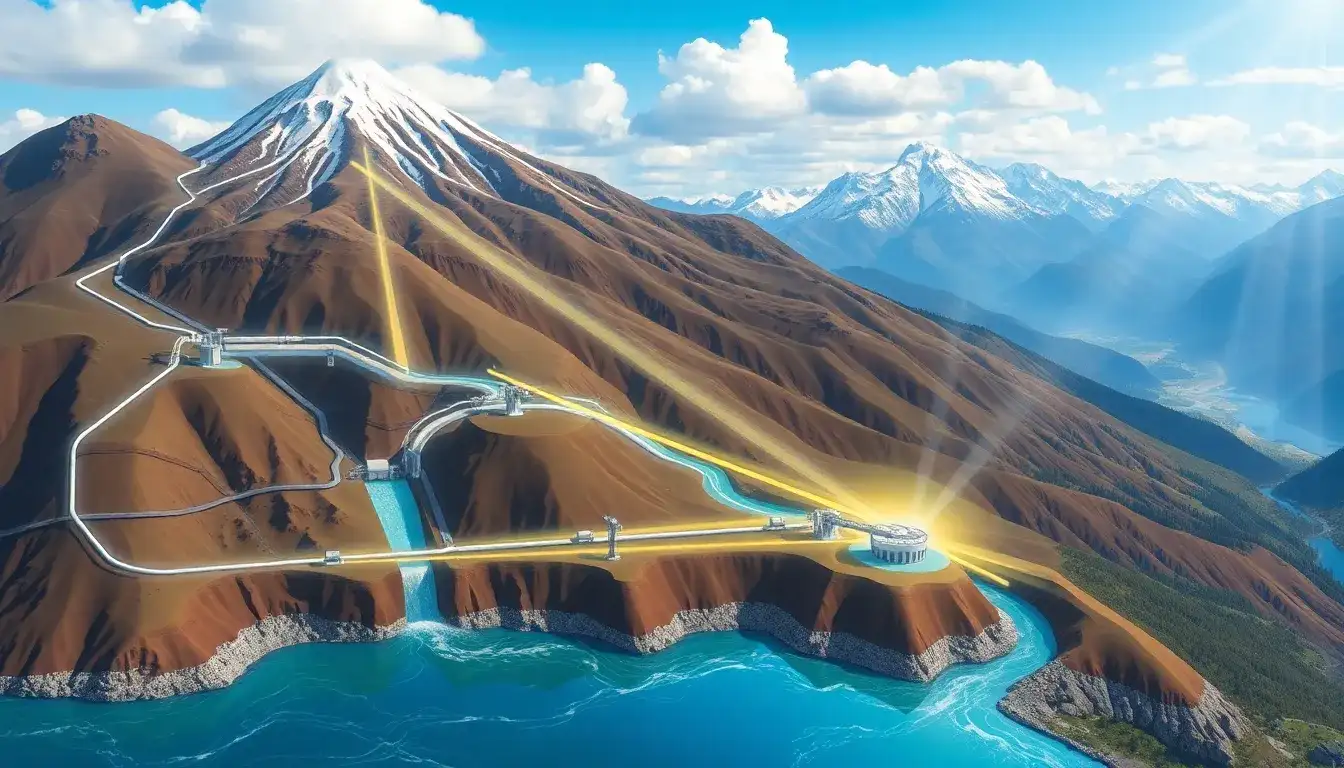
Impact of Elevation Difference on Pumped Hydroelectric Efficiency
- Energy Storage Capacity: The amount of energy a pumped storage hydropower (PSH) system can store depends largely on the size of the water reservoirs and the height difference between them. A greater elevation difference means more gravitational potential energy per unit volume of water, enabling more energy to be stored and later generated when water flows back down.
- Energy Density and System Size: Because pumped storage has relatively low energy density, achieving significant energy storage requires either large water flows or large elevation differences—or both. Larger height differences allow the system to store more energy with smaller reservoir volumes and smaller water conveyance infrastructure, improving project feasibility and reducing footprint and capital cost.
- Efficiency and Losses: While energy recovery efficiency of pumped hydro systems is typically 70–80% or more after accounting for conversion and evaporation losses, having a larger elevation difference generally enhances the overall system efficiency. This is because more energy is harnessed per unit of water moved, improving the energy return on the electricity used for pumping.
- Site Selection and Feasibility: The availability of adequate elevation difference is a key geographic and economic constraint. Some regions lack sites with sufficient hydraulic head to meet minimum criteria (e.g., 100–750 m hydraulic heads used in assessments). Without enough elevation difference, pumped storage may not be viable or efficient.
- Economic Considerations: Higher elevation differences can reduce the size and cost of reservoirs and water conveyance structures needed, potentially lowering capital expenditure. This contributes to pumped storage being the most cost-effective large-scale energy storage technology where appropriate elevation differences exist.
Summary Table
| Factor | Effect of Greater Elevation Difference |
|---|---|
| Energy stored per volume | Increases (more potential energy) |
| Reservoir size needed | Decreases (smaller reservoirs for same energy) |
| Infrastructure size (pipes) | Decreases |
| Energy recovery efficiency | Improves (more energy output relative to input energy) |
| Capital cost | Potentially lower due to smaller infrastructure |
| Site availability | Limited by natural geography; high-elevation sites preferred |
Overall, the elevation difference between reservoirs is a fundamental determinant of pumped hydro system efficiency, capacity, and economic viability. Larger elevation differences enable more efficient, compact, and cost-effective pumped storage solutions, making them critical parameters in design and site selection.
Original article by NenPower, If reposted, please credit the source: https://nenpower.com/blog/how-does-the-elevation-difference-affect-the-efficiency-of-pumped-hydroelectric-systems/

