

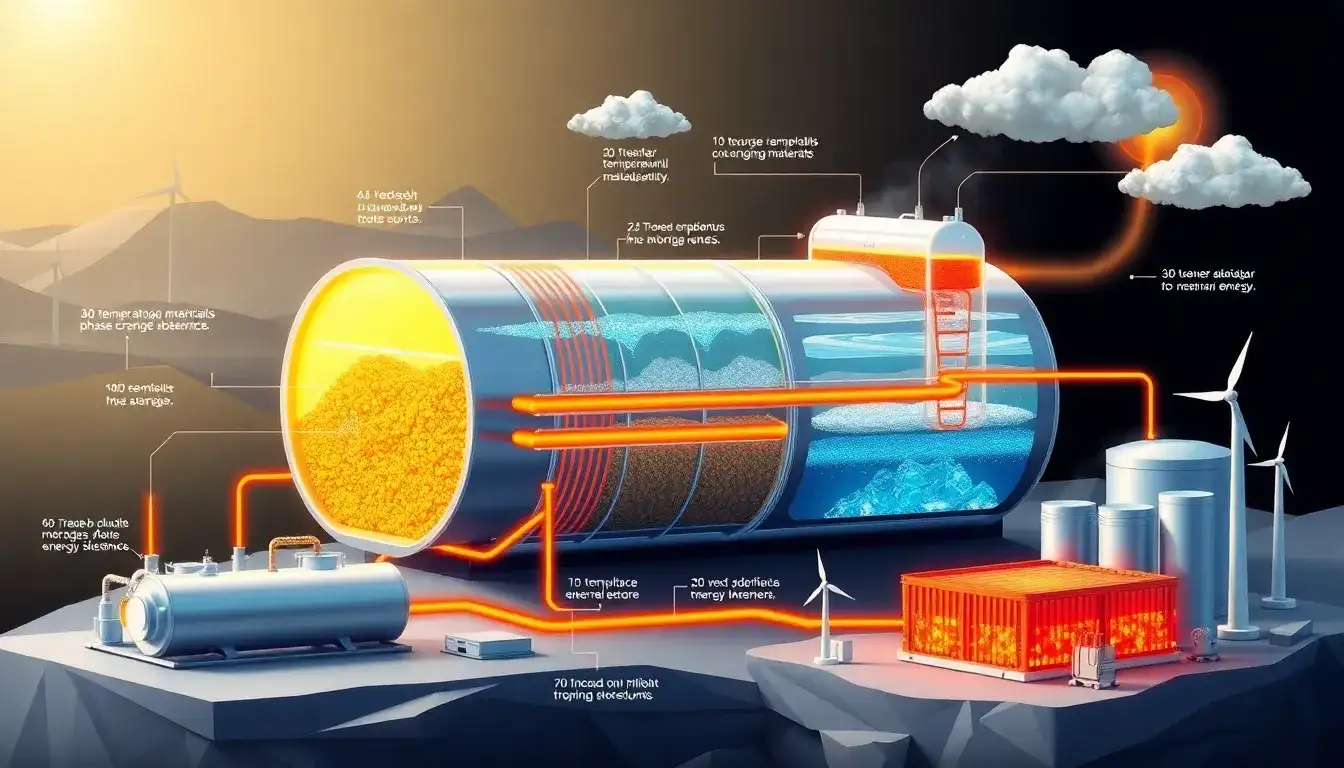
The efficiency of thermal energy storage (TES) systems varies significantly depending on the type of storage medium used—primarily sensible heat storage, latent heat storage (phase change materials), and thermochemical storage—with each offering different efficiency ranges, temperature capabilities, and applications.
Thermal Energy Storage Efficiency by Storage Medium
| Storage Medium | Typical Efficiency Range | Key Characteristics and Temperature Range | Notes on Efficiency Variation |
|---|---|---|---|
| Sensible Heat Storage | 50% to 90% | Stores heat by raising temperature of a medium (e.g., water, molten salts, sand, bricks). Can operate from near ambient to >1000°C depending on material. | Efficiency depends on insulation, heat exchanger design, and temperature losses. Materials like molten salts enable higher temps (up to ~600°C), sand/engineered bricks >1000°C but require stable containers at high temps. Lower efficiencies often due to heat loss and heat exchange losses. |
| Latent Heat Storage (Phase Change Materials, PCM) | 75% to 90% | Stores heat during phase changes (solid-liquid or solid-solid). Enables higher energy density than sensible heat, with narrow operating temperature ranges. Typically effective below 1000°C. | Higher efficiency due to isothermal storage during phase change, but limited temperature range and heat discharge rate. Suitable where temperature control is critical. |
| Thermochemical Storage (TCS) | 75% to nearly 100% | Stores heat via reversible chemical reactions. Higher energy density and can operate above 300°C. Potential for very high efficiencies with minimal thermal losses. | Still largely in development; efficiency can approach 100% theoretically. Offers long-term storage potential. |
Additional Insights on Efficiency Variation
- Sensible Heat Storage: Efficiency is influenced by the thermal properties of the storage material (specific heat capacity, thermal conductivity), insulation quality, and system design. For example, water has an energy density of about 10 kWh/m³ but with lower maximum temperatures, while advanced TES systems (using molten salts or particle beds) can reach ~100 kWh/m³ and operate at higher temps, improving efficiency in industrial heat applications.
- Advanced Particle-Based TES: Recent research, such as the KTH radial packed-bed system with hot air and pebbles or slags, achieves over 90% thermal efficiency by optimizing flow design and reducing pressure drops, which lowers parasitic power consumption during heat transfer.
- ThermalBattery™ Technology: A concrete-based sensible heat TES system achieves efficiencies exceeding 98%, highlighting that well-engineered sensible heat systems with optimal materials and integration can rival electrochemical battery efficiencies but with longer-duration discharge capabilities and greater robustness.
- Comparison to Electrochemical Batteries: While lithium-ion batteries boast charging/discharging efficiencies of 80-90%, thermal storage typically ranges lower (50-70% historically) but can reach over 90% in state-of-the-art designs and approaches nearly 100% in thermochemical systems.
Summary
- Sensible heat storage systems generally offer 50-90% efficiency depending on material and design, with advanced systems moving toward the higher end (~90%) at elevated temperatures.
- Latent heat storage improves efficiency to 75-90% by storing energy during phase change, though within a narrower temperature window.
- Thermochemical storage holds the promise of near 100% efficiency but is less mature commercially.
- Efficiency losses primarily stem from heat losses during storage and heat exchange, as well as parasitic energy used in circulating heat transfer fluids.
- Innovations in materials (e.g., molten salts, engineered sands, slags), system design (e.g., radial flow packed beds), and insulation are pushing TES efficiencies above 90%, making TES increasingly competitive with electrochemical storage technologies for long-duration and high-temperature applications.
Thus, the choice of storage medium critically influences the efficiency, temperature range, energy density, and cost-effectiveness of thermal energy storage systems, with ongoing advancements closing the efficiency gap between thermal and electrochemical energy storage.
Original article by NenPower, If reposted, please credit the source: https://nenpower.com/blog/how-does-the-efficiency-of-thermal-energy-storage-systems-vary-with-different-storage-media-2/

