

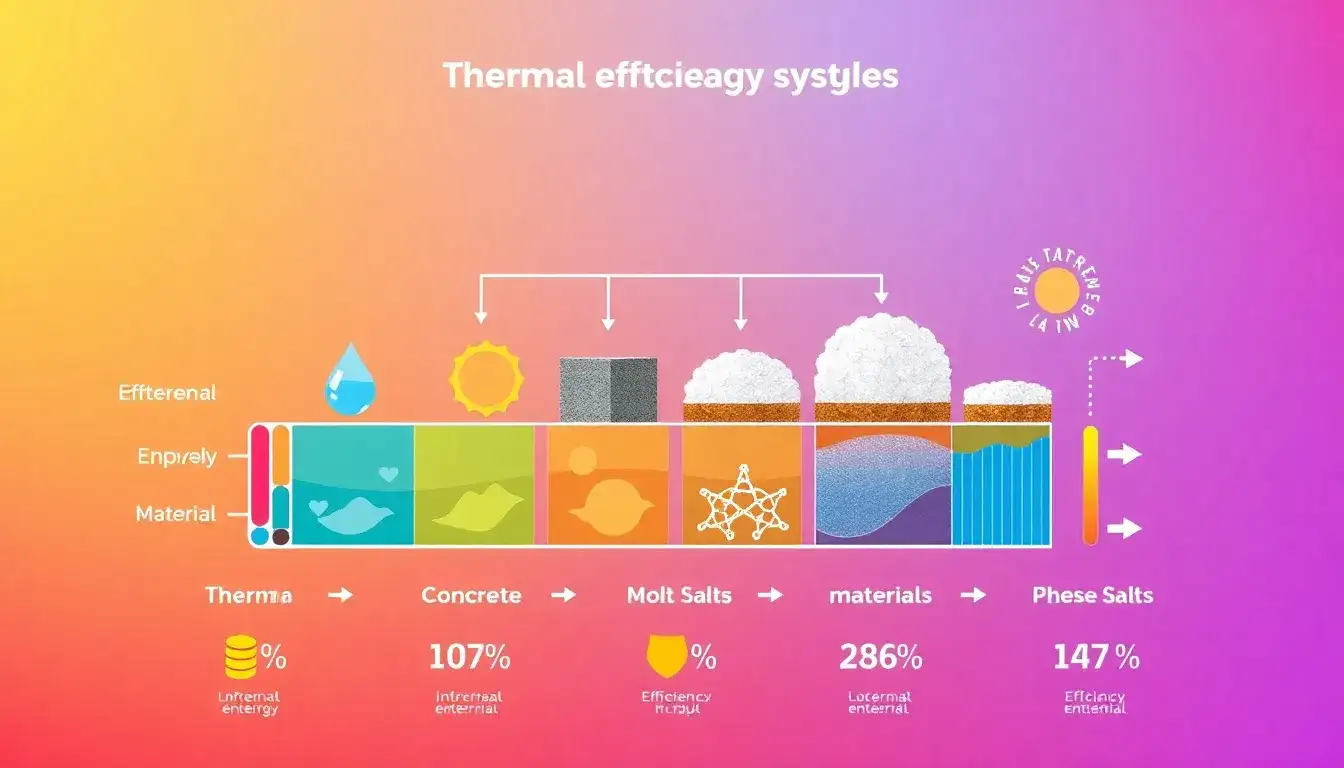
The efficiency of thermal energy storage (TES) systems varies significantly depending on the materials used due to differences in their thermal properties, storage capacity, stability, and cost. Key aspects influencing efficiency include thermal conductivity, heat capacity, operating temperature range, and physical and chemical stability.
Efficiency Variation with Different Materials
1. Sensible Heat Storage Materials
- These materials store energy by increasing their temperature. Common examples include water, sand, rocks, molten salt, concrete, and metals.
- Water tanks are inexpensive and widely used but limited to lower temperature ranges (around 100°C).
- Molten salts and metals can operate at much higher temperatures (e.g., molten salts ~600°C), storing more energy with better efficiency due to higher operating temperatures and thermal capacity.
- Materials like volcanic rock, minerals, ceramics, and concrete offer good stability and cost-effectiveness but vary in thermal conductivity and capacity.
2. Phase Change Materials (PCMs)
- PCMs store energy during phase transitions (e.g., melting/freezing), offering high energy storage density with a stable temperature during storage, which enhances efficiency.
- They tend to balance thermal conductivity and heat storage capacity effectively, reducing heat loss and allowing controlled energy release.
- Their overall performance depends on latent heat of the phase change and thermal conductivity, which can be enhanced with additives or composites.
3. High-Temperature Materials
- Solid or molten silicon can store more than 1 MWh/m³ at very high temperatures (~1400°C), leading to much higher storage capacity and efficiency compared to salts. Silicon is also abundant and potentially cost-effective for large-scale TES.
- Molten aluminum storage, operating around 600°C, allows efficient heat transport and is coupled with Stirling engines for power generation. Its recycled nature adds sustainability benefits.
4. Oils
- Various oils (mineral, synthetic, vegetable) are used for medium- to high-temperature storage due to high specific heat capacity and chemical stability.
- The choice of oil impacts the system’s thermal efficiency, longevity, and cost. For instance, oils with higher thermal stability reduce replacement frequency, improving long-term efficiency and reducing costs.
5. Innovative Materials and Approaches
- Researchers have developed thermal storage systems using pebbles or industrial waste like copper slags that show good thermal and mechanical properties, achieving over 90% efficiency.
- These materials combine stable heat retention with scalability and practicality for industrial use, emphasizing the role of material choice in optimizing TES efficiency.
Material Properties Affecting Efficiency
| Material Type | Thermal Conductivity | Storage Temperature Range | Energy Storage Density | Stability & Cost | Efficiency Considerations |
|---|---|---|---|---|---|
| Water | Moderate (~0.6 W/mK) | Up to ~100°C | Moderate (~4.2 MJ/kg·K) | Very low cost, safe, but limited temp range | Efficient at low temps but limited for high-temp |
| Molten Salt | Moderate to high (~0.5-2 W/mK) | ~250-600°C | High | Low cost, corrosive, chemical stability issues | High efficiency at elevated temps, good storage capacity |
| Silicon (solid/molten) | High (~100 W/mK in solid form) | Up to ~1400°C | Very high (>1 MWh/m³) | Abundant, advanced tech required | High efficiency due to high temp and capacity |
| Molten Aluminum | High (~200 W/mK in solid form) | ~600°C | High | Sustainable via recycling | Efficient heat transport, coupled with power conversion |
| Oils | Low to moderate (~0.1-0.2 W/mK) | Medium to high (~250-400°C) | Moderate to high | Variable cost, depends on stability | Efficient for medium-high temp; stability crucial for cost efficiency |
| Rocks, ceramics, slags | Low to moderate (~0.5-2 W/mK) | Wide (depends on material) | Moderate | Low cost, durable | Efficient for sensible heat storage, scalable |
| Phase Change Materials | Variable (often low) | Depends on phase change | Very high (due to latent heat) | Variable cost, complex handling | Balance conductivity with storage capacity needed |
Summary
The efficiency of TES systems is highly dependent on the storage material:
- Higher storage temperatures and heat capacities improve overall efficiency, as seen with molten salts, molten silicon, and molten aluminum.
- Materials with higher thermal conductivity enable faster charging and discharging rates but may be more expensive.
- Stable, safe, and inexpensive materials like water or rock are efficient for low-temperature and long-duration storage but less effective in high-temperature, high-capacity applications.
- Advanced materials such as silicon and innovative uses of industrial waste show promise for very high-efficiency TES systems.
- Phase change materials offer efficient energy density with controlled temperature storage but need optimized thermal conductivity.
Choosing the most suitable TES material involves balancing these factors based on the specific application, temperature requirements, cost, and desired efficiency outcomes.
Original article by NenPower, If reposted, please credit the source: https://nenpower.com/blog/how-does-the-efficiency-of-thermal-energy-storage-systems-vary-with-different-materials/

