

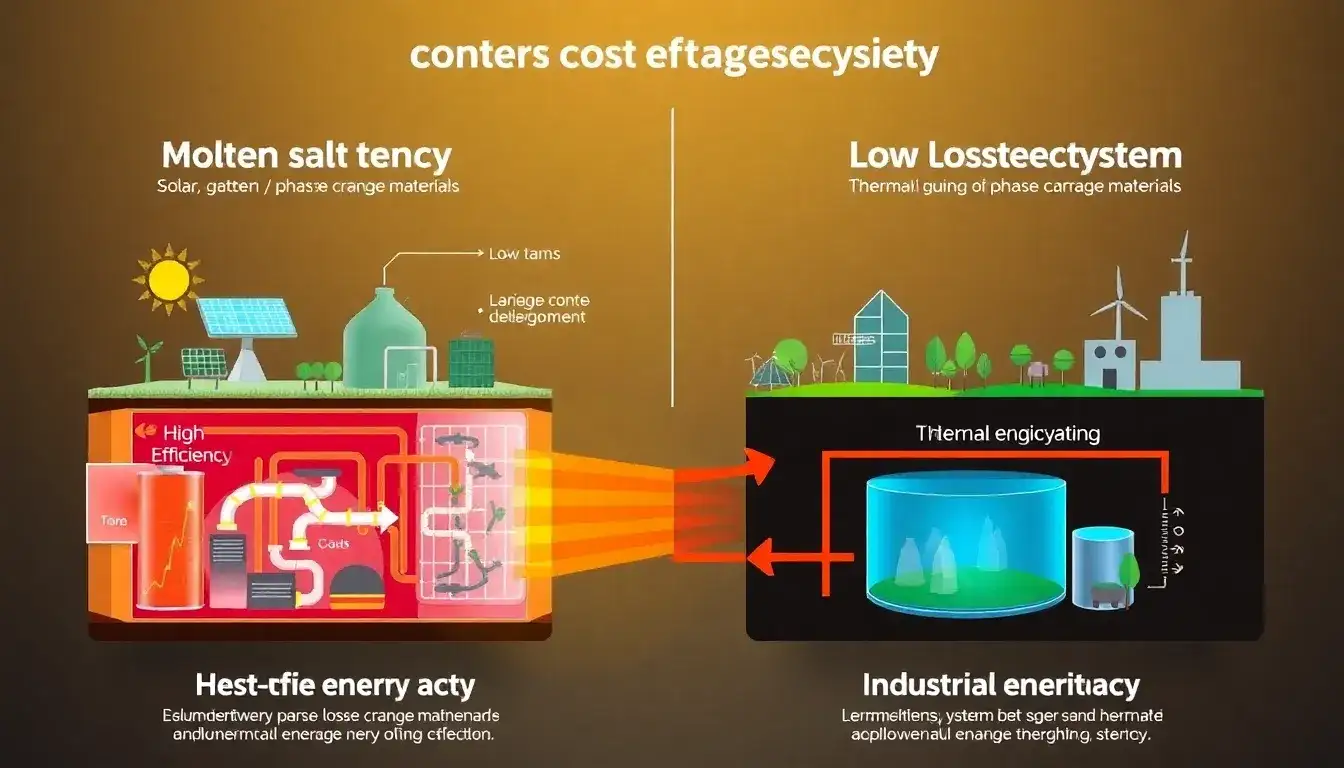
Efficiency and Cost-Effectiveness
- Energy Loss and Storage Capacity: Efficient TES systems minimize heat loss during storage, which directly influences the amount of energy that can be stored and released. Lower heat loss means that less energy is wasted, and more is available when needed, making the system more cost-effective.
- Material Selection and Performance: Materials with high thermal conductivity or suitable phase-change properties (such as melting points near room temperature) can enhance efficiency by facilitating rapid and effective energy transfer. Developing cost-effective materials with these characteristics is crucial for reducing overall costs.
- Operational Flexibility and Reliability: Efficient systems allow for better integration with renewable energy sources by providing flexibility in when energy is stored and released. This flexibility helps manage peak energy demand, reducing potential grid outages and enhancing the stability of energy supply.
- Scale and Longevity: Efficient TES systems can be scaled up or down depending on needs, offering cost savings by allowing users to choose the most suitable size for their requirements. They can also operate over long durations without significant performance degradation, further improving cost-effectiveness.
- Comparison with Other Technologies: Unlike electrochemical batteries, thermal energy storage can offer higher efficiency for longer-duration storage, especially in industrial and building applications. This makes TES more cost-effective for applications where high energy density is not the primary concern.
Examples of Efficient TES Technologies
- Particle Thermal Energy Storage: This technology, such as NREL’s ENDURING system, uses inexpensive materials like silica sand, providing a low-cost, scalable solution for storing thermal energy.
- High-Efficiency Pebble Storage: KTH’s radial packed-bed design achieves over 90% efficiency, reducing power consumption and increasing the potential for market uptake due to its high efficiency and cost-effectiveness.
Future Prospects
- Cost Reduction: Efficiency improvements and advancements in materials are expected to reduce costs further. Industrial applications may see cost reductions of about 30% by 2030, according to projections.
- Decarbonization Goals: Efficient TES systems play a crucial role in decarbonizing industries and buildings by enabling the use of renewable energy sources more effectively.
In summary, the efficiency of TES systems directly impacts their cost-effectiveness by influencing energy loss, material selection, operational flexibility, and scalability. As technology advances, we can expect to see more cost-effective and efficient TES solutions.
Original article by NenPower, If reposted, please credit the source: https://nenpower.com/blog/how-does-the-efficiency-of-thermal-energy-storage-systems-impact-their-overall-cost-effectiveness/

