

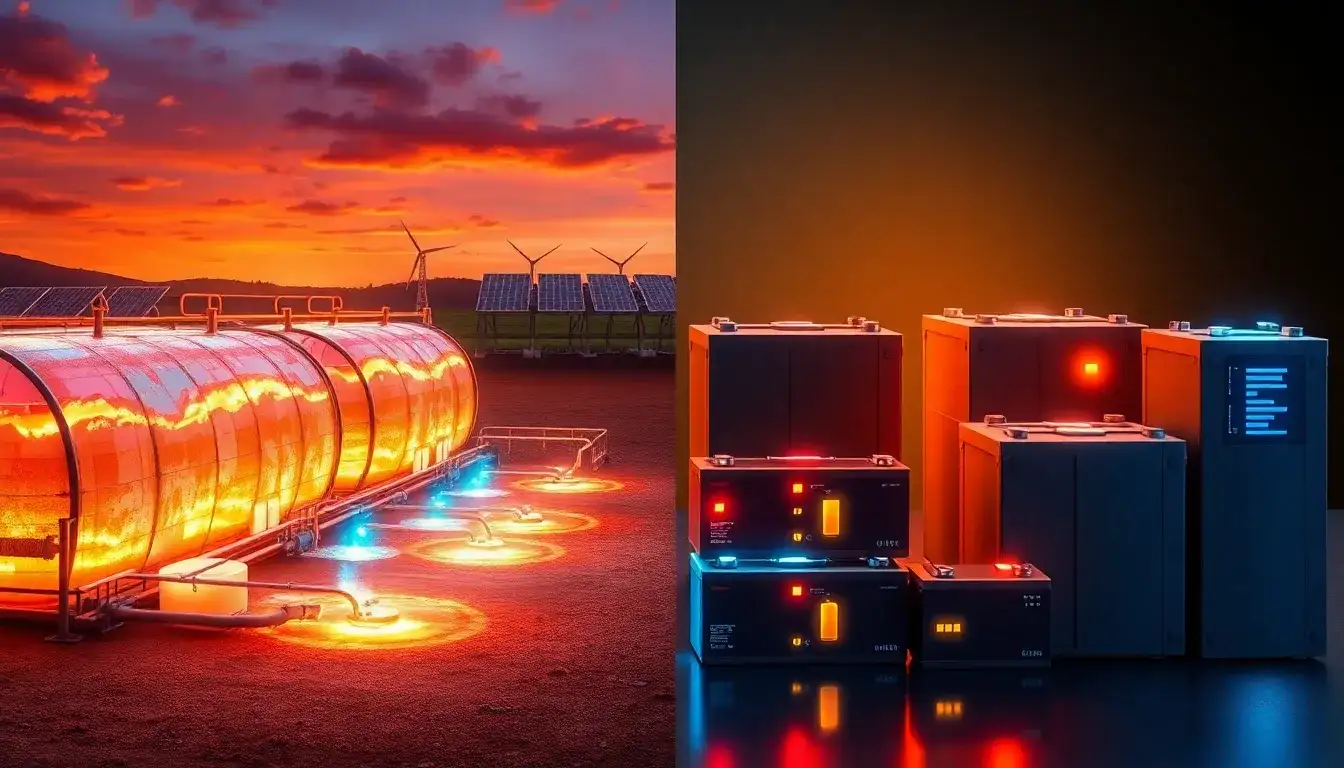
Efficiency Comparison
- Thermal Energy Storage Efficiency
Thermal energy storage systems can achieve efficiencies ranging widely depending on the technology type. Sensible heat TES typically offers efficiencies between 50% and 90%, while advanced phase change materials (PCM)-based systems and thermochemical storage can reach efficiencies up to nearly 100% under ideal conditions. For example, a recent refined thermal storage technology developed by KTH achieves over 90% thermal efficiency at high temperatures (up to 800°C) by using hot air passed through packed beds of pebbles or slags, and further design innovations have reduced parasitic losses, improving practical efficiency. - Battery Storage Efficiency
Battery systems, particularly lithium-ion batteries, have electrical round-trip efficiencies typically around 85% to 95%, meaning most of the stored electrical energy can be retrieved as electricity. Batteries are very efficient at storing and releasing electricity but generally are economically viable only for short to medium duration storage (a few hours).
Key Differences and Context of Use
- Storage Duration and Energy Type
TES is well-suited for long-duration storage—ranging from hours to days, or even seasonal storage—because it can hold thermal energy with minimal losses over extended periods. This makes TES particularly advantageous for applications where heat is the end-use product (e.g., industrial processes, building heating, or concentrated solar power plants) or where long-term storage is needed. Batteries are generally preferred when the required output is electricity directly and for shorter durations. - Cost and Scalability
TES systems, especially those utilizing abundant and inexpensive materials (water, rocks, molten salts, phase change materials, or waste slags), are often more cost-effective per unit of stored energy for large-scale and long-term applications compared to batteries. Batteries are more expensive at large scales for long-duration storage but have a smaller footprint and faster response times. - Energy Density
Batteries have a higher energy density for electrical storage compared to sensible heat TES. However, certain TES methods using phase change or thermochemical reactions can improve storage density and efficiency, narrowing the gap for specific use cases.
Summary Table
| Aspect | Thermal Energy Storage (TES) | Battery Storage |
|---|---|---|
| Typical Efficiency | 50% to 90% (sensible heat); up to ~100% (thermochemical) | 85% to 95% (lithium-ion, electrical) |
| Duration | Hours to months (including seasonal storage) | Hours (typically) |
| Energy Form Stored | Thermal (heat or cold) | Electrical |
| Cost-Effectiveness | More cost-effective for large, long-duration storage | Cost-effective for short duration & power-dense use |
| Applications | Industrial heat, building heating, CSP power generation, seasonal heating/cooling | Grid balancing, load shifting, electric vehicles |
| Energy Density | Lower (varies by material and method) | Higher (per volume/weight) |
Conclusion
Thermal energy storage systems, especially advanced designs such as those using packed beds with high-temperature air or phase change materials, can achieve very high thermal efficiencies (over 90%) and are ideal for long-duration, large-scale heat storage at relatively low cost. Batteries provide high round-trip electrical efficiencies (up to 95%) suited for shorter duration electrical energy storage with fast response. The choice between TES and battery storage depends primarily on the form of energy needed (heat vs. electricity), duration of storage, scale, and cost considerations.
Original article by NenPower, If reposted, please credit the source: https://nenpower.com/blog/how-does-the-efficiency-of-thermal-energy-storage-systems-compare-to-battery-storage/

