

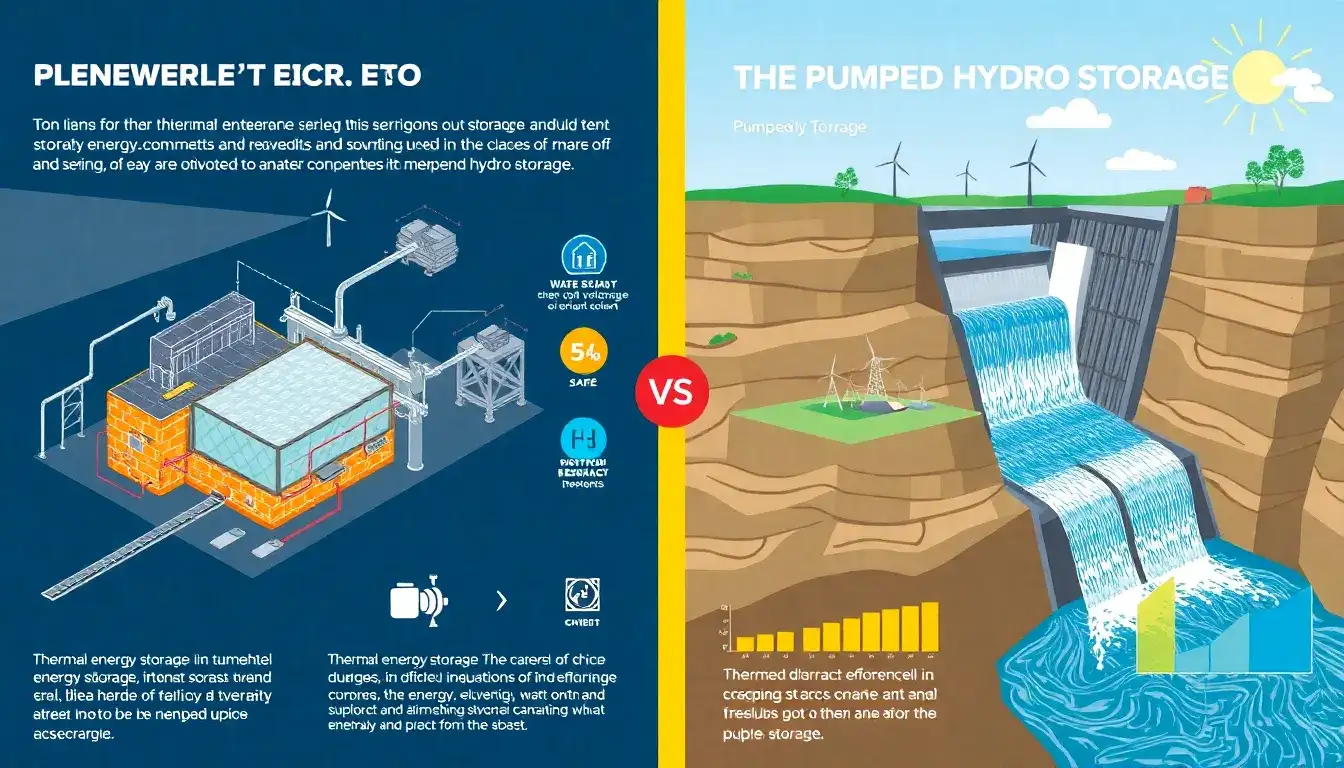
Thermal energy storage (TES) and pumped hydro power are both important energy storage technologies, but they differ significantly in efficiency and application.
Efficiency of Thermal Energy Storage
- TES systems generally operate with efficiencies ranging from about 50% to over 90%, depending on the specific technology and medium used. For example, sensible heat storage typically has efficiencies between 50% and 90%.
- Advanced TES technologies, such as molten salt storage or radial flow packed-bed systems using hot air and pebble layers, have demonstrated thermal efficiencies exceeding 90% in lab tests.
- Thermochemical storage variants of TES can approach efficiencies close to 100%, though these are less common and still under development.
- TES is particularly valuable for storing heat for long durations, seasonal storage, and can store energy without significant losses when properly insulated (e.g., molten salts stored at room temperature).
- TES efficiencies reflect the ratio of heat recovered to heat stored, and the system’s effectiveness depends on thermal insulation, heat exchanger design, and the temperature range.
Efficiency of Pumped Hydro Power
- Though the search results do not explicitly provide pumped hydro efficiency, it is well-established from wider knowledge that pumped hydro power typically achieves round-trip efficiencies around 70% to 85%.
- Pumped hydro stores energy by pumping water uphill into a reservoir when excess electricity is available, then releasing it through turbines to generate electricity when needed.
- It is currently the most widely deployed form of large-scale energy storage due to its proven technology and ability to store energy for long durations, sometimes spanning hours to days.
Comparison Summary
| Feature | Thermal Energy Storage (TES) | Pumped Hydro Power |
|---|---|---|
| Typical Efficiency Range | 50% – 90% (can exceed 90% in advanced TES) | 70% – 85% |
| Type of Energy Stored | Thermal energy (heat) | Electrical energy (potential energy in water) |
| Storage Duration | Short-term to seasonal | Hours to days |
| Applications | Industrial heat, electricity generation (with power cycle), space heating, cooling | Grid-scale electricity storage and grid balancing |
| Mobility | Some forms can be transported (e.g., dehydrated salt) | Stationary, site-dependent (requires geographic features) |
| Energy Loss over Time | Minimal in well-insulated long-term TES | Minimal in reservoir storage but some due to evaporation |
In conclusion, advanced thermal energy storage technologies can reach efficiencies comparable to or even exceeding typical pumped hydro efficiencies, particularly when used for heat storage and industrial applications. However, pumped hydro remains more efficient for direct electrical energy storage and large-scale grid balancing. TES offers flexibility for storing thermal energy over longer periods and is crucial for integrating variable renewables in thermal applications, while pumped hydro excels in electricity grid storage with proven scalability.
Original article by NenPower, If reposted, please credit the source: https://nenpower.com/blog/how-does-the-efficiency-of-thermal-energy-storage-compare-to-pumped-hydro-power/

