

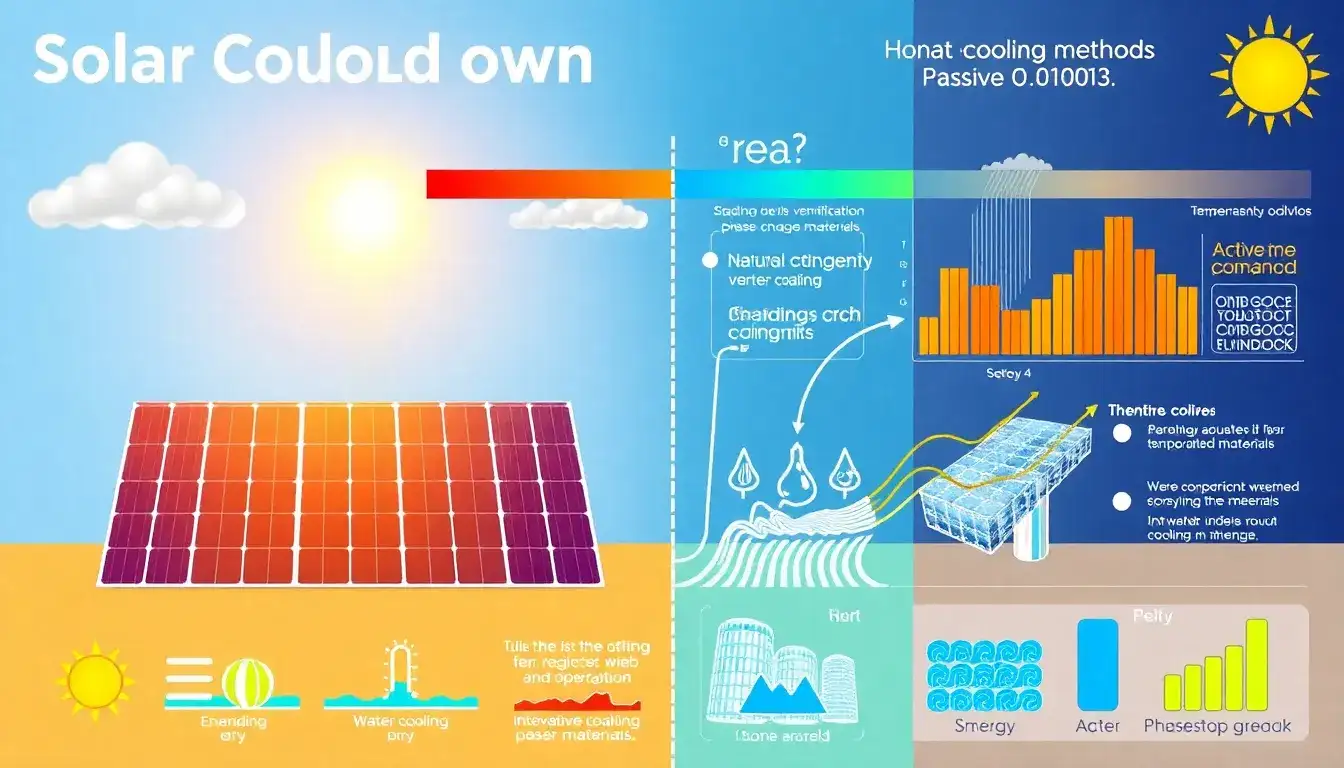
Cooling Methods and Their Impact on Solar Panel Efficiency
1. Passive Cooling Methods
These rely on natural heat dissipation without extra energy input:
- Reflective Coatings: Reflect sunlight to reduce heat absorption, lowering panel temperature by about 5°C and improving efficiency by around 8% during peak sun hours.
- Natural Air Cooling / Ventilation: Elevating panels to allow airflow underneath or using slotted mounts and tilted installations can reduce temperature by 2–4°C, boosting energy output by approximately 5–10% depending on wind conditions.
- Heat Sinks and Fins: Passive heat sinks improve radiative cooling and maintain more uniform temperatures, though efficiency gain is modest compared to active methods.
- Phase Change Materials (PCM): PCMs absorb excess heat and maintain panel temperature closer to 25°C during peak hours, resulting in improved efficiency, especially in summer. Combining PCMs with additives like nanoparticles or porous metals can further enhance heat transfer, but more research is ongoing.
Efficiency Gains: Typically passive methods can increase solar panel efficiency by a small percentage, often less than 10%, but with low cost and maintenance.
2. Active Cooling Methods
These use mechanical or electrical devices to enhance cooling, requiring additional energy input:
- Forced Air Cooling: Using fans or blowers to force airflow around or behind panels can reduce temperature by about 10–13°C, improving electrical efficiency by up to 20%. However, the power consumed by fans slightly reduces net energy gain.
- Water Cooling / Spraying Systems: Water cooling is often more effective than air due to water’s higher thermal conductivity. Spraying water can reduce panel temperature by 10–20°C, increasing energy production by up to 15–20%. Large solar farms, such as those in India, use automated water spraying to minimize efficiency loss during peak heat (which can be as high as 17% without cooling).
- Photovoltaic-Thermal (PV/T) Systems: These combine photovoltaic cells with thermal collectors using forced water or air cooling to simultaneously generate electricity and capture heat. They can achieve conversion efficiencies between 40% and 80%, higher than standalone PV panels.
Efficiency Gains: Active cooling can increase power output significantly, from 15% up to 20% or more, depending on the system and conditions, but with higher installation, operation, and maintenance costs.
3. Integrated and Advanced Cooling Techniques
- Evaporative Cooling: Using evaporative effects of sprayed water to absorb heat and cool panels by 10–15°C, particularly effective in arid climates.
- Heat Pipes and Immersion Cooling: Technologies like heat pipe cooling dissipate heat efficiently and maintain uniform temperature distribution, improving performance with minimal energy consumption.
- Hybrid Systems: Combining air and water cooling, or integrating PCM with nanofluids and heat pipes, can further improve heat transfer and efficiency, especially for large-scale solar farms.
Summary Table of Cooling Methods and Efficiency Impact
| Cooling Method | Typical Temperature Reduction | Efficiency Increase (%) | Notes |
|---|---|---|---|
| Reflective Coatings | ~5°C | ~8% | Passive, low cost, reflects sunlight |
| Natural Air Cooling | 2–4°C | 5–10% | Passive, uses elevation and ventilation |
| Heat Sinks / Fins | Modest | Small | Passive, enhances radiative heat dissipation |
| Phase Change Materials | Maintains ~25°C | Moderate (seasonal) | Passive, absorbs heat over time |
| Forced Air Cooling | ~10–13°C | Up to 20% | Active, requires fan power |
| Water Cooling / Spraying | 10–20°C | 15–20% | Active, highly effective, also cleans panels |
| PV/T Systems | Variable | 40–80% (combined) | Active, combines electrical and thermal conversion |
| Evaporative Cooling | 10–15°C | Moderate | Active/passive hybrid, works best in dry areas |
| Heat Pipes / Immersion | Efficient | Moderate | Passive to active, uniform temperature control |
Conclusion
- Passive cooling methods are economical and can improve efficiency by up to about 10%, suitable for most installations.
- Active cooling methods, especially water cooling and forced airflow, can increase solar panel efficiency by 15–20% or more but require additional energy and investment.
- For large-scale or high-performance solar installations, integrating multiple cooling methods (e.g., water cooling combined with PCMs or heat pipes) can maximize efficiency gains and energy yield, sometimes boosting output by up to 20% or more during hot conditions.
Choosing the optimal cooling method depends on factors like climate, system scale, initial investment, maintenance capacity, and desired efficiency improvements.
Original article by NenPower, If reposted, please credit the source: https://nenpower.com/blog/how-does-the-efficiency-of-solar-panels-change-with-different-cooling-methods/

