

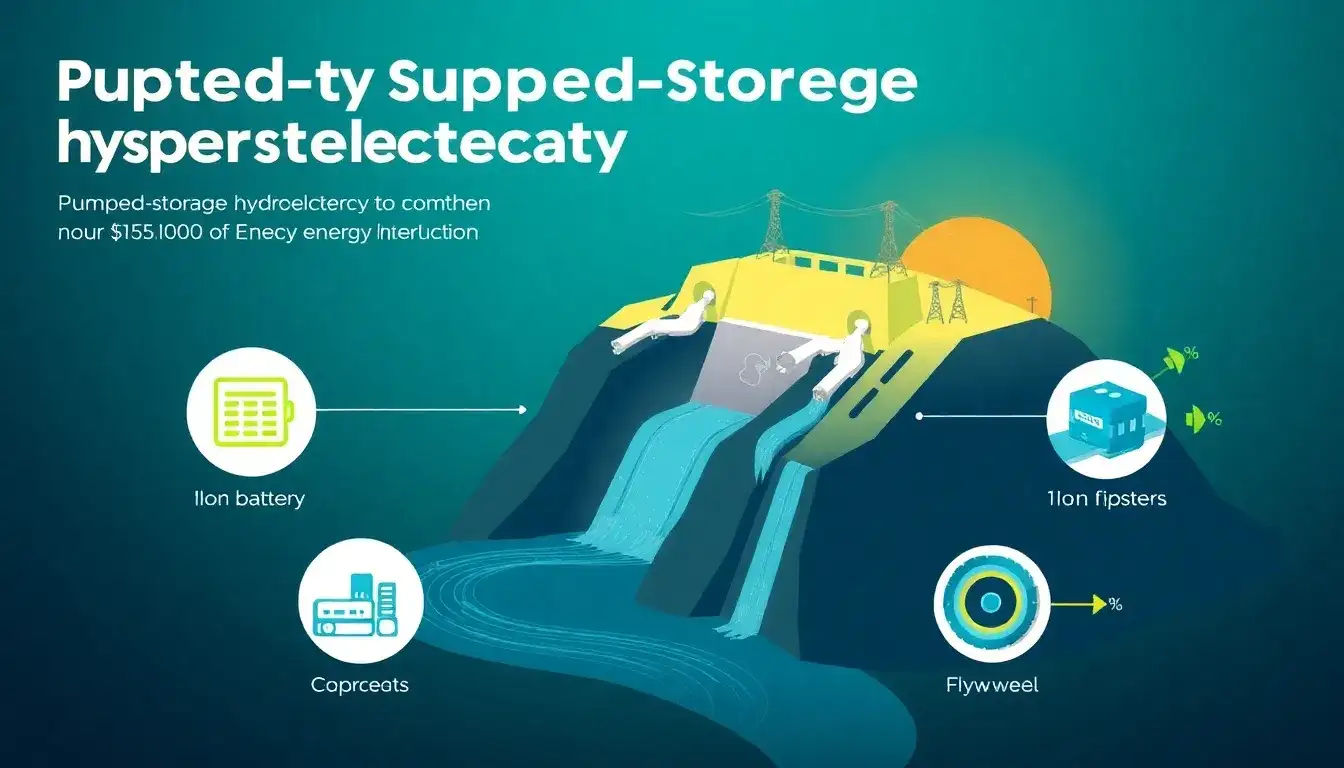
Efficiency Comparison: Pumped-Storage Hydroelectricity vs. Other Energy Storage Methods
Pumped-storage hydroelectricity (PSH) is one of the most efficient and widely used large-scale energy storage technologies worldwide. Here’s how its efficiency compares to other energy storage methods:
Pumped-Storage Hydroelectricity (PSH)
- Efficiency: The round-trip efficiency of PSH ranges from 70% to 80%, meaning that about 20% to 30% of the energy used to pump water is lost during the process.
- Capacity: PSH is the largest-capacity form of grid energy storage globally, accounting for over 95% of all active storage installations as of 2020.
- Role: It plays a crucial role in stabilizing power grids by storing excess energy during low-demand periods and releasing it during peak demand.
Other Energy Storage Methods:
- Utility-Scale Batteries: These have a slightly higher round-trip efficiency, typically around 82%. However, they generally operate at lower utilization factors compared to PSH.
- Compressed Air Energy Storage (CAES): The efficiency of CAES systems ranges from 60% to 65%, which is lower than PSH.
- Hydrogen Storage: This method involves converting electricity into hydrogen gas, which is then stored. However, it has a lower efficiency, typically ranging from 40% to 60% due to the energy-intensive process of hydrogen production and conversion.
- Flow Batteries: Their efficiency varies but is generally around 70% to 80%, similar to PSH. However, they are typically less cost-effective for large-scale storage.
Key Points:
- PSH offers high capacity but requires specific geographical conditions.
- Utility-Scale Batteries provide slightly higher efficiency but are less mature in terms of widespread deployment.
- Compressed Air and Hydrogen systems are less efficient and more complex.
- Flow Batteries have similar efficiency to PSH but are less cost-effective on a large scale.
Overall, PSH remains the most significant means of large-scale energy storage due to its high capacity and widespread deployment, despite batteries offering slightly better efficiency.
Original article by NenPower, If reposted, please credit the source: https://nenpower.com/blog/how-does-the-efficiency-of-pumped-storage-hydroelectricity-compare-to-other-energy-storage-methods/

