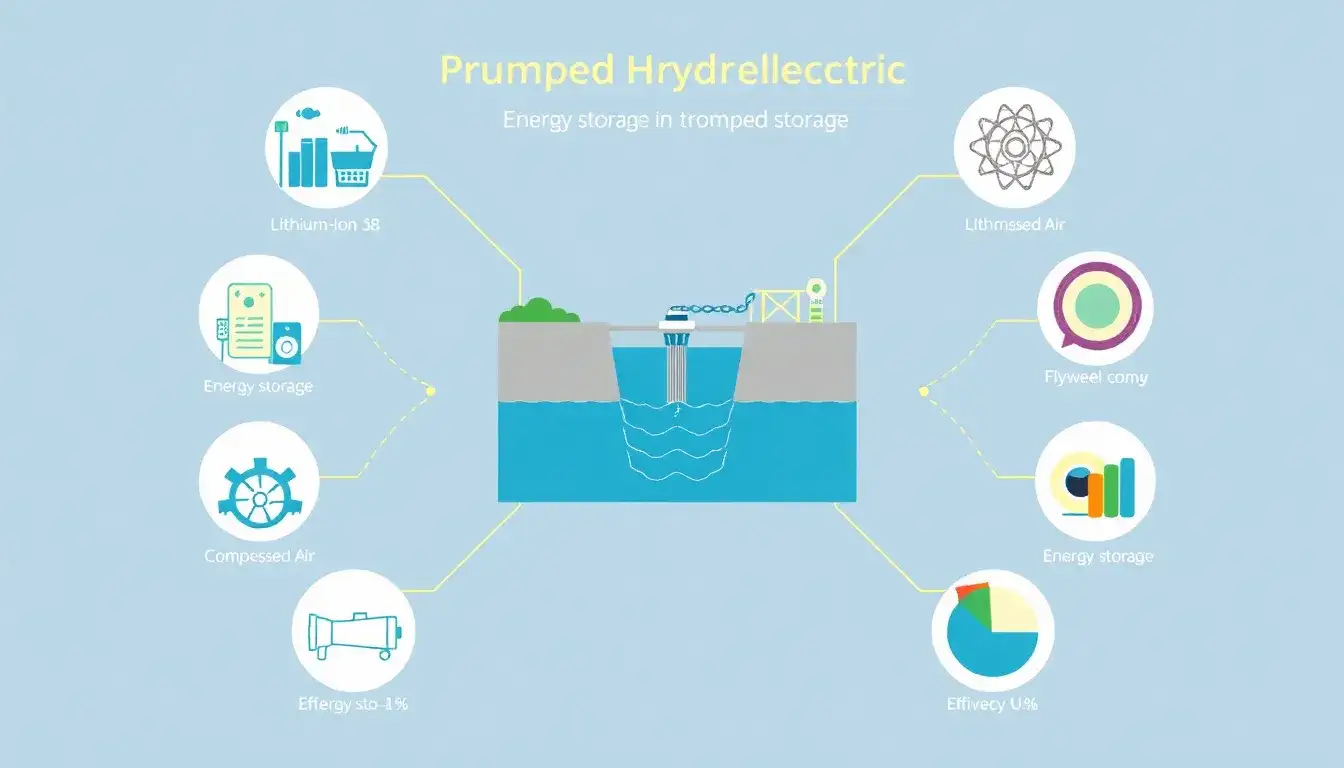
Pumped hydroelectric energy storage (PHES) generally exhibits a high efficiency compared to many other energy storage technologies, with round-trip efficiencies typically ranging between 70% and 80%, and often cited as over 80% in some sources. This means that 70 to 80 percent of the electricity used to pump water to the upper reservoir can be recovered when the water is released to generate power.
Efficiency Comparison with Other Energy Storage Technologies
| Energy Storage Technology | Round-Trip Efficiency | Typical Duration of Discharge | Remarks |
|---|---|---|---|
| Pumped hydroelectric storage | 70% – 80% (up to 80%+) | Typically up to 10 hours | Largest-capacity grid storage, long duration, cost-effective for bulk energy storage |
| Lithium-ion batteries | 85% – 95% | Around 4 to 6 hours | Higher efficiency than pumped hydro but shorter duration and higher costs per kWh stored |
| Compressed air energy storage | 40% – 70% | Several hours | Lower efficiency than pumped hydro, site-specific requirements |
| Flow batteries | 65% – 75% | Can be scaled for long duration | Comparable, but less mature and less deployed than PHES |
Key Points:
- Pumped hydro storage is the dominant form of grid-scale energy storage worldwide, accounting for roughly 95% of active storage installations, with a total installed capacity over 1.6 TWh.
- While lithium-ion batteries generally have higher round-trip efficiencies (often 85%–95%), pumped hydro offers much greater energy storage capacity and longer discharge durations (up to 10 hours or more versus about 6 hours for lithium-ion). This makes pumped hydro preferable for large-scale, long-duration applications.
- Pumped hydro storage also improves grid stability by providing power on demand and can be economically advantageous due to lower costs per unit of stored energy compared to batteries and other technologies. For example, some studies predict significant savings in national energy systems from pumped hydro deployment by 2050.
- Compressed air and flow batteries tend to have lower efficiency and are less widely utilized compared to pumped hydro.
Summary
Pumped hydroelectric energy storage balances a high round-trip efficiency of around 70-80% with large capacity and long discharge duration, making it the leading and most cost-effective grid-scale energy storage method available today. While lithium-ion batteries have higher efficiency, their shorter duration and higher costs limit their use for bulk energy storage. Other technologies like compressed air or flow batteries have lower efficiency and less deployment. Thus, pumped hydro remains the benchmark for large-scale, long-duration energy storage efficiency and practicality.
Original article by NenPower, If reposted, please credit the source: https://nenpower.com/blog/how-does-the-efficiency-of-pumped-hydroelectric-energy-storage-compare-to-other-energy-storage-technologies/