

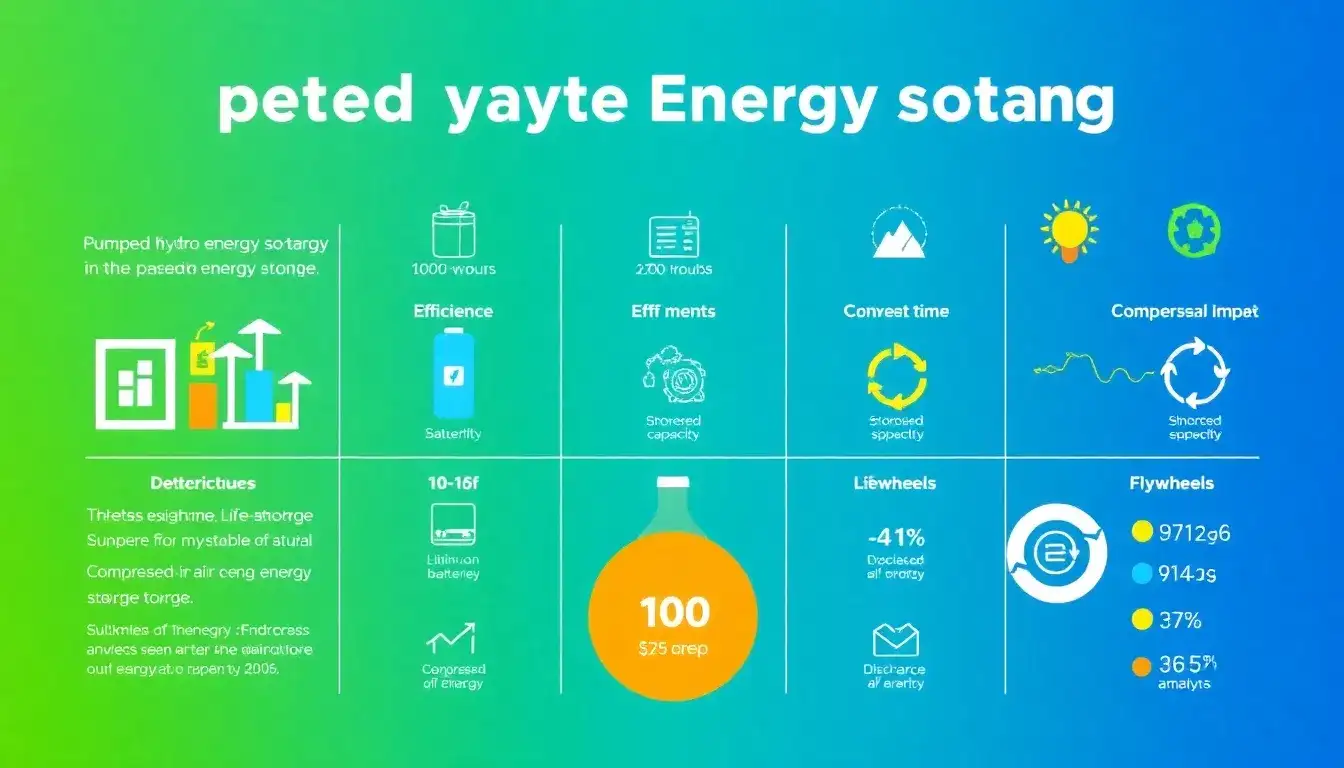
Efficiency Comparison of Pumped Hydroelectric Energy Storage with Other Solutions
Pumped Hydroelectric Energy Storage (PHES)
- Efficiency: The round-trip efficiency of PHES typically ranges between 70% and 80%. This means that for every unit of electricity used to pump water up, between 0.7 and 0.8 units can be generated when the water is released back down through turbines.
- Duration and Capacity: PHES facilities can provide long-duration energy storage, often supplying power for up to 10 hours. They account for the largest capacity of grid energy storage, with over 95% of global installations as of 2020.
- Economic Benefits: Despite being a net energy consumer overall, PHES is highly economical because it allows for the sale of electricity during peak demand periods, maximizing revenue.
Other Energy Storage Solutions
Lithium-Ion Batteries
- Efficiency: Lithium-ion batteries have an efficiency of around 90% to 95% for a charge/discharge cycle, depending on the specific technology and conditions.
- Duration and Capacity: Typically, they offer shorter durations of energy supply compared to PHES, often providing power for around 6 hours.
- Economic Benefits: While they are more efficient than PHES in terms of round-trip efficiency, lithium-ion batteries are generally more expensive per unit of energy storage capacity.
Flywheel Energy Storage
- Efficiency: Flywheels can achieve high efficiency rates, often above 90%, but they are generally used for short-duration storage and power quality applications rather than long-term energy storage.
Compressed Air Energy Storage (CAES)
- Efficiency: CAES systems typically have efficiencies ranging from 40% to 60%, making them less efficient than PHES.
- Duration and Capacity: Like PHES, CAES can provide long-duration storage but is less efficient and less commonly used.
Summary
- Pumped Hydroelectric Storage excels in long-duration storage and large capacity but has a lower efficiency compared to some other technologies like lithium-ion batteries.
- Lithium-Ion Batteries offer higher efficiency but shorter durations and are more expensive per unit of storage.
- Flywheel Energy Storage and CAES serve different niches; flywheels for high-speed applications and CAES for large-scale, long-duration needs but with lower efficiency.
In conclusion, while PHES is not the most efficient in terms of round-trip efficiency, it offers unparalleled capacity and duration, making it a crucial component for stabilizing grids with high shares of intermittent renewable energy sources.
Original article by NenPower, If reposted, please credit the source: https://nenpower.com/blog/how-does-the-efficiency-of-pumped-hydroelectric-energy-storage-compare-to-other-energy-storage-solutions/

