

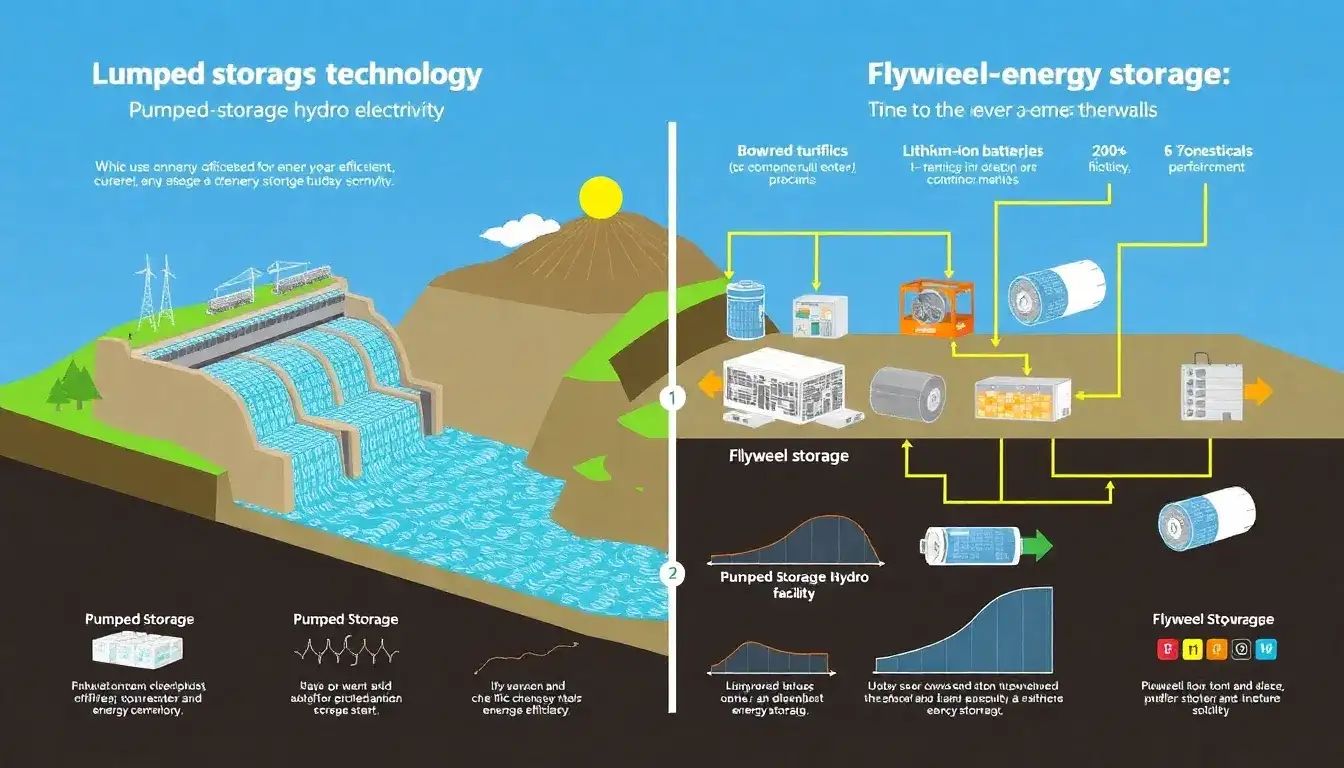
Pumped hydro storage (PHS) is generally among the most efficient and cost-effective large-scale energy storage technologies available, with round-trip efficiencies typically ranging between 70% and 87%, often cited around 80%. This means that about 70 to 87 percent of the electrical energy used to pump water uphill can be recovered when the water flows back down through turbines.
Comparison of Efficiency
- Pumped Hydro Storage:
- Round-trip efficiency: 70–87%, commonly about 80%
- Well-established, mature technology with proven longevity (equipment lasts 40+ years, dams can last 100+ years)
- Can provide long-duration storage (hours to days) and large capacity, ideal for grid balancing and load shifting
- Highly cost-effective on a large scale, with low cost per megawatt-hour compared to other technologies
- Other Energy Storage Technologies (contextual knowledge):
- Lithium-ion batteries typically have round-trip efficiencies between 85% and 95%, slightly higher than pumped hydro on a per-cycle basis but with shorter life spans and higher costs for large-scale storage.
- Flow batteries offer efficiencies in the range of 65–85%, but are less mature and generally more costly at large scales.
- Compressed air energy storage (CAES) has efficiencies around 40–70%, lower than pumped hydro.
- Thermal energy storage efficiencies vary widely depending on the method and application but are typically lower in round-trip efficiency compared to pumped hydro.
Key Advantages of Pumped Hydro Storage
- Large-scale capacity and long discharge duration make PHS ideal for daily or weekly bulk energy storage, which battery technologies typically cannot economically match at very large scales.
- Cost-effectiveness is enhanced by the long lifecycle and relatively low operating costs despite high upfront capital expenses for site development and infrastructure.
- Fast response and grid services: PHS can respond in seconds or milliseconds (especially variable speed plants), providing critical grid stability and balancing as renewable penetration increases.
- Sustainability and low environmental impact for closed-loop systems, which do not rely on natural river flow and can be sited to minimize ecosystem effects.
Summary
Pumped hydro storage offers slightly lower round-trip efficiency compared to modern lithium-ion batteries but excels in large-scale, long-duration storage with proven reliability, lower levelized costs, and significant grid flexibility benefits. Its efficiency of around 80% is very competitive among bulk energy storage technologies and remains the benchmark for cost-effective, large-scale renewable energy integration.
Original article by NenPower, If reposted, please credit the source: https://nenpower.com/blog/how-does-the-efficiency-of-pumped-hydro-storage-compare-to-other-energy-storage-technologies-2/

