

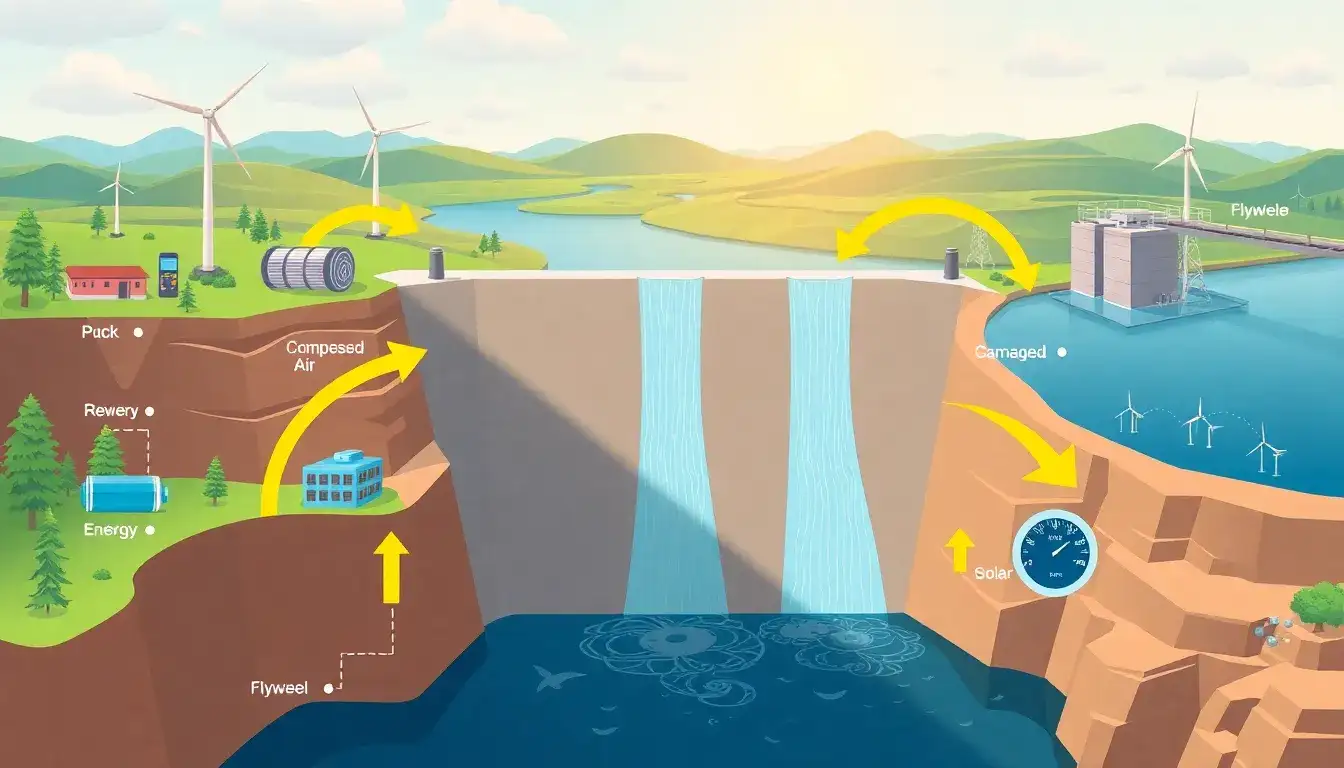
Comparison of Energy Storage Efficiencies
| Technology | Round-Trip Efficiency Range |
|---|---|
| Pumped Hydro Storage (PHS) | 70% to 80% |
| Utility-Scale Batteries | Approximately 82% |
| Flow Batteries | Around 70% |
| Compressed Air Energy Storage (CAES) | 60% to 65% |
| Hydrogen Storage | 40% to 60% |
Pumped Hydro Storage (PHS) is highly efficient and scalable, offering large capacities and long durations of energy supply, typically around 10 hours. It is crucial for load balancing and supporting intermittent renewable energy sources.
Utility-Scale Batteries, like lithium-ion, have a slightly higher efficiency than PHS but generally provide shorter durations of discharge. However, battery technology continues to advance, improving efficiency and reducing costs.
Flow Batteries and Compressed Air Energy Storage (CAES) have efficiencies comparable to or slightly lower than PHS, while Hydrogen Storage is less efficient but offers potential for long-term energy storage.
Key Advantages of Pumped Hydro Storage
- Scalability: PHS is the largest form of energy storage globally.
- Durability: Facilities can last up to 100 years.
- Renewable: Utilizes water, a renewable resource.
- Stability: Provides grid stability with rapid response times.
Environmental Impact and Cost
While PHS has environmental benefits as a clean energy source, it requires significant geographical resources and can have initial high capital costs. However, it offers one of the lowest long-term costs per unit of energy stored.
Original article by NenPower, If reposted, please credit the source: https://nenpower.com/blog/how-does-the-efficiency-of-pumped-hydro-storage-compare-to-other-energy-storage-solutions/

