

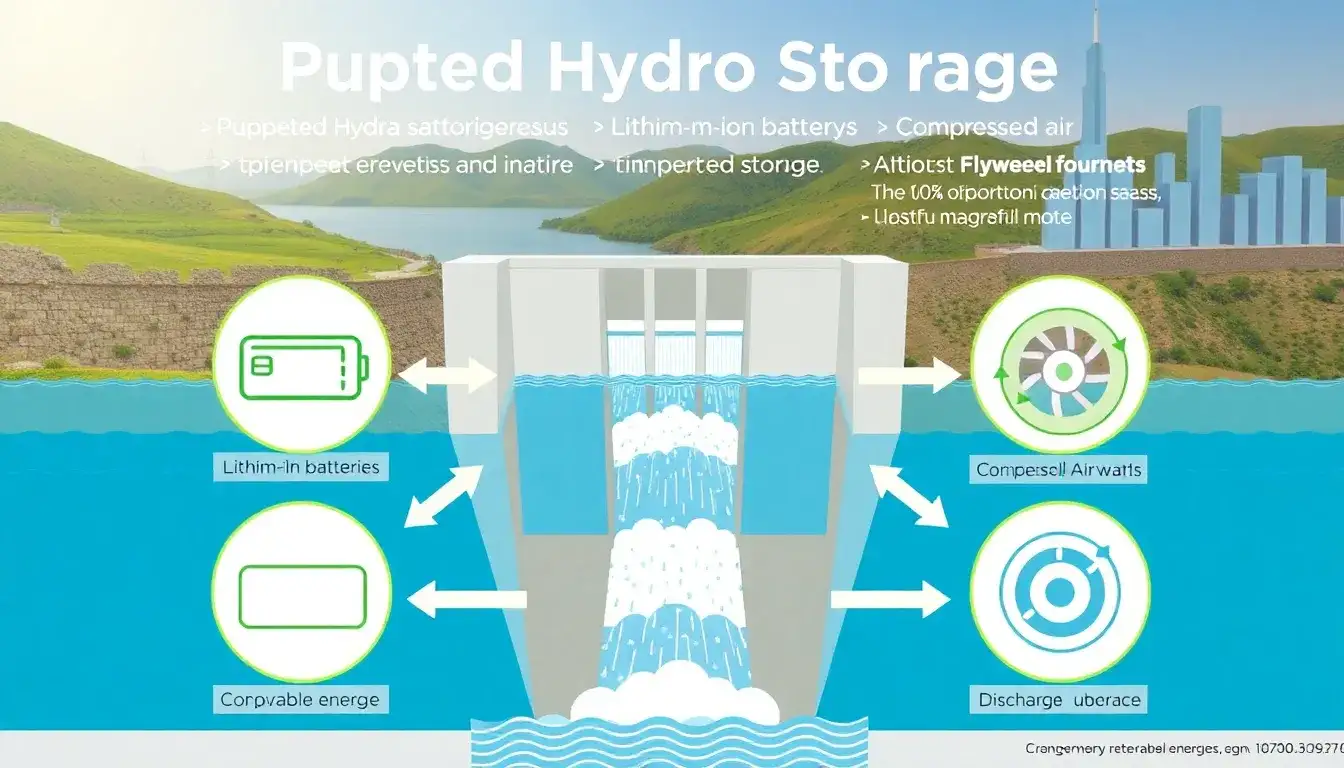
The efficiency of pumped hydro storage (PHS) is generally high compared to other energy storage methods. Here’s a comparison with some key technologies:
Efficiency Comparison
- Pumped Hydro Storage (PHS): PHS has an efficiency ranging from 70% to over 80%, depending on the source and setup. This efficiency refers to the round-trip process, where water is pumped up during off-peak hours and released to generate electricity during peak hours. PHS is renowned for its large-scale storage capacity and long lifespan, typically providing 10 hours of electricity.
- Battery Storage (e.g., Lithium-ion): Battery storage typically has a round-trip efficiency of around 80% to 90%, but with a shorter duration. While batteries are more efficient in terms of round-trip efficiency, they generally offer less storage duration than PHS. A typical lithium-ion battery provides 4-6 hours of energy storage.
- Compressed Air Energy Storage (CAES): This method has an efficiency between 60% and 65%. It involves compressing air in underground caverns during off-peak hours and expanding it to generate electricity during peak hours.
- Flow Batteries: Flow batteries have an efficiency around 70% to somewhat higher, but their scalability for long-duration storage is still developing.
Operational Comparison
| Technology | Round-Trip Efficiency | Typical Duration |
|---|---|---|
| Pumped Hydro | 70% – 80% | Up to 10 hours |
| Battery Storage | 80% – 90% | 4-6 hours |
| Compressed Air | 60% – 65% | Varies |
| Flow Batteries | 70% | Varies |
Conclusion
Pumped hydro storage stands out as a highly efficient and reliable method for large-scale, long-duration energy storage. While batteries are slightly more efficient on a per-charge basis, PHS offers greater capacity and duration. Other methods like CAES and flow batteries have varying efficiencies but are generally less efficient than PHS and battery storage.
Original article by NenPower, If reposted, please credit the source: https://nenpower.com/blog/how-does-the-efficiency-of-pumped-hydro-storage-compare-to-other-energy-storage-methods/

