

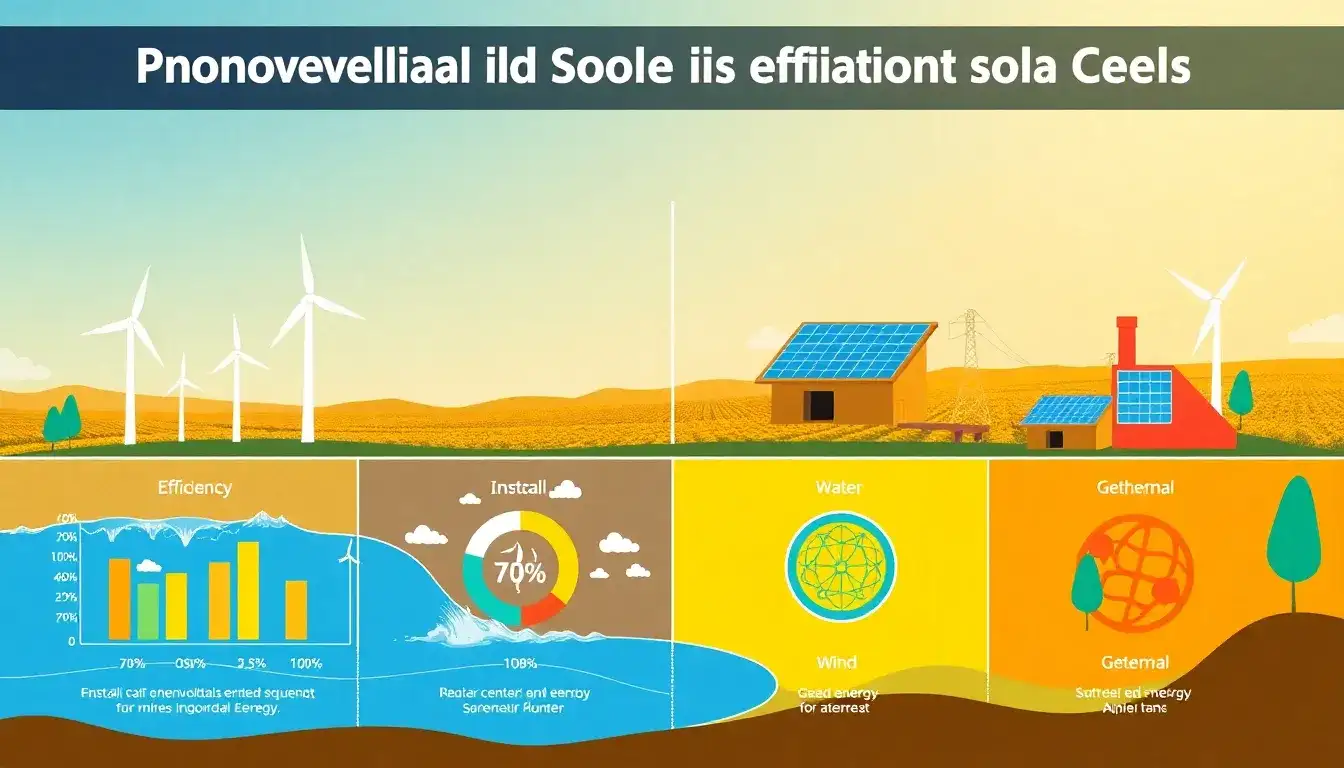
Photovoltaic (PV) cell efficiency refers specifically to the percentage of sunlight converted into electricity, which differs fundamentally from other renewable energy sources’ efficiency metrics, as these typically measure energy conversion from mechanical or thermal processes. Here’s a structured comparison:
Efficiency Definitions
- Photovoltaics: 6–44.4% (lab cells: up to 44.4% multi-junction; commercial panels: 14–24.4%)
- Wind turbines: 30–50% of wind kinetic energy converted to electricity.
- Hydropower: ~90% mechanical-to-electrical conversion (system efficiency, accounting for water head and flow).
- Geothermal: 10–20% thermal-to-electrical efficiency (higher for direct heating).
- Biomass: 20–40% efficiency in electricity generation via combustion/gasification.
Key Comparisons
| Metric | Solar PV | Wind | Hydropower | Geothermal |
|---|---|---|---|---|
| Primary Input | Sunlight | Wind kinetic energy | Water flow | Earth’s heat |
| Conversion Type | Photoelectric | Mechanical | Mechanical | Thermal/Mechanical |
| Typical Efficiency | 15–24.4% (commercial) | 30–50% | ~90% (mechanical) | 10–20% |
| Space Efficiency | Moderate (5–20 W/m²) | High (>500 W/m²) | Very high | Site-dependent |
| Scalability | Highly modular | Large turbines | Dam-dependent | Location-limited |
Critical Factors
- Solar PV Efficiency Drivers:
- Cell type: N-type heterojunction (HJT) and TOPcon cells achieve 21–24.4%, while PERC variants reach ~21%.
- Temperature: High temperatures reduce output (e.g., N-type HJT loses 0.25–0.27%/°C vs. P-type’s 0.35–0.43%/°C).
- Wind/Hydro Advantages:
- Higher capacity factors (25–55% for wind vs. 15–25% for solar).
- Less land use per kWh (offshore wind: ~3 MW/ha vs. solar: ~0.5 MW/ha).
- Practical Considerations:
- Solar PV’s efficiency is less critical in large installations but pivotal for space-constrained rooftops.
- Geothermal and hydropower provide baseload power but require specific geographies.
Economic Context
- Solar PV: Costs ~$0.50–0.90/W for panels, with efficiency gains reducing balance-of-system expenses.
- Wind: ~$1.2–2.2/W (onshore), offset by higher capacity factors.
- Efficiency ≠ Cost-Effectiveness: While multi-junction solar cells reach 44%, they remain prohibitively expensive for most uses, highlighting the trade-off between peak efficiency and affordability.
In summary, solar PV’s efficiency is lower in energy conversion percentage compared to wind or hydropower’s mechanical processes but is uniquely advantageous for decentralized, scalable applications. Efficiency metrics must be contextualized with capacity factors, land use, and cost to assess overall viability.
Original article by NenPower, If reposted, please credit the source: https://nenpower.com/blog/how-does-the-efficiency-of-photovoltaic-cells-compare-to-other-renewable-energy-sources/

