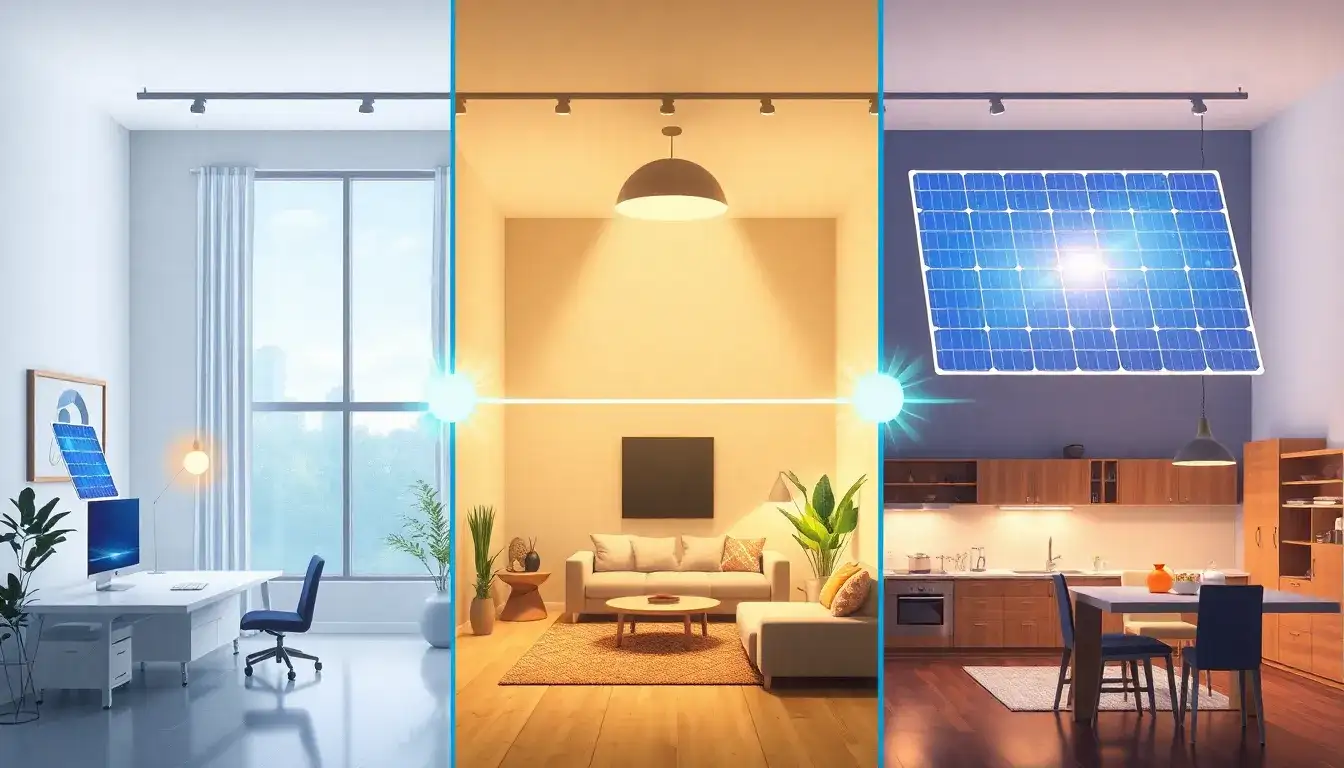
The efficiency of perovskite solar panels under different indoor lighting conditions varies significantly depending on the light source spectrum, intensity, and device optimization strategies.
Efficiency Under Indoor Lighting Conditions
- Recent research has demonstrated perovskite solar cells achieving exceptionally high power conversion efficiencies (PCE) indoors. A notable example is a device developed by Taiwanese researchers that reached 42% efficiency under 3,000 K LED illumination at 1,000 lux, which is typical indoor lighting brightness. This improvement was credited to enhanced carrier transport and defect passivation at the nickel oxide/perovskite interface and further optimization using self-assembled monolayers to improve perovskite growth and optoelectronic properties.
- Another study achieved indoor efficiencies near 36% under 1000 lux cool-white LED illumination by optimizing the perovskite film formulation, showing that solvent engineering also plays a key role in indoor performance.
- High-bandgap perovskite materials are particularly well-suited for indoor environments because their bandgap matches well with the emission spectra of common LED lighting used indoors. This spectral match enhances the absorption and energy conversion efficiency under typical indoor illuminance levels ranging from 5 to 40,000 lux.
Effect of Different Illumination Intensities and Orientations
- Indoor lighting intensity and orientation significantly affect perovskite solar cell performance. For example, a year’s monitoring of perovskite solar cells showed substantial variation in energy yield depending on illumination intensity and angle. Optimal orientation yields up to 36% higher performance compared to horizontal placement, whereas a poor orientation can cause up to a 72% drop in output.
- The energy harvested under typical indoor lighting is sufficient to power low-energy devices like IoT sensors most days of the year, indicating practical efficiency for indoor applications. However, some low-light days require energy storage due to reduced generation.
Summary of Factors Influencing Efficiency
| Factor | Effect on Efficiency |
|---|---|
| Light Spectrum (LED type) | Matching bandgap to LED spectra improves absorption and efficiency. |
| Illumination Intensity (lux) | Efficiency scales with intensity but saturates; 1000 lux typical indoors. |
| Device Interface Optimization | Defect passivation and carrier transport boosts indoor efficiency up to 42%. |
| Orientation | Optimal orientation increases efficiency by ~36%, poor orientation reduces by ~72%. |
In summary, perovskite solar panels show markedly improved efficiency under indoor lighting when using high-bandgap materials optimized for LED spectra, advanced interface engineering, and proper device placement. Efficiencies exceeding 40% under standard indoor lighting such as 3000 K LEDs at 1000 lux have been reported, highlighting their great potential for indoor energy harvesting applications like powering IoT devices.
Original article by NenPower, If reposted, please credit the source: https://nenpower.com/blog/how-does-the-efficiency-of-perovskite-solar-panels-change-under-different-indoor-lighting-conditions/