

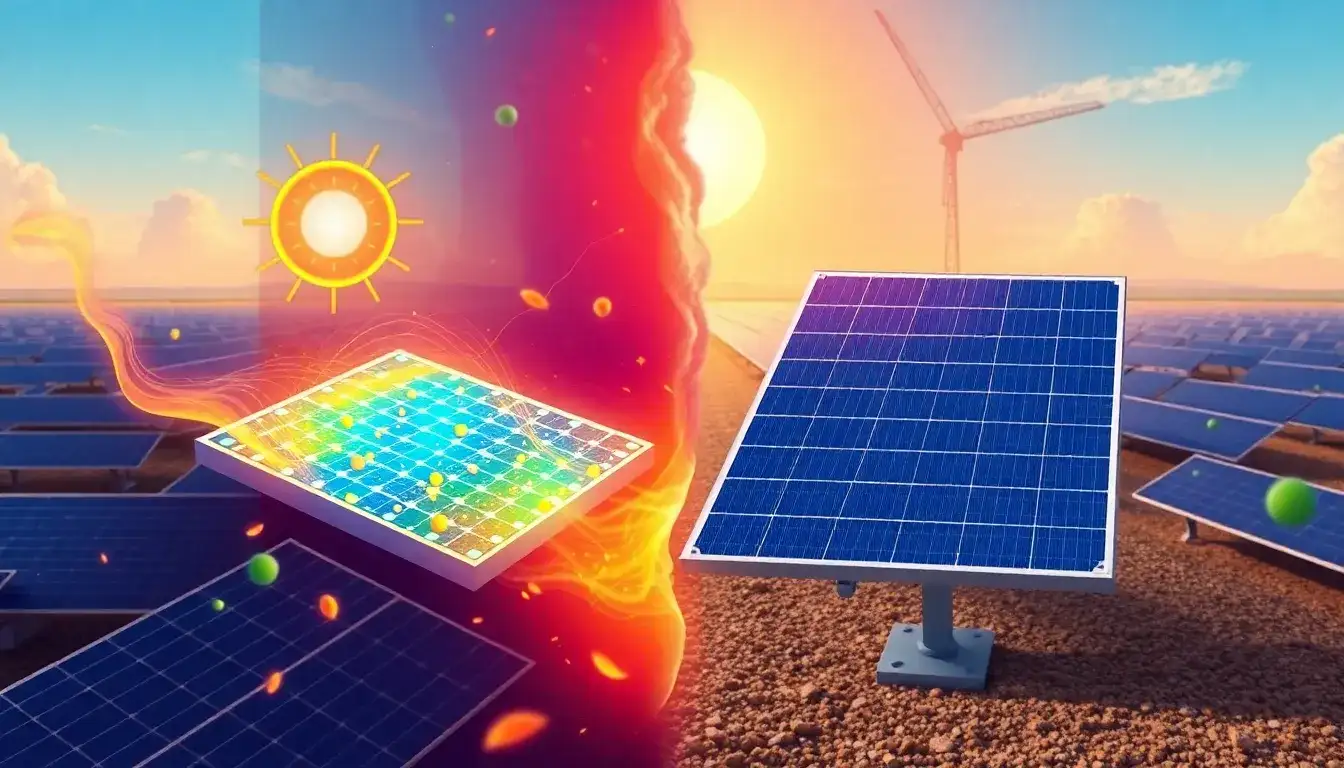
Efficiency Comparison: Perovskite Solar Cells vs. Traditional Silicon Cells Under Extreme Temperatures
Perovskite solar cells (PSCs) and traditional silicon solar cells exhibit different efficiencies under extreme temperatures. Here’s a comparison:
Efficiency at Room Temperature
- Perovskite Solar Cells: PSCs have achieved power conversion efficiencies (PCEs) over 25% in laboratory settings, often rivaling or surpassing silicon-based cells in terms of efficiency under ideal conditions.
- Silicon Solar Cells: Silicon cells typically operate at efficiencies around 20-21%, though some high-efficiency designs have reached closer to 23%.
Performance Under Extreme Temperatures
- Perovskite Solar Cells:
- High Temperatures: PSCs are prone to thermal instability. However, recent advancements have shown significant improvements in maintaining efficiency under high temperatures. For example, certain cells can retain over 90% of their efficiency even at temperatures around 65°C. Another study demonstrated that perovskite cells can maintain over 85% efficiency after exposure to 85°C and high humidity for 1,000 hours.
- Low Temperatures: Researchers have also explored the behavior of PSCs in cold environments, revealing potential recoverable performance after exposure to extreme cold conditions.
- Silicon Solar Cells:
- High Temperatures: Silicon solar cells generally perform well at high temperatures, though efficiency decreases as temperature increases. They typically can handle the high encapsulation temperatures without significant degradation.
- Low Temperatures: Efficiency increases at lower temperatures due to reduced thermal excitation of charge carriers.
Summary
Perovskite solar cells offer competitive efficiencies at room temperature but face challenges with thermal stability in extreme heat. However, recent innovations have significantly enhanced their performance and stability, making them more viable for high-temperature applications. Silicon cells are robust at high temperatures but see a drop in efficiency. Overall, both types have their advantages and challenges in extreme environments.
| Feature | Perovskite Solar Cells | Silicon Solar Cells |
|---|---|---|
| Room Temperature Efficiency | Often exceeds 25% in laboratory settings | Typically around 20-21%, with some reaching 23% |
| High Temperature Stability | Improved but still susceptible; innovations enhance stability | Robust, though efficiency decreases as temperature increases |
| Low Temperature Performance | Can recover performance after cold exposure | Efficiency increases with reduced temperature |
While perovskite solar cells still face challenges with stability, ongoing research is addressing these issues, making them increasingly competitive with silicon cells under various conditions.
Original article by NenPower, If reposted, please credit the source: https://nenpower.com/blog/how-does-the-efficiency-of-perovskite-solar-cells-compare-to-traditional-silicon-cells-under-extreme-temperatures/

