

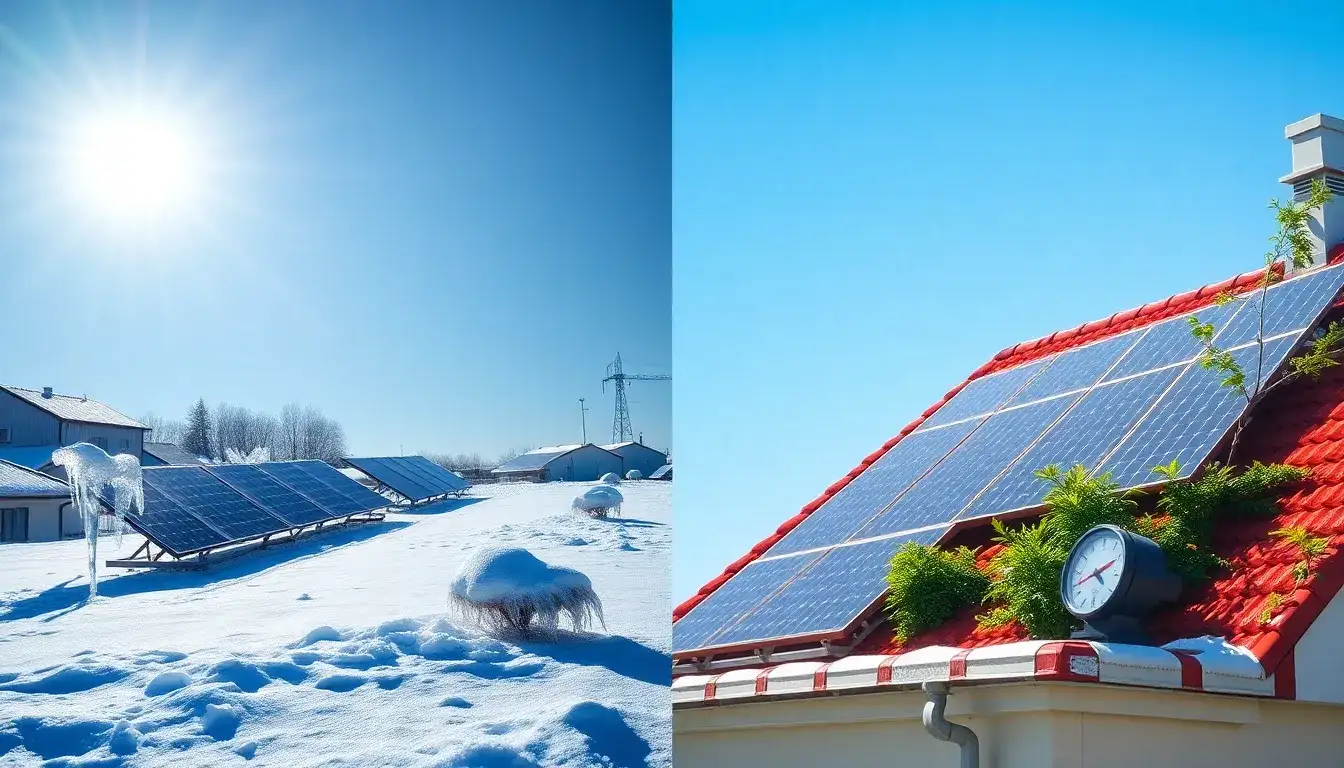
Performance Differences Between Cold and Warm Weather
- Improved Efficiency in Cold Weather: N-type solar panels benefit from lower electrical resistance when temperatures drop, which allows electricity to flow more easily and results in higher electrical output. Cold air helps maintain high voltage and relaxes electrons, reducing energy loss and enhancing overall efficiency.
- Reduced Temperature Coefficient: N-type panels have a lower temperature coefficient than typical p-type panels, meaning their performance decreases less as temperatures rise. Conversely, their efficiency improves more markedly when temperatures fall below the standard testing condition of 25°C (77°F). For example, solar panel efficiency can increase approximately 0.38% for every degree Celsius below 25°C.
- Stable Performance in Cold and Low-Light Conditions: N-type TOPCon solar cells, a common advanced type of N-type panels, maintain high efficiency even in cold, low-light, or cloudy conditions due to excellent carrier transport properties and passivated contact structures that reduce recombination losses. This helps sustain power output during shorter daylight or overcast winter days.
Comparison in Warmer Climates
- Although heat generally reduces solar panel efficiency by increasing internal resistance and reducing bandgap energy, N-type solar panels suffer less from these effects than p-type panels due to their superior temperature coefficients and design, resulting in less power loss in hot weather.
- Still, efficiency is maximized at cooler temperatures rather than hot ones, as excessive heat can reduce output even in N-type panels, though less severely.
Summary Table
| Aspect | Cold Weather | Warm Weather |
|---|---|---|
| Electrical resistance | Decreased — improves current flow | Increased — reduces efficiency |
| Voltage & electrical pressure | Maintained high | Reduced |
| Temperature coefficient effect | Efficiency increases with cold | Efficiency declines with heat |
| Longevity and durability | Enhanced due to materials & design | Stable but heat stress can occur |
| Overall efficiency | Higher | Slightly lower than in cold weather |
| Performance in low light | Maintained due to good carrier transport | Maintained but less optimal |
Conclusion
N-type solar panels perform significantly better in cold climates than in warmer ones. Their reduced temperature coefficient, lower electrical resistance at low temperatures, and robust design enable them to maintain high power output and efficiency during cold weather, making them highly suitable for regions with harsh winters. While they also perform well in hot climates compared to other panel types, cold conditions generally enhance their efficiency even further.
Therefore, the efficiency of N-type solar panels in cold weather is superior to that in warmer climates, making them an excellent choice for renewable energy generation in cold regions.
Original article by NenPower, If reposted, please credit the source: https://nenpower.com/blog/how-does-the-efficiency-of-n-type-solar-panels-in-cold-weather-compare-to-their-performance-in-warmer-climates/

