

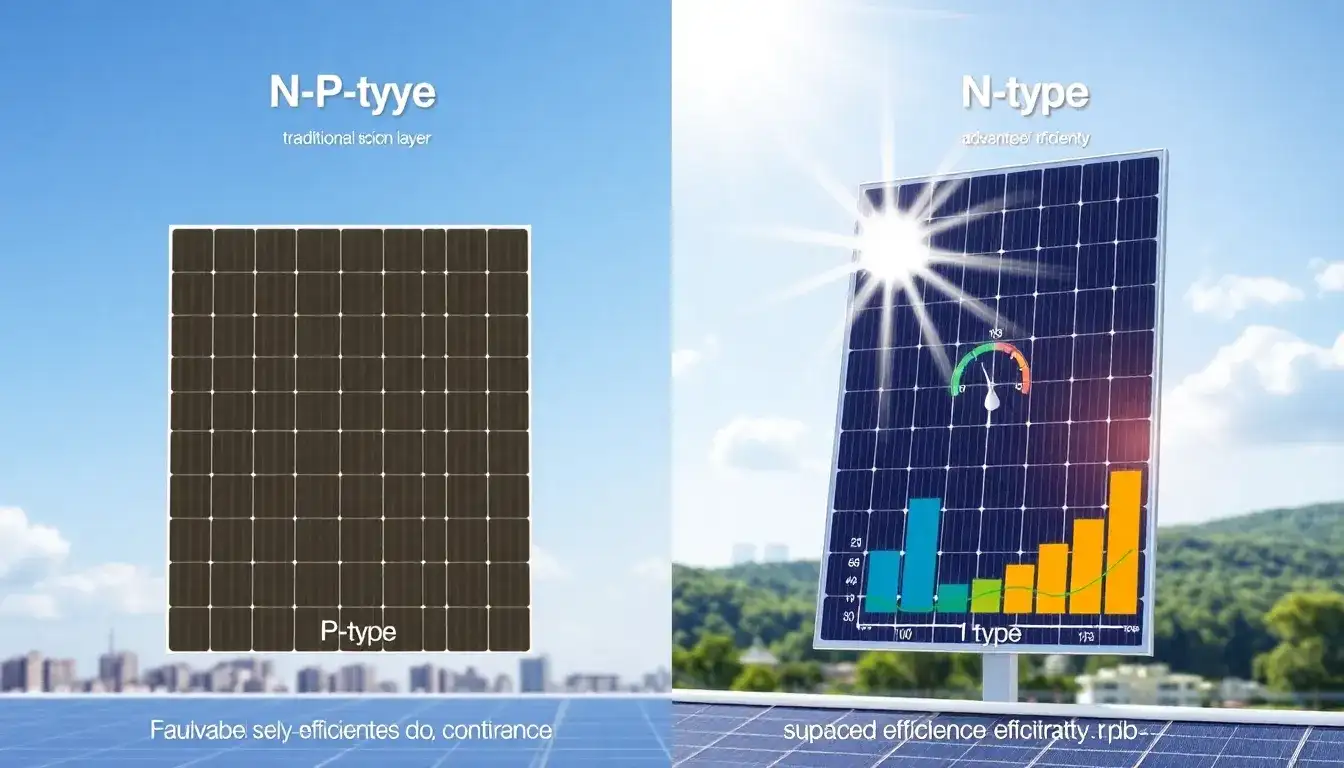
N-type solar panels demonstrate superior efficiency compared to traditional P-type models. N-type panels achieve up to 25.7% efficiency, while P-type panels typically reach 23.6%. This gap stems from structural and material differences:
Key Efficiency Factors
- Light-induced degradation (LID): P-type panels lose up to 10% efficiency due to boron-oxygen defects, while N-type panels avoid LID entirely.
- Recombination rates: N-type silicon’s thinner emitter layer and higher electron mobility reduce energy losses.
- Temperature performance: N-type panels have a lower temperature coefficient (-0.30%/°C vs. -0.50%/°C for P-type), maintaining efficiency better in heat.
Performance Over Time
N-type panels degrade slower due to immunity to potential-induced degradation (PID) and LID, often backed by longer warranties (e.g., 30-year power output guarantees vs. 25 years for P-type). Their higher initial cost is offset by greater long-term energy yields.
Applications
- Space-constrained setups: N-type’s efficiency advantage makes it ideal for limited roof space.
- Harsh climates: N-type outperforms P-type in both hot and cold environments due to enhanced temperature resilience.
In summary, N-type panels offer higher efficiency, durability, and climate adaptability, while P-type remains a budget-friendly option for standard applications.
Original article by NenPower, If reposted, please credit the source: https://nenpower.com/blog/how-does-the-efficiency-of-n-type-solar-panels-compare-to-traditional-p-type-panels/

