

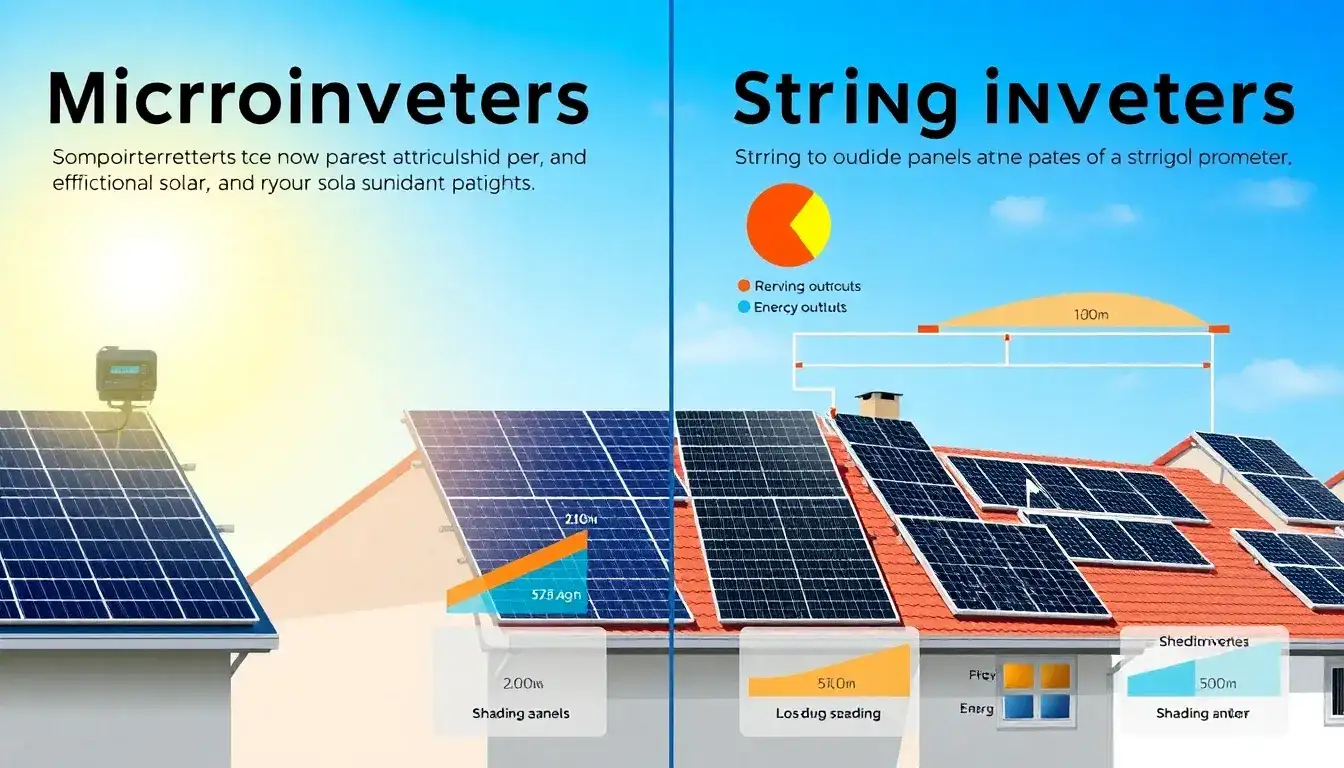
The efficiency comparison between microinverters and string inverters revolves mainly around how each handles the conversion of solar panel power and the impact of shading or panel performance variability.
Efficiency of Microinverters vs String Inverters
Microinverters:
- Convert DC to AC power at each individual solar panel, allowing each panel to operate independently. This modular approach means that shading, dirt, or malfunction on one panel does not reduce the output of others, maintaining high system efficiency.
- Excel in installations with shading or complex roof layouts, as each panel maximizes its output individually without being limited by weaker panels.
- Generally have better long-term efficiency and durability despite higher upfront costs. This is because the system loses less energy due to underperforming panels and has no single central point of failure.
- With microinverters, the overall system efficiency is the sum of each panel’s independent efficiency, avoiding the “lowest-performing panel limitation” of string inverters.
String Inverters:
- Convert DC power to AC power from a whole string (series group) of solar panels at a central inverter. This means the output of the entire string is limited by the weakest or most shaded panel in the string.
- Less efficient in shaded or complex roofing situations because a partially shaded panel reduces the current through the entire string, lowering overall energy production.
- Typically offer lower upfront cost and are simpler to install and maintain, but can incur higher long-term efficiency losses and maintenance costs due to shading sensitivity and a single point of failure.
- Power optimizers can be added to string inverter systems to mitigate some efficiency losses by conditioning power at each panel, but these do not convert DC to AC independently like microinverters and still rely on the central inverter for the final conversion.
Summary Table of Efficiency Factors
| Factor | Microinverters | String Inverters |
|---|---|---|
| Conversion Location | At each solar panel (module-level) | Central inverter for entire string |
| Impact of shading | Minimal; shaded panels don’t limit others | Significant; weakest panel limits entire string |
| Panel performance variability | Panels operate independently, maximizing output | All panels limited by lowest performer |
| System efficiency in shade | Higher overall efficiency | Reduced efficiency without optimizers |
| Long-term efficiency | Typically better due to independent operation | Can degrade due to shading and single point failure |
| Use of power optimizers | Not needed for optimization | Required to improve partial shading performance |
Conclusion
Microinverters provide higher system efficiency in real-world scenarios, especially where shading or roof complexity causes some panels to perform worse than others. By converting power at each panel, microinverters avoid the efficiency losses common in string inverter systems where the entire string output is curtailed by the weakest panel.
String inverters tend to be less efficient under suboptimal conditions but offer lower initial costs and simpler installation. Using power optimizers with string inverters can help narrow this efficiency gap but typically at an additional cost.
Thus, if maximizing energy harvest and long-term efficiency is a priority, microinverters are generally superior. For simple, unshaded roofs and lower upfront budget, string inverters remain a viable and cost-effective choice.
Original article by NenPower, If reposted, please credit the source: https://nenpower.com/blog/how-does-the-efficiency-of-microinverters-compare-to-string-inverters/

