

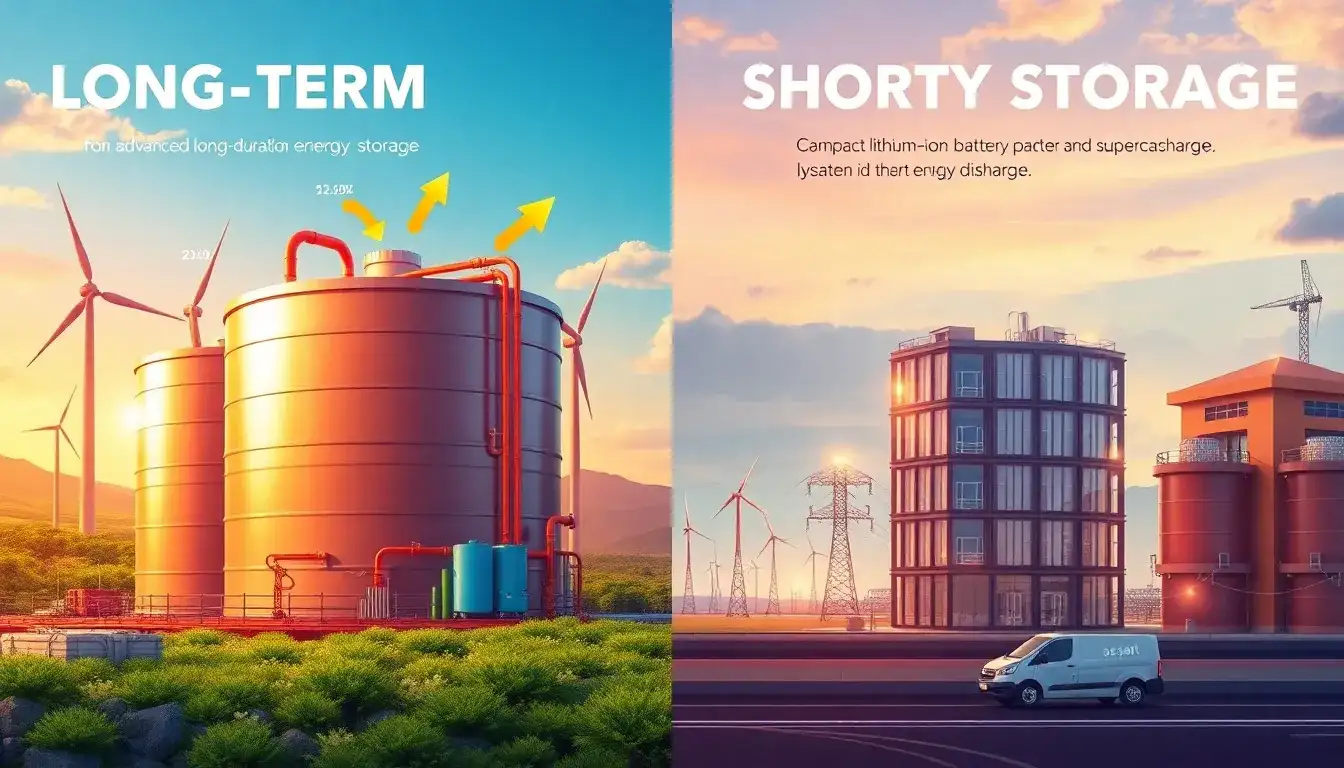
Long-duration energy storage (LDES) and short-duration energy storage differ significantly in their applications, efficiency, and cost-effectiveness.
Overview of Long-Duration and Short-Duration Storage
- Long-Duration Energy Storage (LDES): LDES technologies are designed to store energy over a long period, typically beyond eight hours. These systems are crucial for balancing energy supply and demand over extended periods, especially when using intermittent renewable sources like solar and wind. Examples include pumped hydro storage, compressed air energy storage, and hydrogen storage.
- Short-Duration Energy Storage: Short-duration storage solutions, often provided by technologies like lithium-ion batteries, are optimized for short-term energy needs. They are typically used to address peak demand, stabilize grid frequency, and provide power during brief outages or short supply shortfalls.
Efficiency Comparison
- Efficiency by Application:
- Long-Duration Storage is highly efficient for energy shifting and capacity provision, allowing grids to optimize renewable energy integration and reduce reliance on fossil fuels. It offers low marginal costs and is scalable, making it competitive for longer duration needs.
- Short-Duration Storage, like lithium-ion batteries, excels in short-term applications but might be less efficient for long-term storage due to higher marginal costs and lower scalability beyond a few hours.
- Cost Efficiency:
- LDES becomes more cost-effective for longer duration needs, enabling the decoupling of charge and discharge speeds, which is beneficial for balancing renewable energy’s intermittency.
- Short-Duration Storage is often more expensive per unit of stored energy over long durations but offers quick response times essential for immediate grid stabilization.
Environmental Impact
- Carbon Footprint Reduction: LDES can play a significant role in reducing carbon emissions by enabling a higher portion of renewable energy to be integrated into the grid without relying on fossil fuels during off-peak periods.
- Short-Duration Systems also contribute to emissions reduction but are more suited for immediate response rather than long-term energy balancing.
Conclusion
In summary, long-duration energy storage is more efficient and cost-effective for applications requiring energy storage over extended periods, particularly in stabilizing grids with high renewable penetration. Short-duration storage excels in quick response scenarios but becomes less efficient for longer durations. As the world transitions to renewable energy, LDES will play a crucial role in ensuring reliable and sustainable energy systems.
Original article by NenPower, If reposted, please credit the source: https://nenpower.com/blog/how-does-the-efficiency-of-long-duration-energy-storage-compare-to-short-duration-storage/

