

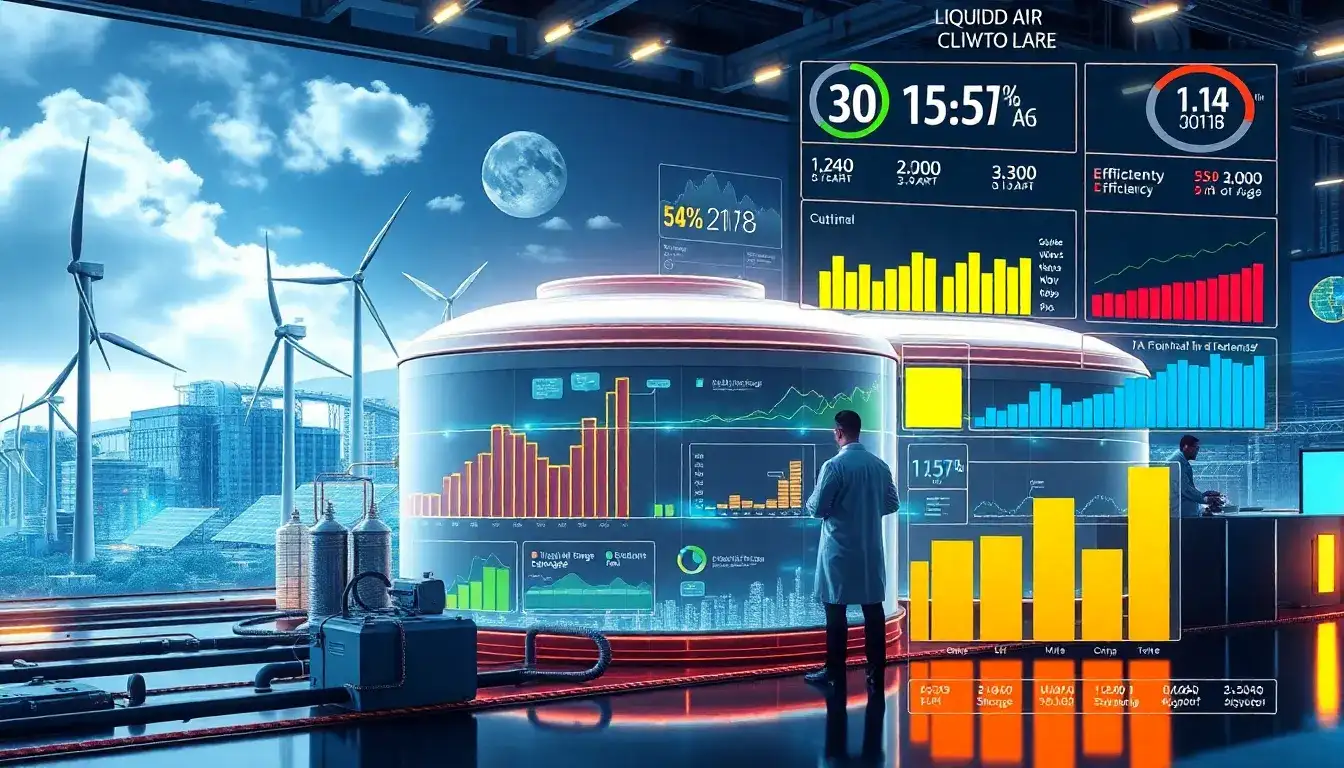
Comparison of Liquid Air Energy Storage (LAES) Efficiency with Other Grid-Scale Technologies
Overview
Liquid Air Energy Storage (LAES) is a promising technology for grid-scale energy storage, offering unique advantages compared to other methods. While its efficiency may not be the highest, its cost-effectiveness and potential for improved performance make it an attractive option.
Efficiency Comparison
- LAES Efficiency: Standalone LAES systems typically achieve an efficiency of up to 57%. A recent improvement involves enhancing efficiency through the use of external fuels like natural gas in oxy-fuel combustion systems, significantly increasing power output during discharge.
- Pumped Hydro Storage (PHS): Historically the most widely used large-scale energy storage technology, PHS can achieve an efficiency of around 80-90% but is geographically limited.
- Lithium-Ion Batteries: These batteries offer round-trip efficiencies of around 90-95% but are more expensive per megawatt-hour compared to LAES.
- Other Technologies: Compressed Air Energy Storage (CAES) and flywheel storage technologies also offer various efficiency levels, but LAES stands out due to its potential for cost-effectiveness and adaptability.
Cost and Economic Comparison
- Cost of LAES: The Levelized Cost of Storage (LCOS) for LAES is estimated to be about $60 per megawatt-hour, significantly lower than lithium-ion batteries and half that of pumped hydro.
- Economic Benefits: LAES can offer additional economic benefits, such as utilizing waste heat and selling by-products like nitrogen.
Conclusion
While LAES may not have the highest efficiency among grid-scale energy storage technologies, its economic advantages and potential for improvement in efficiency and multi-application capabilities make it a viable option for future energy storage needs.
Original article by NenPower, If reposted, please credit the source: https://nenpower.com/blog/how-does-the-efficiency-of-liquid-air-energy-storage-compare-to-other-grid-scale-energy-storage-technologies/

