

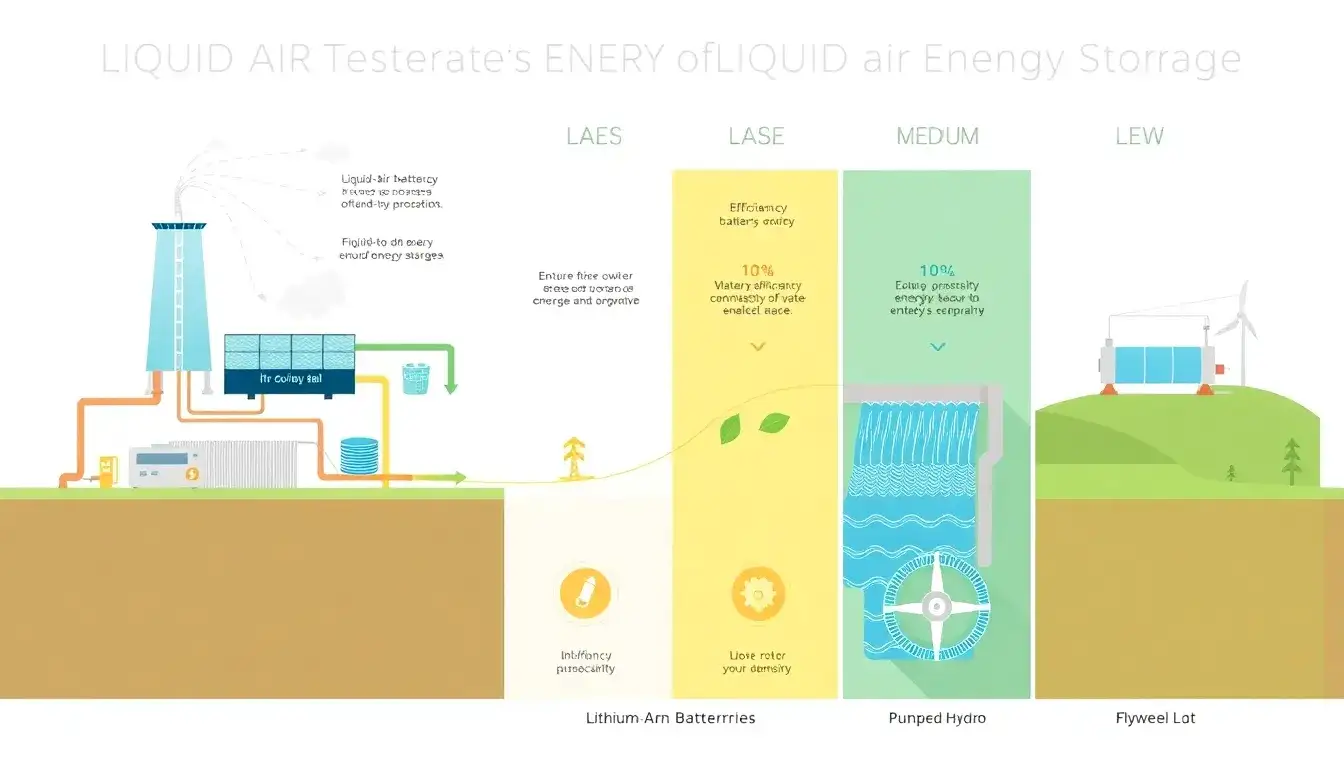
Liquid Air Energy Storage (LAES)
- Efficiency: LAES systems typically have a round-trip efficiency of up to 57% in standalone configurations. Recent developments aim to improve this efficiency, especially through system integration and optimization.
- Advantages: LAES systems are clean, have high energy density, and can be located almost anywhere. They offer long-duration energy storage capabilities.
Compressed Air Energy Storage (CAES)
- Efficiency: CAES systems generally have a higher efficiency than LAES, often achieving round-trip efficiencies of around 42% to 54%. However, they require large underground caverns, limiting their geographic flexibility.
- Advantages: CAES can store large amounts of energy, making it suitable for grid-scale applications.
Pumped Hydro Storage (PHS)
- Efficiency: PHS systems are among the most efficient, with round-trip efficiencies typically ranging from 80% to 90%. They require specific topographies, which can be a limitation.
- Advantages: PHS offers high capacity and long-duration storage, making it widely used for grid stability.
Lithium-Ion Batteries
- Efficiency: Lithium-ion batteries have high round-trip efficiencies, often above 90%. However, they have a lower energy density compared to LAES and CAES.
- Advantages: They are versatile, scalable, and widely used for both grid-scale and small-scale energy storage applications.
In summary, while LAES systems have lower efficiency compared to PHS and lithium-ion batteries, their ability to be installed anywhere without requiring specific landscapes is a significant advantage. Additionally, LAES can provide cost-effective solutions for long-duration storage, potentially offering a lower Levelized Cost of Storage (LCOS) compared to other technologies like lithium-ion batteries.
Original article by NenPower, If reposted, please credit the source: https://nenpower.com/blog/how-does-the-efficiency-of-laes-systems-compare-to-other-energy-storage-technologies/

