

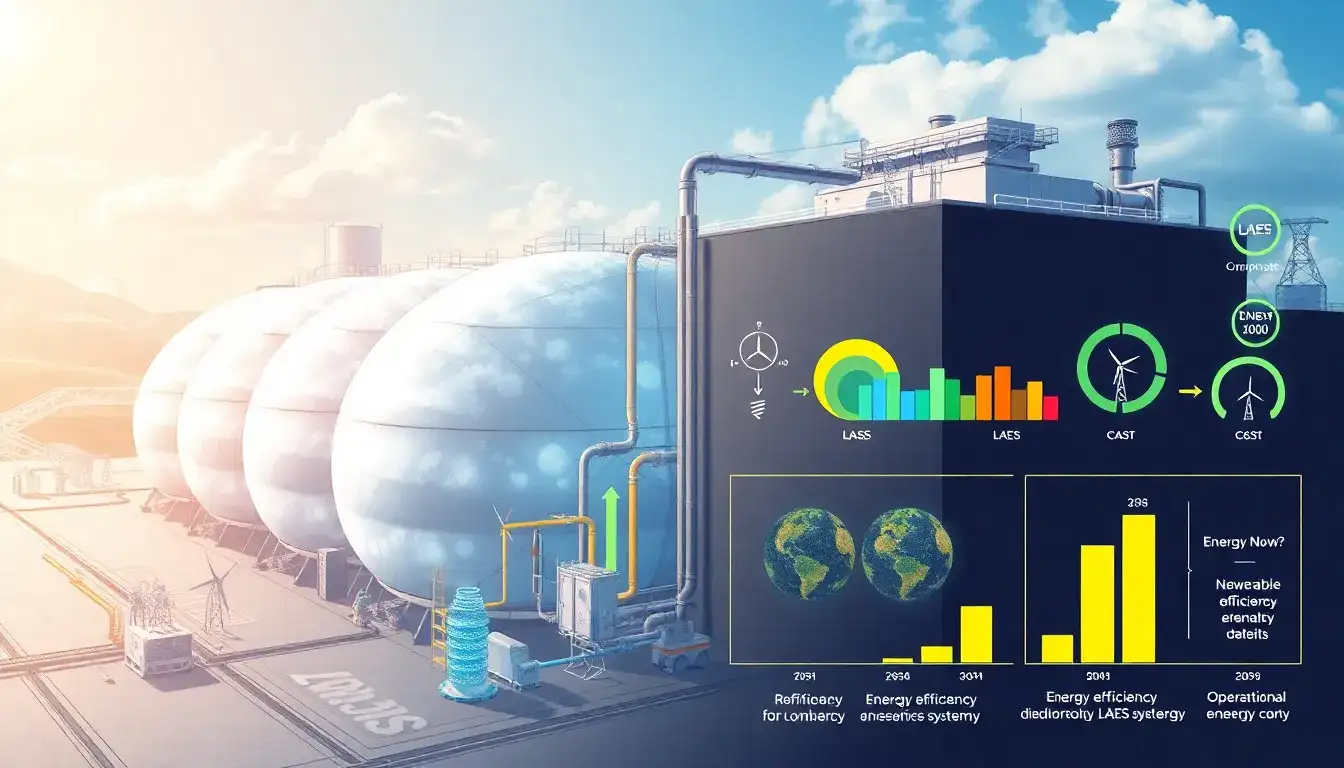
The efficiency of Liquid Air Energy Storage (LAES) has a nuanced impact on its overall cost-effectiveness, but it is not the sole or even primary determinant of economic viability.
Impact of Efficiency on Economic Viability
- Research indicates that improvements to the energy efficiency of LAES have little to no direct impact on its economic viability. For example, a recent model found that enhancing LAES efficiency did not significantly affect the technology’s financial competitiveness, suggesting that other factors like capital costs and market conditions play a more critical role.
- Despite relatively low round-trip efficiency compared with some other storage technologies, LAES can still be cost-competitive due to its durable, flexible operation and the absence of capacity degradation issues.
Cost Reduction and Hybridization
- LAES systems tend to have relatively high payback periods and profits are limited by low efficiency if operated in isolation. However, integrating LAES with other recovery systems or hybrid plants (such as LNG regasification and combustion integration) can significantly boost round-trip efficiency—up to about 70-74% in some studies—which in turn improves economic performance.
- Hybridization and added energy recovery techniques can lower the effective storage cost and enhance revenues, thus improving overall cost-effectiveness despite initial efficiency limitations.
Operational and Market Factors
- Economic viability is more sensitive to operational strategies and market conditions than efficiency alone. For instance, weekly storage cycles tend to be more economically efficient than monthly storage, which requires more excess capacity but does not proportionally increase revenue.
- LAES’s ability to reduce renewable energy curtailment by over 40% and decrease system operating costs by around 19% in regions like Spain demonstrates that the system’s contributions to grid flexibility and system-wide cost savings are major drivers of its cost-effectiveness, beyond just efficiency metrics.
- Capital expenditure subsidies also strongly enhance LAES economic viability, highlighting the importance of policy and financial support.
Summary
| Factor | Influence on LAES Cost-Effectiveness |
|---|---|
| Energy Efficiency | Limited direct impact on economic viability |
| Hybridization/Recovery Systems | Improves round-trip efficiency (~70-74%) and cost-effectiveness |
| Operational Strategy | Weekly vs monthly storage affects cost efficiency |
| Grid Benefits | Reduces renewable curtailment and system operating costs |
| Capital Subsidies | Significantly enhance financial attractiveness |
In conclusion, while the inherent energy efficiency of LAES is relatively low compared to some storage technologies, its cost-effectiveness depends more heavily on hybridization with other systems, operational strategies, subsidies, and its ability to provide grid-wide economic benefits. Efficiency improvements alone do not markedly improve the economic case for LAES but do contribute positively when combined with these other factors.
Original article by NenPower, If reposted, please credit the source: https://nenpower.com/blog/how-does-the-efficiency-of-laes-impact-its-overall-cost-effectiveness/

