

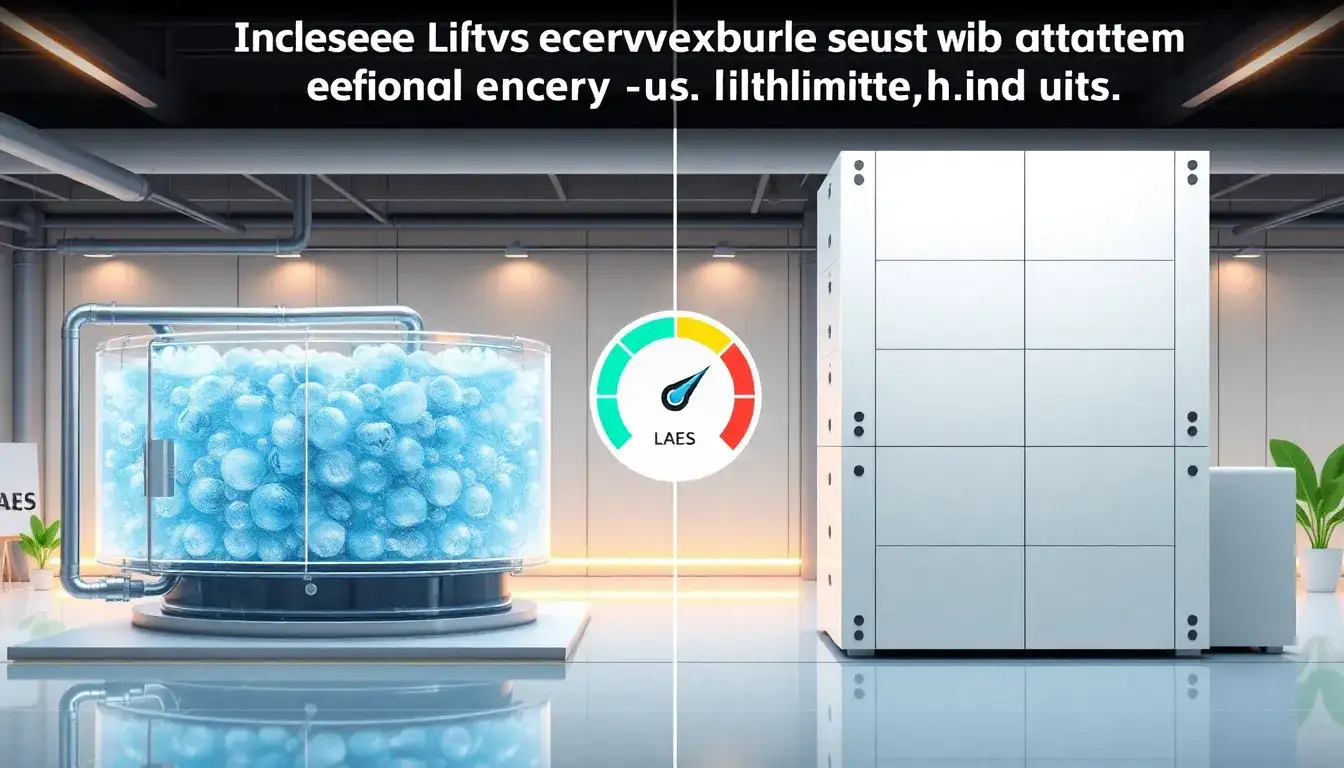
Efficiency of LAES vs. Lithium-Ion Batteries
Round-Trip Efficiency:
- LAES systems typically achieve a round-trip efficiency in the range of 50–60%. Some advanced LAES designs have reported improvements, such as a 56.7% increase in round-trip efficiency when integrating oxy-fuel combustion and thermal energy recovery techniques, reaching around 56–57% effective efficiency.
- Lithium-ion batteries generally have a much higher round-trip efficiency, typically around 85–95%, which is significantly better than the current LAES technology. This high efficiency makes lithium-ion batteries more efficient in terms of energy retained during storage cycles.
Cost and Scale Considerations:
- While lithium-ion batteries excel in efficiency, their levelized cost of storage (LCOS) is higher compared to LAES. MIT research indicates that the LCOS for LAES can be about $60 per MWh, which is roughly one-third of the LCOS for lithium-ion batteries and half that of pumped hydro storage. This suggests that despite lower efficiency, LAES could be more cost-effective for large-scale and long-duration storage.
- LAES can provide much larger energy storage capacity and power output compared to lithium-ion battery systems. For example, LAES can potentially deliver 500 MWh compared to Tesla’s Hornsdale Power Reserve’s 129 MWh, highlighting LAES’s advantage in scale and grid service capabilities.
Applications and Grid Services:
- Lithium-ion batteries are currently better for short-duration and fast-response energy storage needs due to their high efficiency and power density.
- LAES offers advantages in large-scale, long-duration energy storage with the ability to provide synchronous inertia and reactive power to maintain grid stability, which lithium-ion batteries cannot yet fully supply.
Summary Table
| Feature | LAES | Lithium-Ion Batteries |
|---|---|---|
| Round-trip efficiency | 50–60% (up to ~57% advanced) | 85–95% |
| Levelized Cost of Storage (LCOS) | About $60/MWh | Approximately 3x LAES’s LCOS |
| Energy storage capacity | Can exceed 500 MWh | Typically lower (~129 MWh example) |
| Power density and response time | Lower; suitable for large-scale | High; suitable for short-term grid support |
| Grid services | Provides synchronous inertia and reactive power | Limited in synchronous grid support |
In conclusion, lithium-ion batteries outperform LAES in efficiency and power density, making them ideal for short-term, high-power applications. Conversely, LAES is less efficient but offers significant cost advantages and scalability for long-duration, large-scale energy storage and grid stability services.
Original article by NenPower, If reposted, please credit the source: https://nenpower.com/blog/how-does-the-efficiency-of-laes-compare-to-lithium-ion-batteries/

