

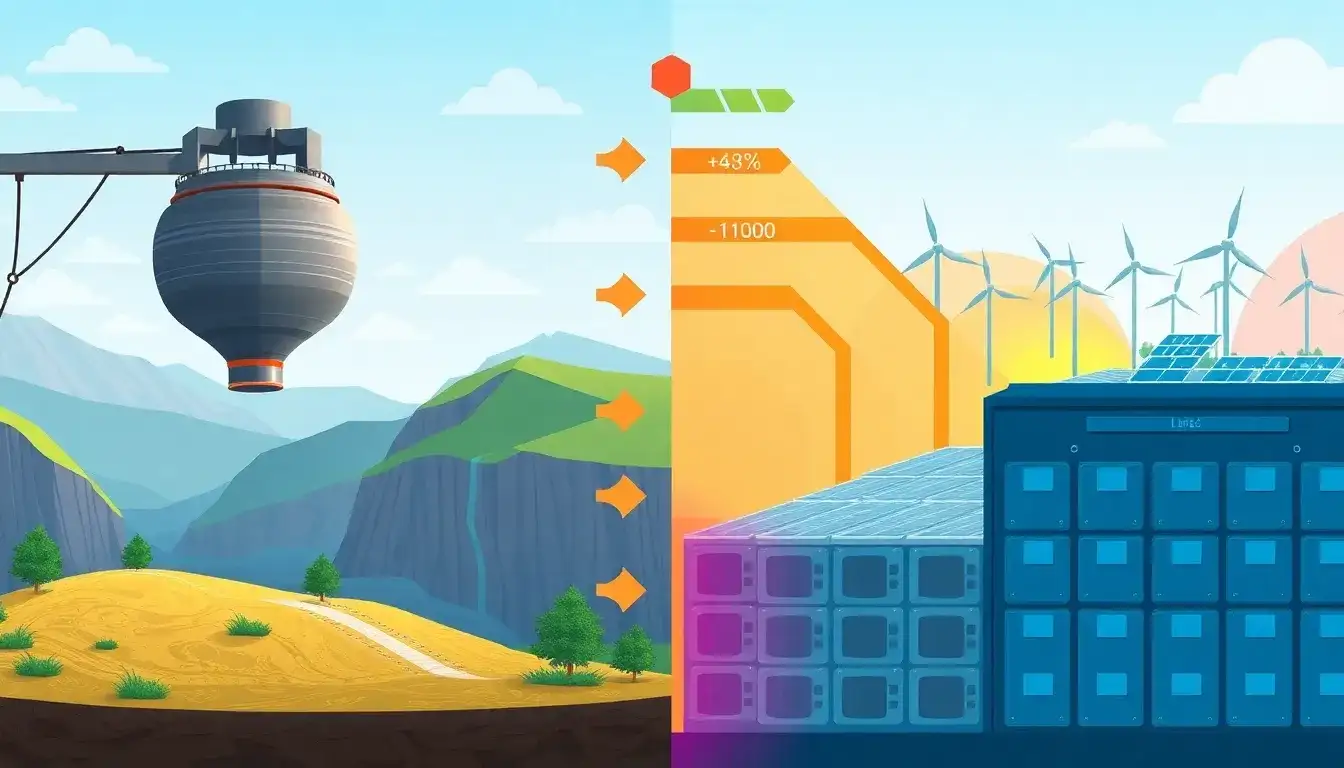
The efficiency of gravity-based energy storage systems, such as gravity batteries, compares favorably to traditional battery storage in several aspects:
Efficiency Comparison
- Gravity-based Systems: These systems typically achieve high round-trip efficiencies, ranging from 80% to 85%. This is competitive with or slightly lower than advanced lithium-ion batteries, which have efficiencies around 87% to 89%. The efficiency of gravity systems stems from converting electrical energy into gravitational potential energy by lifting masses and then converting it back when the mass is lowered.
- Traditional Battery Storage: Traditional battery technologies, such as lithium-ion batteries, offer high efficiency and rapid scalability. However, they can suffer from battery degradation over charge cycles, reducing their capacity over time.
Longevity and Scalability
- Gravity-based Systems: These systems have long asset lifetimes, often lasting 50-60 years or more. They are less prone to degradation, maintaining their capacity over time, making them attractive for long-duration storage needs. However, they can be more expensive upfront due to the infrastructure required (e.g., large weights, cranes).
- Traditional Battery Storage: Lithium-ion batteries, while scalable and affordable for many applications, generally have shorter lifespans (typically around 10-20 years for grid-scale applications) and can degrade faster with more charge cycles.
Geographical Constraints
- Gravity-based Systems: While pumped hydroelectric storage is geographically limited by the need for water and specific terrain, newer solid gravity energy storage systems (such as those using concrete blocks) can be built almost anywhere, offering greater flexibility.
- Traditional Battery Storage: Lithium-ion batteries can be deployed almost anywhere, providing flexibility in both urban and remote settings.
In summary, gravity-based systems offer high efficiency, long lifetimes, and improved geographical adaptability compared to traditional lithium-ion battery storage. However, they can have higher upfront costs and infrastructure needs, while lithium-ion batteries provide scalability and faster deployment capabilities with a lower entry cost.
Original article by NenPower, If reposted, please credit the source: https://nenpower.com/blog/how-does-the-efficiency-of-gravity-based-energy-storage-compare-to-traditional-battery-storage/

