

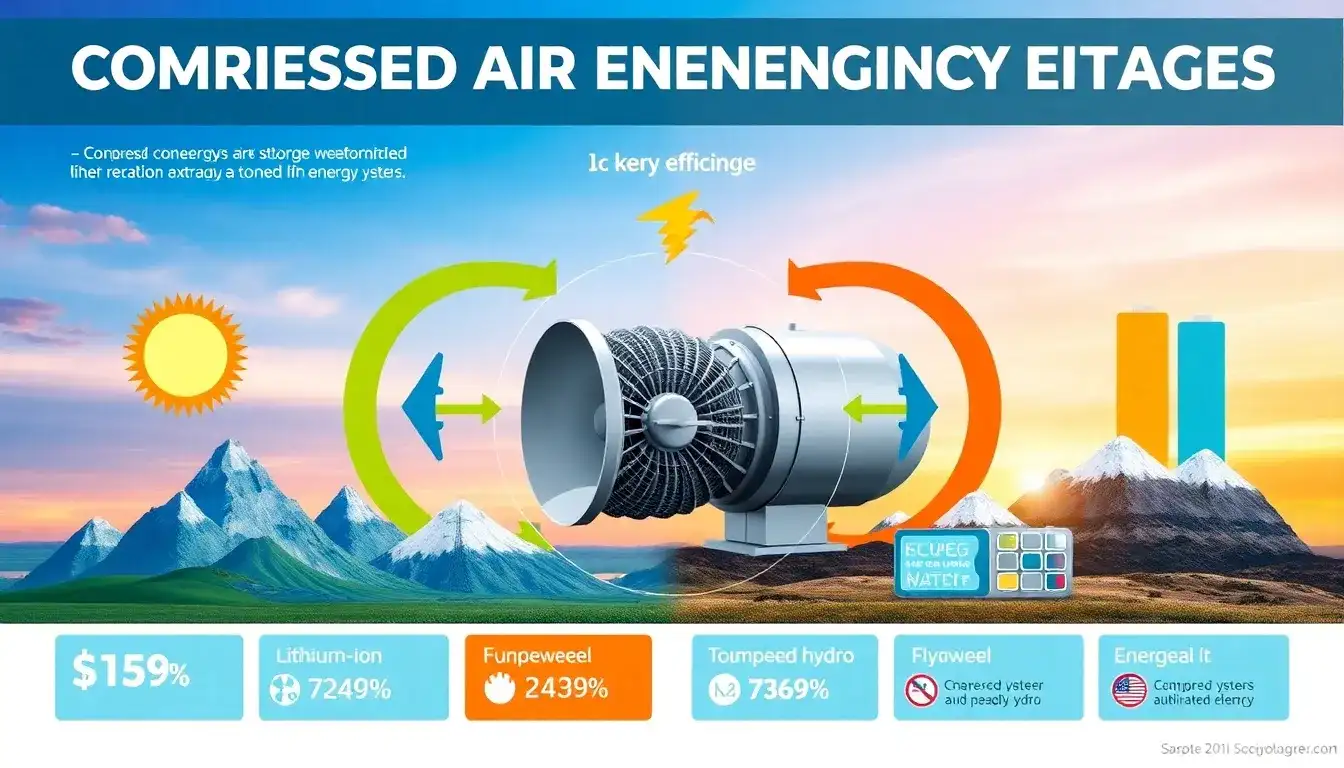
Compressed Air Energy Storage (CAES) systems have a round-trip efficiency generally ranging between about 60% and 71%, depending on the specific technology and system design. For example, simulated continuous operation efficiencies are around 70.5% to 71%, while real-world operational systems typically achieve about 60% to 65% efficiency in compressing, storing, and then generating electricity from air.
Efficiency Comparison with Other Energy Storage Technologies
| Energy Storage Technology | Typical Round-Trip Efficiency | Key Notes |
|---|---|---|
| CAES | 60% – 71% | Efficiency losses mainly due to thermal energy management during air compression and expansion. |
| Lithium-ion Batteries | ~85% – 95% | High efficiency; widely used for short to medium duration storage; limited by cost and degradation over cycles. |
| Pumped Hydro Storage (PHS) | 70% – 85% | Higher efficiency than CAES; well-established for long-duration storage but site-limited. |
| Lead-Acid Batteries | ~70% – 85% | Lower cycle life and lower energy density compared to lithium-ion; less efficient than lithium-ion. |
| Liquid Air Energy Storage (LAES) | Around 60% – 70% | Similar efficiency range to CAES, using cryogenic air storage. |
Main Points on CAES Efficiency and Comparison
- Efficiency: CAES is less efficient than lithium-ion batteries, which often exceed 85% efficiency, but can be comparable to or slightly lower than pumped hydro storage depending on thermal management strategies used.
- Thermal losses: A major factor reducing CAES efficiency is the heat generated during air compression, which if not recovered or managed effectively, leads to energy loss. Some CAES systems use natural gas to heat the air before expansion, adding fossil fuel dependency and further reducing net efficiency.
- Storage duration: CAES can typically store energy for up to about 8 hours, making it suitable for short to medium term storage of large-scale energy, especially to balance intermittent renewables.
- Affordability and scalability: CAES is generally more affordable and scalable for large energy capacity storage compared to batteries, with lower operational costs and longer life cycles. It also avoids the environmental and resource extraction issues of chemical batteries.
- Environmental impact: CAES does not rely on toxic chemicals, making it more environmentally sustainable in comparison to chemical batteries.
Summary
While CAES systems have lower round-trip efficiencies (60-71%) compared to lithium-ion batteries (85-95%) and are generally less efficient than pumped hydro storage, they offer advantages in large-scale energy capacity, affordability, and environmental impact. Their efficiency is chiefly limited by thermal losses during air compression and expansion, but with improved thermal management and newer designs, some CAES systems approach the higher end of efficiency ranges. CAES complements other storage technologies by providing cost-effective, scalable solutions for managing grid-scale renewable energy intermittency, despite lower conversion efficiency.
Original article by NenPower, If reposted, please credit the source: https://nenpower.com/blog/how-does-the-efficiency-of-caes-systems-compare-to-other-energy-storage-technologies/

