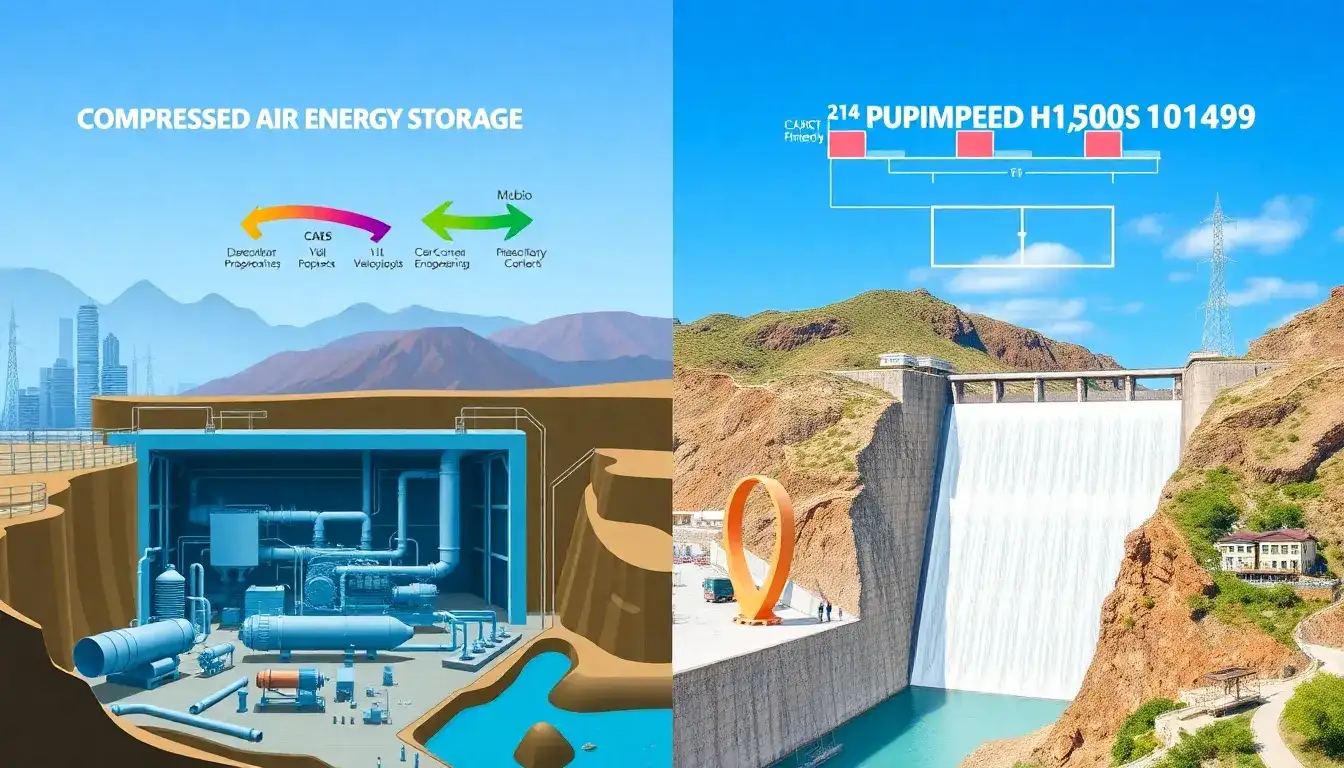
Comparing Efficiency of CAES and Pumped Hydro Storage
Efficiency Overview
- CAES (Compressed Air Energy Storage): The efficiency of CAES varies widely, typically ranging from about 40-80% depending on the specific system design and thermal management. Traditional large-scale CAES systems often have efficiencies between 40-52% due to heat losses and the need for supplementary heating during expansion, which can be achieved by burning fossil fuels. However, advanced systems like adiabatic CAES aim to improve efficiency by capturing and reusing the heat generated during compression, potentially reaching efficiencies around 70-71%.
- Pumped Hydro Storage (PHS): Pumped hydro storage is generally more efficient, with round-trip efficiencies typically ranging from 70-85%. This higher efficiency is due to the direct conversion of electrical energy into potential energy (raising water) and back, with less energy loss during the conversion process.
Key Differences
| Attribute | CAES | Pumped Hydro Storage |
|---|---|---|
| Efficiency | 40-80%, typically lower due to heat management | 70-85% |
| Scalability | Highly scalable with large underground storage capacities | Limited by geography; requires suitable reservoirs |
| Geographical Requirements | Can utilize various geological formations for storage | Needs specific terrain for reservoirs |
| Environmental Impact | Generally considered environmentally friendly, minimal footprint | Significant environmental impact due to water diversion |
| Energy Storage Duration | Can store energy for long durations | Also suitable for long-duration storage |
Conclusion
While CAES offers the advantage of wide scalability and low environmental impact, its efficiency generally lags behind pumped hydro storage. However, advancements in CAES technology, such as adiabatic systems, are aimed at improving efficiency. Pumped hydro storage remains the more efficient option but is limited by geographical constraints.
Original article by NenPower, If reposted, please credit the source: https://nenpower.com/blog/how-does-the-efficiency-of-caes-compare-to-that-of-pumped-hydro-storage/