

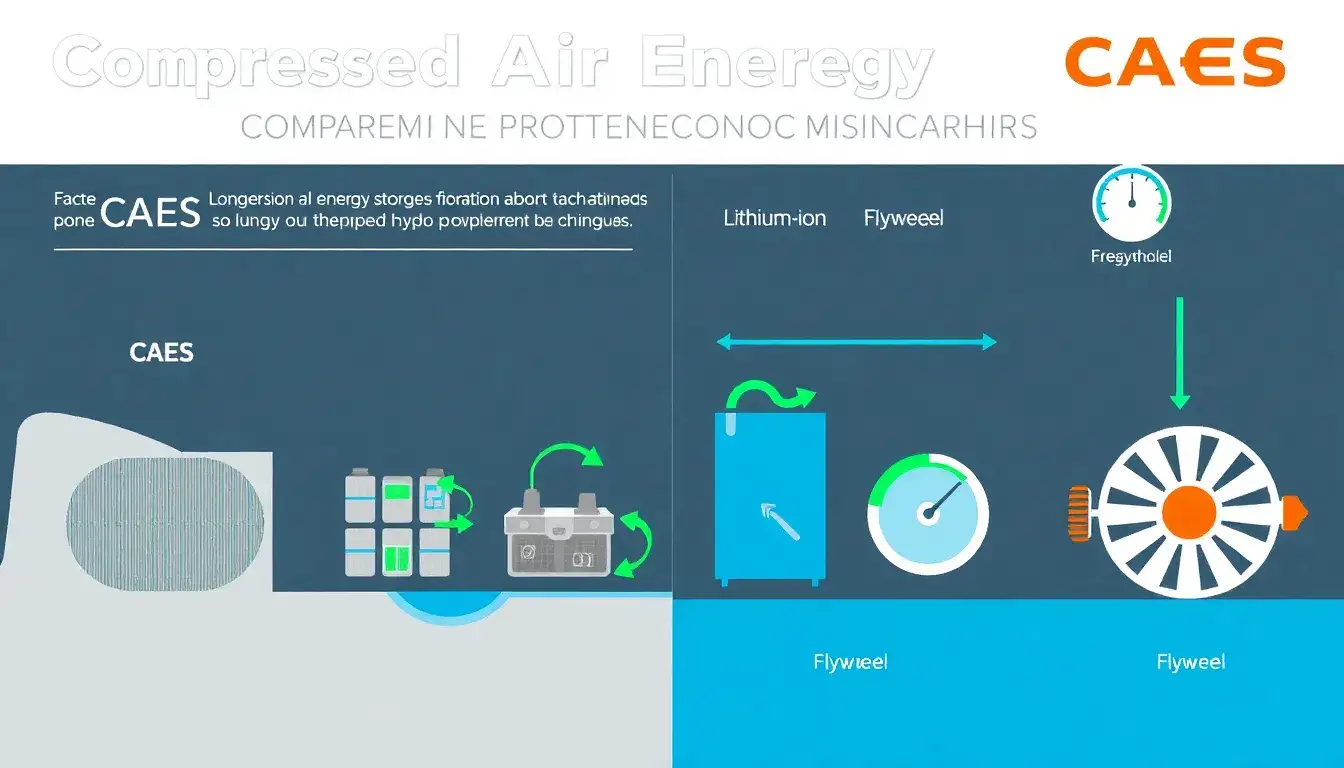
The efficiency of Compressed Air Energy Storage (CAES) systems typically ranges between about 60% to 71% depending on the specific technology and design used. Modern adiabatic CAES systems, which capture and reuse the heat generated during air compression, can achieve round-trip efficiencies around 70% to 71% under continuous operation. More conventional diabatic CAES systems generally have lower efficiencies, around 54% to 65%.
When comparing CAES to other long-duration energy storage technologies:
| Storage Technology | Typical Round-Trip Efficiency | Duration Capability | Notes |
|---|---|---|---|
| CAES (Adiabatic modern) | ~70% | Long-term (up to 25 days) | Benefits from thermal energy recovery, suitable for grid scale |
| CAES (Traditional Diabatic) | 54% – 65% | Long-term | Requires natural gas heating, less efficient, but large-scale |
| Pumped Hydro Storage (PHS) | 70% – 85% | Long-term (days to weeks) | Highest efficiency among large-scale storages, geography-limited |
| Lithium-ion Batteries | 85% – 90% | Short to medium term (hours) | High efficiency, but costly and limited cycle life |
| Flow Batteries (e.g. vanadium) | 65% – 75% | Long-duration possible | Moderate efficiency, scalable, longer cycle life than lithium-ion |
Key points about CAES efficiency relative to other technologies:
- CAES efficiencies (60-71%) are generally lower than pumped hydro storage (70-85%) and lithium-ion batteries (85-90%). Traditional CAES often loses efficiency due to heat lost during air compression and the need to heat the air using fossil fuels before expansion.
- Advanced adiabatic CAES improvements that capture compression heat can raise efficiency close to 70%, narrowing the gap with pumped hydro.
- CAES offers major advantages in duration, capable of storing energy for over 25 days, making it suitable for long-duration storage needs beyond the typical 8-12 hours supported by batteries.
- CAES systems tend to have lower installation and maintenance costs compared to pumped hydro and batteries, and they do not rely on chemical materials, which benefits sustainability and lifespan.
- Conversely, batteries offer higher efficiency and faster response but have shorter lifespans and higher costs, whereas pumped hydro is highly efficient but geographically constrained and expensive to build.
In summary, while CAES is somewhat less efficient than lithium-ion batteries and pumped hydro storage, it is competitively efficient (especially with modern adiabatic designs) and uniquely capable as a cost-effective, long-duration, large-scale energy storage solution with a long operational lifespan and sustainability benefits. This makes CAES a valuable complement to other storage technologies in balancing intermittent renewable energy sources over extended periods.
Original article by NenPower, If reposted, please credit the source: https://nenpower.com/blog/how-does-the-efficiency-of-caes-compare-to-other-long-duration-storage-technologies/

