Efficiency Comparison of CAES to Other Large-Scale Energy Storage Technologies
Compressed Air Energy Storage (CAES) is an effective method for storing large amounts of energy, but its efficiency varies compared to other technologies. Here’s a comparison:
CAES Efficiency
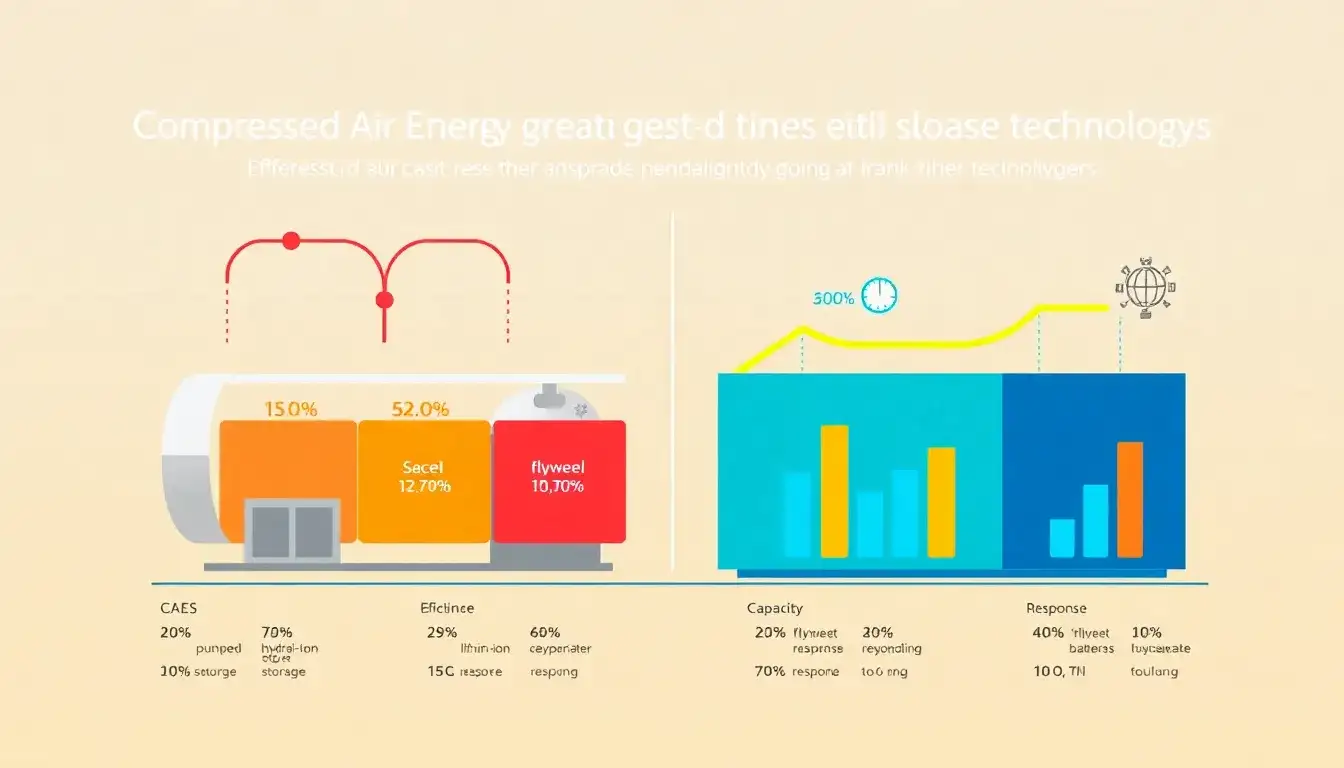
- CAES typically has a round-trip efficiency ranging from 60% to 65% for most conventional systems, with some studies indicating higher efficiencies in advanced designs like adiabatic systems, which can achieve 70.5% to 71% efficiency.
- The main challenge in CAES is managing the heat generated during compression and lost during expansion, requiring additional heating, often with fossil fuels, which affects efficiency.
Other Large-Scale Energy Storage Technologies
- Pumped Hydro Storage (PHS):
- PHS is one of the most efficient large-scale energy storage technologies, with a round-trip efficiency of 70% to 85%.
- It relies on the elevation difference in water reservoirs, making it highly reliable and widely used.
- Lithium-Ion Battery Storage:
- Lithium-ion batteries offer high round-trip efficiencies, typically 80% to 90% or even higher.
- They are versatile and can be used for both small and large-scale applications but have high initial costs and limited lifespans compared to CAES.
- Flow Batteries:
- Flow batteries, another chemical battery type, generally have efficiencies nearing 80%.
- They offer the advantage of scalability and long-term storage capabilities with potentially lower costs for long-duration applications.
Key Points
- Efficiency: CAES is less efficient than lithium-ion batteries and pumped hydro storage but more sustainable in terms of materials and environmental impact.
- Cost and Longevity: CAES systems have initial high capital costs but offer long lifespans and minimal maintenance needs, making them cost-effective in the long run.
- Environmental Impact: CAES relies on natural resources and does not involve toxic materials, giving it an environmental advantage.
In summary, while CAES may not be as efficient as some other energy storage technologies, its advantages lie in sustainability, scalability, and potential for long-term cost savings, making it a viable option for large-scale energy storage.
Original article by NenPower, If reposted, please credit the source: https://nenpower.com/blog/how-does-the-efficiency-of-caes-compare-to-other-large-scale-energy-storage-technologies/