

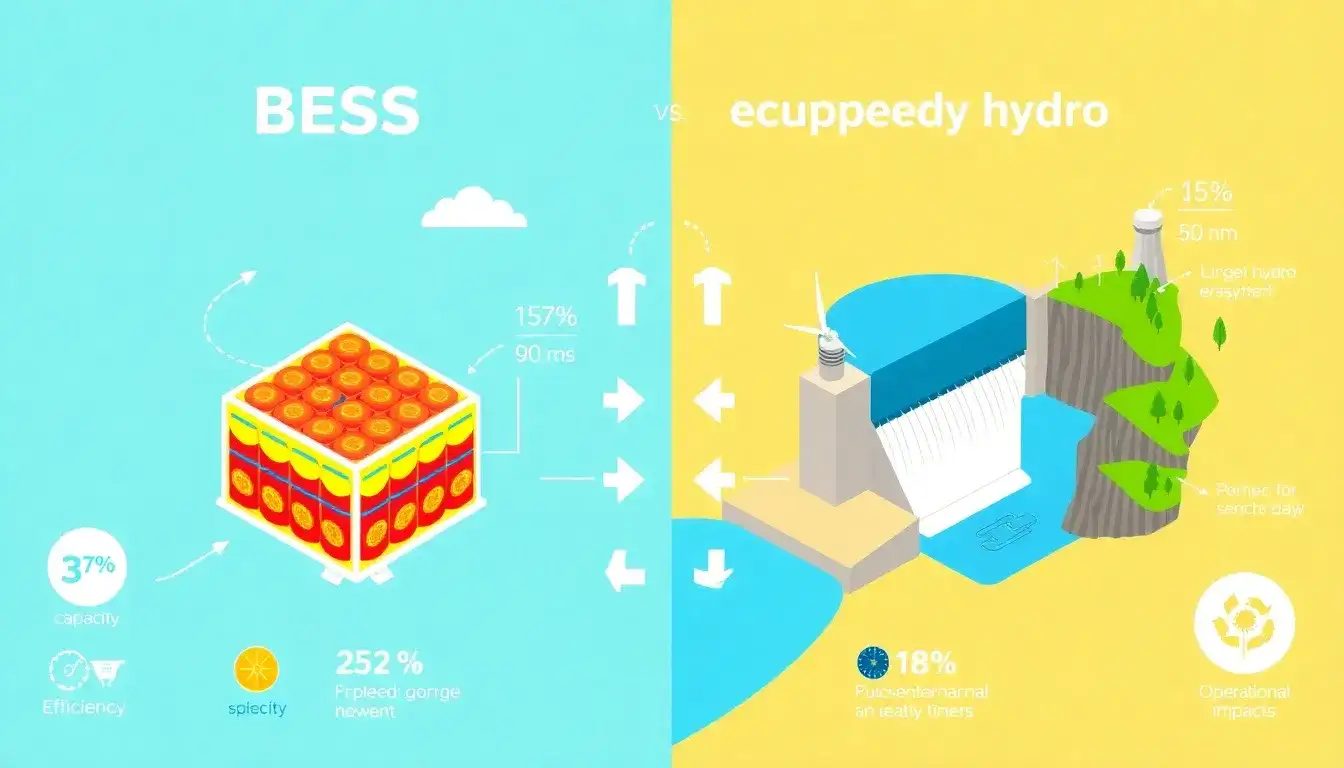
To compare the efficiency of Battery Energy Storage Systems (BESS) and Pumped Hydro Storage (PHS), we need to look at their round-trip efficiencies (RTE).
Round-Trip Efficiency (RTE) Comparison
- Battery Energy Storage Systems (BESS): The efficiency of BESS can vary depending on the type of battery. For example, lithium-ion batteries typically have an RTE of around 83%. This means that for every unit of energy stored, about 0.83 units can be retrieved.
- Pumped Hydro Storage (PHS): PHS systems generally have an RTE ranging from 79% to 81%. This indicates that out of every unit of energy stored, about 0.79 to 0.81 units can be retrieved.
Key Differences and Considerations
- Scalability and Utility: PHS is currently the largest form of energy storage and dominates in terms of capacity. It is highly suitable for large-scale applications, offering high utilization factors. However, geographical constraints limit its deployment to locations with suitable topography.
- Flexibility and Deployment: BESS offers greater flexibility in deployment and can be scaled from small residential systems to large utility-scale installations. This flexibility, along with decreasing costs, has made BESS increasingly popular.
- Environmental Impact: PHS involves significant water usage and alteration of natural habitats, whereas BESS, especially newer battery technologies, is generally more environmentally friendly in terms of footprint.
Summary
In summary, while BESS often has a slightly higher RTE than PHS, PHS remains a critical player in large-scale energy storage due to its capacity and utilization benefits. BESS, however, offers greater flexibility and is becoming increasingly important for integrating renewable energy sources into the grid.
| Technology | Typical Round-Trip Efficiency |
|---|---|
| Lithium-ion Batteries | 83% |
| Pumped Hydro Storage | 79-81% |
The choice between these technologies often depends on specific application needs, geographical constraints, and the desired scale of energy storage.
Original article by NenPower, If reposted, please credit the source: https://nenpower.com/blog/how-does-the-efficiency-of-bess-compare-to-that-of-pumped-hydro-storage/

