

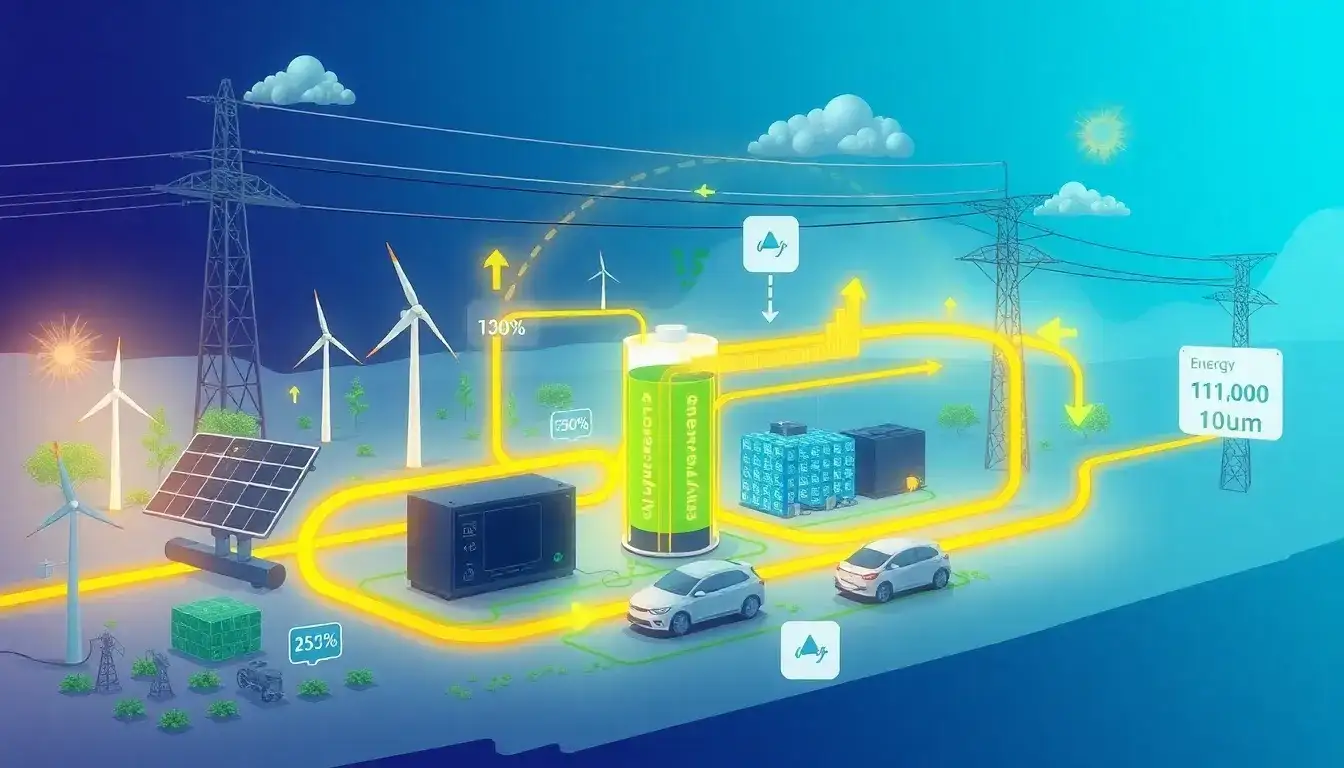
Impact of Charging and Discharging Efficiency on Power Systems
1. Energy Efficiency and Usable Capacity
Battery efficiency is the ratio of energy output during discharge to the energy input during charging. Higher efficiency means more of the stored energy is available for use, while inefficiencies result in energy losses primarily as heat.
- At high discharging rates, the usable capacity of a battery decreases because the battery cannot sustain its rated capacity under rapid load. For example, a battery rated at 100Ah may only deliver 80Ah at a 2C discharge rate, reducing effective system capacity.
- Similarly, a difference between charge and discharge voltage (over-potential) indicates energy loss that reduces overall efficiency.
2. Battery Capacity Degradation and Lifespan
Charging and discharging rates strongly influence battery degradation:
- Fast charging or heavy discharging accelerates capacity fade and shortens battery life, reducing how long the battery can effectively contribute power to the system.
- Operating within recommended charge/discharge rates and avoiding full depth of discharge (DoD) cycles can prolong battery lifespan and maintain capacity. For example, partial cycles like charging to 75% and discharging to 65% can vastly increase cycle life compared to full cycles (0–100%).
- Excessive depth of discharge and high charge voltage lead to faster chemical wear and capacity loss, which impacts the system by requiring more frequent battery replacements or capacity oversizing.
3. Thermal Effects and Safety Risks
High charging and discharging rates produce heat, which exacerbates battery degradation and can lead to unsafe conditions if not managed properly. This requires additional thermal management systems, increasing complexity and cost.
4. System Reliability and Performance
- Lower efficiencies mean more energy must be supplied to recharge batteries for the same usable output, increasing operational costs and reducing overall system efficiency.
- Inefficient battery operation can lead to reduced runtime and unexpected power losses, impacting the stability and reliability of the power system especially in critical applications like electric vehicles and grid storage.
5. Optimization of Charging/Discharging for System Benefit
Effective battery management systems (BMS) that control charging and discharging rates help maintain efficiency and prolong battery life, indirectly improving overall power system economics and reliability. Smart charging strategies that avoid extremes in state of charge (SoC) and keep currents moderate improve operational efficiency without sacrificing time critically.
Summary Table of Effects
| Aspect | Impact on Power System | Consequence |
|---|---|---|
| High Discharge Rates | Reduced usable capacity and efficiency | Less available energy, shorter runtime |
| Fast Charging | Increased efficiency loss, heat generation | Accelerated aging, safety risks |
| Deep Discharge (High DoD) | Faster capacity fade | Frequent replacements, increased cost |
| Thermal Effects | More complex cooling, risk of thermal runaway | Higher capital and operational costs |
| Proper Rate Management | Improved battery lifespan and energy efficiency | Longer service life, stable and reliable power |
In essence, the efficiency of battery charging and discharging critically governs how much energy the power system can effectively store and deliver, the longevity and safety of the battery assets, and the overall cost-effectiveness and reliability of the entire power system. Optimizing these rates ensures maximal energy utilization and longer battery service life, thus enhancing power system performance and sustainability.
Original article by NenPower, If reposted, please credit the source: https://nenpower.com/blog/how-does-the-efficiency-of-battery-charging-and-discharging-impact-the-overall-power-system/

