

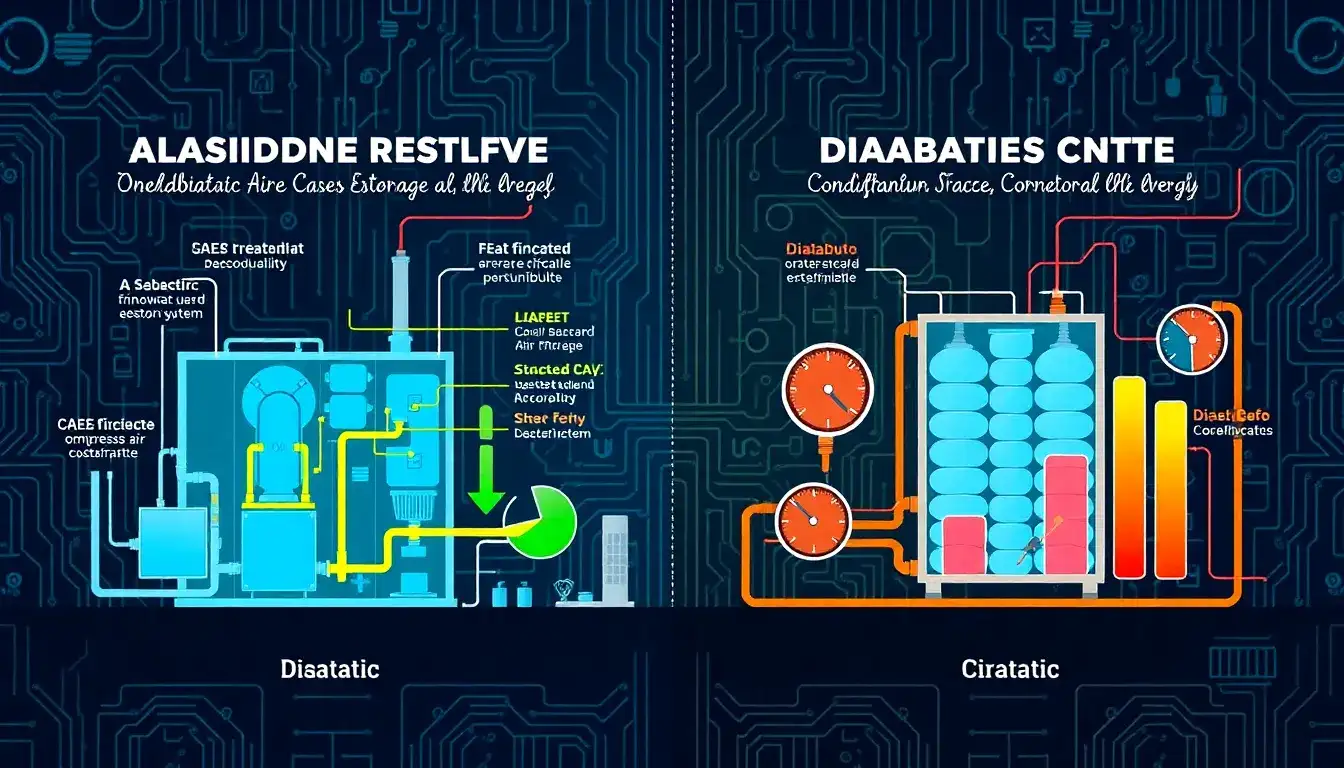
Adiabatic compressed air energy storage (CAES) systems are generally more efficient compared to diabatic CAES systems due to their approach to managing heat generated during air compression.
Efficiency Comparison:
- Adiabatic CAES Systems:
- These systems capture and store the heat produced during air compression and reuse it during expansion, avoiding the loss of thermal energy.
- Theoretically, with perfect insulation, the efficiency could approach 100%, but practically, round-trip efficiencies are expected to be around 70% or slightly above.
- Innovations in thermal energy storage (such as storing heat in concrete, stone, hot oil, or molten salt) have led to efficiencies exceeding 70% in real systems.
- For example, a simulated adiabatic CAES system reported efficiencies between 70.5% and 71%.
- They operate without the need for fuel combustion, resulting in zero CO2 emissions, which is an environmental advantage.
- Advanced adiabatic systems, sometimes called “advanced adiabatic” or AA-CAES, are under development and promise significant efficiency improvements over traditional methods.
- Diabatic CAES Systems:
- In diabatic systems, the heat generated during compression is lost (usually by cooling the air before storage).
- To generate power, the stored compressed air is reheated using external fuel (often natural gas) before expansion in the turbine.
- This reheating process and thermal losses reduce overall cycle efficiency.
- Typical round-trip efficiencies for diabatic CAES systems are lower than those of adiabatic, often in the range of 40-55%.
- Additionally, the reliance on fossil fuel combustion results in CO2 emissions.
Summary Table:
| Feature | Adiabatic CAES | Diabatic CAES |
|---|---|---|
| Heat management | Heat stored and reused | Heat lost, reheating with fuel |
| Round-trip efficiency | ~70% or higher | ~40-55% |
| Fuel consumption | None | Requires external fuel for reheating |
| CO2 emissions | Zero | Emits CO2 |
| Thermal energy storage type | Solid or fluid media (e.g., concrete, molten salt) | Not applicable (heat discarded) |
In conclusion, adiabatic CAES systems are significantly more efficient and environmentally friendly compared to diabatic systems because they recycle the heat from compression rather than discarding it and burning fuel for reheating. While diabatic systems are currently more common due to simpler technology, adiabatic systems are gaining interest for their potential to achieve higher efficiencies of around 70% or more without CO2 emissions.
Original article by NenPower, If reposted, please credit the source: https://nenpower.com/blog/how-does-the-efficiency-of-adiabatic-caes-systems-compare-to-diabatic-systems/

